 Japan's rapid industrialization and urbanization of the 60s and 70s considerably enhanced its economic standing and the overal quality of life of its people, but also created a number of unintended consequences, particularly related to environmental degradation.
The process of degradation resulted from not only the vast amount of natural resources used in manufacturing, but also in the pollution, wastes and other emissions dumped into the environment. A number of major industrial accidents attributed to pollution (for example, the Minamata disease that resulted from mecury poisoning of fish in the Minamata bay) further intensified the need to "protect" the environment. The resulting actions taken by the Japanese Government during the 90s and this century, provide a number of inspiring ideas for other countries to adopt, including the context within which such ideas were generated. At the global level, the imspiration and precedence for 3R issues (reduce, reuse and recycle) in Japan is derived from three perspectives -
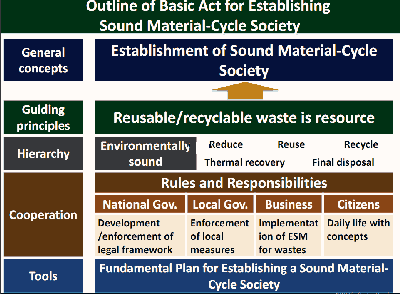 Japan's Law on Sound Material Cycle Society (Source: Ministry of Environment, Japan) The 3R approach provides opportunities for a very broad range of issues, actors and outcomes to be brought together into a working framework. In the case of Japan, for example, it aims to set up a "sound material cycle society", which is a society where consumption of natural resources is minimized and the environmental load is reduced, as much as possible. These aims considers waste as a resource that can be recycled. It identifies the roles and resposibilities of public and private organizations at the national and local levels. The reason why the Japanese 3R Initiative has been successful is because of the strong support that it has received at the national level among all relevant ministries and cooperation among different stakeholders in the public and private sectors, promotion of science and technology for 3Rs, and cooperation with universities and research institutes to develop cutting edge solutions. There is much we can learn from the Japanese experience, since a balanced approach has been taken to operationalize the initiative by focusing on (a) laws, legislation and governance, (b) education and awareness raising, and (c) technology development. This is backed by key subsidies and grants for project implementation and uptake. As a result of this support and reinforcement, growth areas can be seen in a number of fields, including:
Particularly impressive are the laws and legislation that have been passed under the 3R umbrella, including, for example:
What we can learn from Japan is the development of a package of measures that need to be put in place, not only directly focusing on 3Rs, but also on a number of supportive initiatives (for example the more than 20 eco-towns set up around Japan, which become hotbeds of innovation, focusing on innovative and cutting edge environmental technology development) with a distinct environmental flavour to its activities. The emerging lessons form Japan need to be adopted and customized to countries in the developing world in order to develop workable strategies for demonstration projects, and for commitments from developing countries. Demonstration projects and institutional strengthening exercises by building on experiences in Japan and other countries, and catering to the needs and specific conditions of each country - will go a long way in demonstrating the viability of the 3R approach. The complex and exciting opportunities provided by emerging economies such as China and India, will further enhance the need and effectiveness of 3R policies. This includes sustainable production and supply-side issues, and sustainable consumption and demand-side issues. The Japanese experience has so far demonstrated the need to build multi-stakeholder commitment to sustainability by strong 3R policies and strategies, which is supported by improved access to accurate and trustworthy information. On the other hand, creation of market opportunities and making a business case for the adoption of 3Rs will help in persuading the private sector to participate in 3R issues. Providing clear options in areas such as environmentally sound technologies and green products will help in the uptake of 3R policies. As shown by a number of entities need to come together for this purpose: National and local governments, private sector entities (business, trade and industry), and civil society entities, (including other UN bodies, NGOs/NPOs, consumer groups, universities), including others such as SMEs and private companies, industry associations and institutes, chambers of commerce, consumer groups, universities and research institute, etc. The key inputs provided by each set of partners are different. For governmental partners the inputs focus on policy instruments such as laws, rules, procedures, and market-based instruments. For private sector partners, the focus is on technology systems, including their transfer, management systems, research etc. For the civil society partners, the focus is on education - awareness raising, lessons learnt, sustainable consumption etc. Japan's Sound Matrial Cycle Society law and the 3R Initiative has shown the need for a broad-based "umbrella" public policy, within which a number of different actions, by different actors, to achieve different objectives, can be enabled. 1See a translation of the "Basic Act for Establishing a Sound Material-Cycle Society"
|