
Co-Creation in Environmental Decision-Making: Collaborative Pathways for Inclusive Sustainability
Hari Srinivas Policy Tools Series C-116
Abstract
Co-creation in environmental decision-making represents a shift from traditional, top-down approaches toward collaborative processes that actively involve diverse stakeholders in shaping sustainability initiatives. By engaging citizens, communities, and experts from the earliest stages, co-creation integrates scientific knowledge with local, experiential, and cultural insights to develop more context-sensitive and equitable solutions.Moving beyond participation as consultation, co-creation emphasizes shared ownership, iterative learning, and the redistribution of power in decision-making processes. It contributes not only to improved project outcomes but also to strengthened trust, institutional legitimacy, and the potential for transformative change. The document also situates co-creation within a broader ecosystem of related approaches, including co-design, co-production, and co-governance, offering a comprehensive guide for practitioners, policymakers, and educators seeking to advance inclusive and sustainable environmental governance.
Keywords
Co-creation, environmental decision-making, participatory governance, co-design, co-production, co-governance, sustainability transitions, stakeholder engagement


1. Introduction
Co-creation in environmental decision-making is a collaborative process that brings together diverse stakeholders - including citizens, communities, practitioners, and experts - at the earliest stages of an initiative to jointly shape its direction. Rather than treating people as passive recipients of decisions, co-creation positions them as active contributors to defining problems, generating knowledge, and developing solutions.This early and continuous engagement helps build shared understanding, mutual trust, and collective ownership. By integrating scientific expertise with local knowledge, cultural values, and lived experiences, co-creation enables more context-sensitive, equitable, and sustainable outcomes.
Figure 1: Co-creation builds sustainable environmental decisionsImportantly, co-creation moves beyond purely technical or top-down approaches. It recognizes that environmental challenges - such as urban greening, ecosystem restoration, and climate adaptation - are not only scientific or managerial problems, but also social and political ones. As such, effective responses require inclusive processes that reflect the priorities, trade-offs, and realities of the communities they affect.
Table 1: Co-creation - Related terms
Generic Terms Innovation & Design Concepts Governance & Sustainability Concepts Collaboration User-Centered Design / Human-Centered Design Participatory Governance Participation / Public Participation Design Thinking Collaborative Governance Stakeholder Engagement Open Innovation Multi-Stakeholder Processes Community Engagement Crowdsourcing Collective Intelligence Partnerships Living Labs Social Innovation Empowerment Environmental decision-making has traditionally been driven by expert-led, top-down models that prioritize technical efficiency and regulatory compliance. While such approaches can deliver rapid results, they often overlook local knowledge, exclude affected communities, and struggle to build long-term legitimacy.
Co-creation represents a fundamental shift from this model. It redistributes power, integrates multiple forms of knowledge, and emphasizes collaboration, equity, and shared ownership of both processes and outcomes.
Table 2: Comparing Traditional and Co-creation Approaches.
Feature Traditional Approach Co-Creation Approach Role of the Public Passive recipients, respondents to surveys or consultations Active partners, co-designers, and sometimes initiators Knowledge Base Primarily expert-driven, scientific and technical Transdisciplinary, combining scientific, local, and experiential knowledge Problem Framing Defined by authorities or experts Jointly defined with stakeholders (“co-identification”) Decision-Making Centralized within institutions Shared, negotiated, and iterative Goal Efficiency, compliance, and technical optimization Equity, legitimacy, and transformative change Power Dynamics Concentrated and hierarchical Distributed and collaborative Process Style Linear and predefined Iterative, adaptive, and reflexive Outcomes Technically sound but sometimes socially contested Context-sensitive, widely accepted, and locally owned 2. Key Aspects
Inclusive and Meaningful Participation
Co-creation begins with the deliberate inclusion of a wide range of stakeholders - including citizens, community groups, NGOs, and experts - from the earliest stages of a project. Particular attention is given to marginalized or underrepresented groups, whose voices are often excluded in conventional processes. However, inclusion alone is not sufficient. The quality of participation matters. Meaningful co-creation requires that participants have real opportunities to influence decisions, rather than simply being consulted after key choices have already been made.
Shared Knowledge and "Hybrid" Understanding
A defining feature of co-creation is the integration of different types of knowledge. Scientific and technical expertise is combined with local, experiential, and cultural knowledge to create a more holistic understanding of environmental challenges. Tools such as citizen science, participatory mapping, and community-based monitoring enable this blending of perspectives. The result is not just more data, but better insight - grounded in both empirical evidence and lived reality.
Joint Ownership and Legitimacy
When stakeholders are actively involved in shaping decisions, they are more likely to develop a sense of ownership over both the process and its outcomes. This strengthens legitimacy and increases the likelihood of long-term success. In environmental contexts, where implementation often depends on behavioral change or local stewardship, this sense of ownership is critical. Projects such as urban greening or ecosystem restoration are more sustainable when communities see them as "their" initiatives rather than externally imposed interventions.
Iterative and Adaptive Processes
Co-creation is rarely linear. It involves continuous cycles of dialogue, feedback, and adjustment. Conflicts and disagreements are not viewed as obstacles, but as opportunities to refine understanding and negotiate better solutions. This adaptive nature makes co-creation particularly suited to complex environmental challenges, where uncertainty is high and conditions may change over time.
Co-Creation Across Project Phases
Co-creation typically unfolds across several interconnected phases (also see Annex on Related Terms):
Figure 3: The Four Phases of Co-CreationTable 3 outlines the four key phases of the co-creation process, highlighting how stakeholders collaborate from problem identification to evaluation and learning. Each phase involves distinct activities, participants, and expected outcomes, illustrating the iterative and participatory nature of co-creation. Together, these phases demonstrate how inclusive engagement can strengthen planning, implementation, and long-term sustainability of projects and policies.
Table 3: Co-creation Phases and Actions
Phase Description Key Activities Main Participants Expected Outputs Co-Identify Defining and understanding the problem collaboratively with all relevant stakeholders.
- Stakeholder consultations
- Problem mapping
- Needs assessments
- Shared priority setting
Community members, local authorities, researchers, NGOs, businesses Shared understanding of issues, agreed priorities, and clearly defined objectives Co-Design Generating ideas, scenarios, and solution pathways together through participatory planning.
- Workshops and brainstorming sessions
- Scenario development
- Strategy formulation
- Prototype or pilot design
Planners, experts, citizens, policy makers, technical specialists Action plans, project designs, policy options, and collaborative strategies Co-Implement Jointly carrying out interventions, projects, and actions in partnership with stakeholders.
- Project execution
- Resource sharing
- Capacity building
- Community participation
Government agencies, NGOs, communities, private sector actors, volunteers Implemented projects, strengthened partnerships, and operational solutions Co-Evaluate Assessing outcomes collectively, including defining what �gsuccess�h means for all participants.
- Monitoring and evaluation
- Feedback collection
- Impact assessment
- Lessons learned workshops
Stakeholders, evaluators, beneficiaries, researchers, policy makers Evaluation reports, shared learning, improved practices, and future recommendations Focus on Co-Benefits and Equity
Co-creation explicitly seeks to distribute benefits fairly across different groups, particularly those who are most vulnerable to environmental risks. It encourages the identification of "co-benefits" - solutions that address multiple objectives simultaneously, such as climate resilience, social inclusion, and public health.By foregrounding equity, co-creation helps ensure that sustainability transitions do not reinforce existing inequalities, but instead contribute to more just and inclusive outcomes.
3. Practical "Enablers" and Barriers
While co-creation offers significant benefits, it does not happen automatically. It requires deliberate design, facilitation, and resource commitment. Understanding both the enabling conditions and common barriers helps practitioners move from intention to effective implementation.Key Enablers of Co-Creation
Some of key enablers of co-creation are listed below. These are not just supportive elements, but often preconditions for meaningful co-creation.
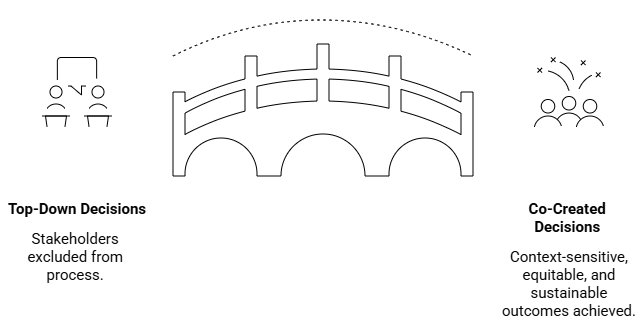
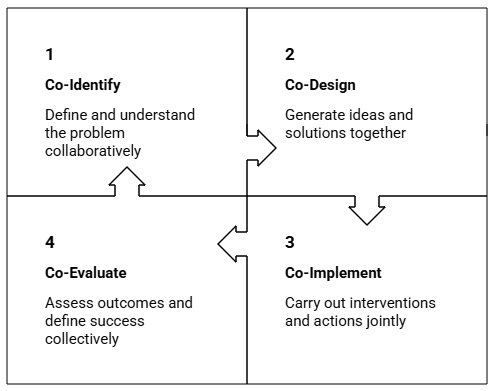
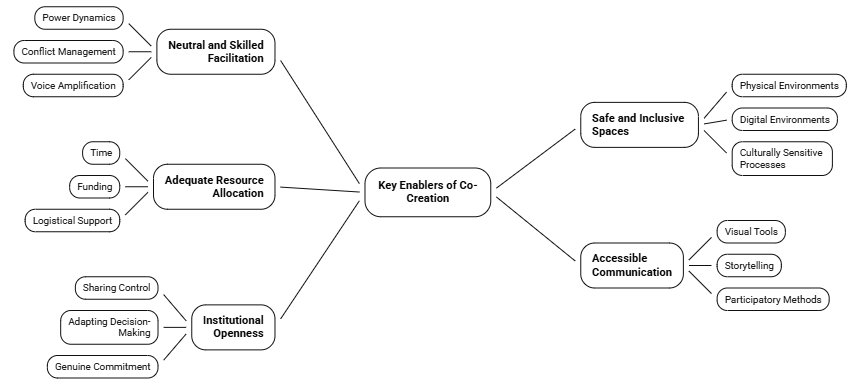
Figure 4: Key Enablers of Co-Creation
Table 4 highlights several enabling conditions necessary for meaningful and effective co-creation. Beyond participation alone, successful co-creation depends on supportive institutional environments, inclusive communication, adequate resources, and trusted facilitation processes that allow diverse stakeholders to engage openly and equitably. Together, these factors help build trust, strengthen collaboration, and ensure that co-creation processes lead to more legitimate and sustainable outcomes.
Table 4: Enabling Co-Creation
Enablers Description Neutral and Skilled Facilitation
Effective co-creation depends on facilitation that can balance power dynamics, manage conflict, and ensure that all voices are heard. Independent or trusted third-party facilitators are often critical, especially in contexts with strong institutional or political hierarchies. Safe and Inclusive Spaces
Participants must feel safe, respected, and valued in order to contribute openly. This includes both physical and digital environments, as well as culturally sensitive processes that encourage participation from marginalized groups. Adequate Resource Allocation
Co-creation requires time, funding, and logistical support. Providing stipends, transport, childcare, or translation services can make participation possible for those who would otherwise be excluded. Accessible Communication
Technical information must be translated into clear, accessible formats. Visual tools, storytelling, and participatory methods can help bridge the gap between expert knowledge and community understanding. Institutional Openness
Organizations must be willing to share control and adapt their decision-making processes. Without genuine institutional commitment, co-creation risks becoming superficial. Common Barriers to Co-Creation
Some of the challenges frequently encountered in co-creation processes are listed below. If unaddressed, these can undermine the effectiveness of the process (Also see Section 6 on "Challenges and Mitigation"):Table 5 identifies some of the major barriers that can limit the effectiveness of co-creation processes. While co-creation aims to promote inclusive participation and shared decision-making, challenges such as unequal power relations, limited communication, tokenistic engagement, and participation fatigue can undermine meaningful collaboration. Recognizing and addressing these barriers is essential for building trust, sustaining stakeholder engagement, and achieving equitable and impactful outcomes.
Table 5: Barriers to Co-Creation
Barriers Description Time and Process Intensity
Co-creation takes longer than conventional decision-making due to the need for dialogue, trust-building, and iteration. This can conflict with political or funding timelines. Tokenism
Stakeholders may be invited to participate without being given real influence. This often leads to frustration and erodes trust, particularly among communities that have experienced repeated "consultation without impact." Power Imbalances
Differences in knowledge, authority, or social status can lead to domination by certain actors, marginalizing others despite formal inclusion. Knowledge and Communication Gaps
Complex technical information can be difficult for non-experts to engage with, while local knowledge may be undervalued or overlooked by professionals. Participation Fatigue
Communities, especially marginalized ones, may be repeatedly asked for input without seeing tangible outcomes, leading to disengagement. Bridging Enablers and Barriers
A useful way to think about co-creation is that each barrier to co-creation has a corresponding enabling strategy to overcome that barrier. For example:This reinforces the notion that co-creation is not just a philosophy, but a designed process requiring continuous adjustment.
- Power imbalances ➔ addressed through facilitation and ground rules
- Tokenism ➔ addressed through shared decision-making mechanisms
- Knowledge gaps ➔ addressed through accessible communication tools
- Participation fatigue ➔ addressed through transparency and feedback loops
Table 6: Enablers and Barriers of Co-creation
Enablers: Barriers:
- Neutral Facilitation: Using third-party moderators to balance power dynamics.
- Safe Spaces: Creating environments (physical or digital) where marginalized groups feel safe to speak.
- Resource Allocation: Providing stipends or childcare to ensure low-income residents can participate.
- Time Intensity: Co-creation takes longer than top-down decision-making.
- Tokenism: Inviting “representatives” who don't actually speak for the community.
- Knowledge Gaps: The struggle to translate complex technical data into “layperson” terms.
4. Examples in Practice
Co-creation is increasingly being applied across a wide range of environmental contexts. The following examples illustrate how its principles translate into practice, highlighting different entry points, tools, and outcomes.
Case Study Card 1:
Urban Greening and Public Space Planning
In many cities, co-creation is used to design and manage green spaces that reflect local needs and values.Residents are engaged through participatory mapping, community workshops, and digital tools to identify how spaces are used, what they lack, and what they could become. These insights are then combined with ecological and spatial data to guide planning decisions.
Typical Co-creation Elements
- Participatory GIS mapping of community preferences
- Co-design workshops for park layouts and functions
- Community stewardship programmes for maintenance
Value Added: Green spaces become more inclusive, better used, and more aligned with local cultural and social practices.
Ecosystem Restoration and Nature-Based Solutions
Co-creation plays a key role in ecosystem restoration projects, particularly where local livelihoods and environmental goals intersect.For example, in river or watershed restoration, communities contribute knowledge about seasonal flows, traditional practices, and access needs. This ensures that restoration efforts are both ecologically sound and socially acceptable.
Typical Co-creation Elements
- Joint problem identification (e.g. flooding, erosion)
- Community input into design and access considerations
- Shared monitoring of ecological outcomes
Value Added: Restoration projects are more sustainable because they integrate ecological science with local realities and encourage long-term community stewardship.
Climate Adaptation Planning
Climate adaptation requires decisions under uncertainty, making co-creation particularly valuable.Cities and regions increasingly involve stakeholders in developing adaptation strategies, such as heat action plans or flood resilience measures. Scenario-building exercises and participatory risk assessments help stakeholders understand trade-offs and co-develop solutions.
Typical Co-creation Elements
- Co-development of climate risk scenarios
- Participatory vulnerability assessments
- Joint prioritization of adaptation measures
Value Added: Adaptation strategies are more robust, context-specific, and socially accepted, increasing their effectiveness over time.
Sustainable Resource Management Policies
Co-creation is also used in designing policies related to energy, water, and resource use.For instance, developing sustainable heating systems or water management plans often involves multiple stakeholders with competing interests. Co-creation processes help build shared visions and negotiate trade-offs.
Typical Co-creation Elements
- Multi-stakeholder dialogues and deliberation platforms
- Co-design of policy instruments and incentives
- Feedback loops during policy implementation
Value Added: Policies gain legitimacy and are more likely to be implemented effectively because stakeholders have been involved in shaping them.
Cross-Cutting Insight
Across all these examples, a common pattern emerges:
- Co-creation starts with shared problem definition
- It relies on blending knowledge systems
- It builds ownership and trust
- It leads to more durable and equitable outcomes
5. Why Co-creation Matters
Co-creation is not simply a participatory method; it represents a fundamental shift in how environmental decisions are understood, made, and implemented. Its importance lies in its ability to address the complexity, uncertainty, and contested nature of sustainability challenges.
Improved and More Context-Sensitive Outcomes
Environmental interventions designed through co-creation are more likely to reflect local realities, needs, and constraints. By integrating diverse knowledge systems, they move beyond "one-size-fits-all" solutions and instead produce context-specific responses that are both practical and effective. Addressing Power and Inequality
Environmental decision-making is inherently political, often shaped by unequal access to resources, knowledge, and influence. Co-creation creates spaces where these imbalances can be acknowledged and, to some extent, corrected by redistributing voice and agency. This is particularly important in sustainability transitions, where the costs and benefits of change are rarely evenly distributed.
Building Trust and Institutional Legitimacy
Trust is a critical but often overlooked component of environmental governance. Co-creation fosters transparency and accountability by involving stakeholders directly in decision-making processes. Over time, this can strengthen relationships between communities, governments, and other actors, enhancing the legitimacy of both decisions and institutions.
Enabling Transformative Change
Many environmental challenges require not incremental adjustments, but systemic transformation. Co-creation supports such change by: In this sense, co-creation is not just about better projects, but about reshaping governance systems themselves.
- Encouraging new ways of thinking and problem-framing
- Building shared visions of the future
- Enabling collective action across sectors and scales
6. Challenges and Mitigations
Co-creation is inherently complex because it involves sharing power, navigating conflicting interests, and working across different knowledge systems. Rather than viewing these challenges as failures, they should be anticipated and managed through deliberate design and facilitation.
Table 7: Challenges and Mitigation Strategies for Co-creation
Common Challenge Description Mitigation Strategy Power Imbalances Authorities, experts, or dominant groups may shape discussions and outcomes, limiting meaningful participation. Use neutral facilitation, establish clear ground rules, and actively validate lived experience alongside technical expertise. Tokenism Participation is superficial, with little real influence on decisions. Ensure transparency in how input is used; embed stakeholder roles in decision-making structures, not just consultation processes. Consultation Fatigue Communities are repeatedly asked for input without seeing results or impact. “Close the loop” by communicating outcomes clearly: what was heard, what changed, and why. Conflicting Values and Interests Divergent priorities (e.g. economic development vs environmental protection) can create deadlock. Use early-stage value mapping and scenario-building to identify co-benefits and negotiate trade-offs. Time and Resource Constraints Co-creation processes require sustained engagement, which may not align with funding or political cycles. Build realistic timelines, allocate dedicated resources, and treat relationship-building as a core project component. Knowledge Gaps Technical complexity and differing knowledge systems hinder mutual understanding. Use visual tools, methods, and knowledge brokers to translate across domains. Effective co-creation does not eliminate conflict or complexity; it creates structured ways to work through them. The goal is not consensus at all costs, but informed, negotiated, and transparent decision-making.
7. The Tipping Point: Indicators of Success
The success of co-creation is not always captured by conventional metrics such as project completion or cost efficiency. Instead, it is often reflected in qualitative shifts in relationships, language, and behavior. These shifts signal a deeper transformation in how stakeholders engage with each other and with environmental issues.Relational Indicators
Shift in Language and Ownership Stakeholders begin to use collective language such as "we," "our project," or "our community," indicating a shared sense of responsibility and ownership. Increased Trust and Openness Interactions become more constructive, with greater willingness to share perspectives, acknowledge uncertainty, and engage in dialogue. Knowledge Indicators
Hybrid Knowledge Creation Technical data is complemented by local, cultural, and experiential insights. For example, formal maps may be enriched with community narratives, values, or historical knowledge. Improved Mutual Understanding Different stakeholder groups develop a clearer appreciation of each other's perspectives, constraints, and priorities. Process Indicators
Constructive Conflict Transformation Disagreements evolve from adversarial positions into problem-solving discussions, where trade-offs are openly negotiated. Sustained Engagement Participation continues beyond initial consultations into implementation and evaluation phases, indicating long-term commitment. Outcome Indicators
Locally Accepted and Supported Solutions Decisions are more widely accepted, reducing resistance and increasing the likelihood of successful implementation. Equitable Distribution of Benefits Outcomes reflect attention to fairness, particularly for marginalized or vulnerable groups. A Practical Note
Not all indicators need to be formally measured. In many cases, practitioners can observe these shifts through changes in meeting dynamics, the diversity of voices contributing or the continuity of stakeholder involvement over time.These signals often provide early evidence that co-creation is moving from process to impact.
8. Co-Creation as a Decision-Making Tool
Co-creation offers a practical and principled pathway for addressing the complexity of contemporary environmental challenges. By bringing diverse stakeholders into the heart of decision-making, it moves beyond consultation toward shared ownership, mutual learning, and collective responsibility.This shift not only improves the quality and relevance of outcomes, but also strengthens trust, legitimacy, and long-term commitment. In contexts marked by uncertainty, competing interests, and deep interdependencies, co-creation provides a flexible and adaptive approach that is better aligned with the realities of sustainability transitions.
At the same time, co-creation is not a quick fix or a universally applicable solution. It requires time, resources, institutional openness, and skilled facilitation to be effective. When thoughtfully designed and genuinely implemented, however, it can transform how decisions are made and how relationships are built across sectors and communities.
As environmental governance continues to evolve, co-creation stands out as both a method and a mindset - one that enables more inclusive, equitable, and resilient pathways toward sustainable futures.
This work by GDRC is licensed under a Creative Commons Attribution-ShareAlike 4.0 International License. You are free to share and adapt this piece of work for your own purposes, as long as it is appropriately cited. More info: http://creativecommons.org/licenses/by-sa/4.0/
on

 |
Environmental Decision-Making Contact:
|