Japan's Heritage Blueprint:
Four Pillars of Continuity and Resilience
 |
Hari Srinivas |
|
Policy Analysis Series C-120
|
Abstract:
This research note explores the role of traditional knowledge in addressing the challenges of climate change. Traditional knowledge, encompassing the practices, beliefs, and innovations developed by indigenous and local communities over generations, offers time-tested and sustainable approaches to land, water, and biodiversity management. By examining case studies across Asia - including forest management in Nepal, agroforestry in India, and water systems in Indonesia - this study highlights the practical applications of traditional ecological knowledge in both climate change adaptation and mitigation. The integration of traditional and scientific knowledge systems can lead to more culturally appropriate, inclusive, and effective climate solutions.
Institutional efforts and international frameworks, such as those by the IPCC, UNFCCC, and UNESCO, further support the recognition and mainstreaming of traditional knowledge in global climate policy. The study also outlines methods for respectfully capturing and preserving this knowledge, emphasizing community participation and ethical documentation practices.
|
Keywords:
heritage conservation, intangible cultural properties, machizukuri, circular renewal, disaster resilience, digital heritage, cultural policy, authenticity
|
Heritage conservation is often framed as a technical exercise in preserving monuments. In reality, it is a long-term societal commitment that requires legal foresight, economic incentives, skilled labour, community participation, and technological adaptation. Japan offers one of the most coherent and internally consistent examples of how these elements can be aligned.
This paper examines Japan's heritage conservation strategies through four interlocking pillars that together transform philosophy into policy. Rather than attempting to freeze the past, Japan has developed a system that manages change deliberately, ensuring that skills, materials, meaning, and memory are continuously renewed. The result is a conservation model that is both deeply traditional and structurally modern.
The Philosophy of "Living History"
To understand Japan's success in heritage conservation, one must first understand its unique relationship with time. In many Western conservation models, the goal is "stasis" - freezing a building in its original state and preserving the physical fabric at all costs. Japan, however, operates on the principle of Living History.
This approach is rooted in the aesthetic of Mono no Aware, an awareness of the impermanence of things.
|
| |
| |
Mono no Aware (pronounced moh-noh noh ah-wah-reh) is a Japanese aesthetic concept that refers to a deep, gentle awareness of the impermanence of things, and the quiet, bittersweet emotion that arises from this realization.
It captures the sensitivity to fleeting beauty in everyday life, where appreciation is inseparable from the knowledge that the moment will pass.
. | |
|
| | |
Since traditional Japanese architecture is primarily wood-based, it is inherently susceptible to rot, fire, and decay. Rather than fighting nature with stone, Japan developed a strategy where the knowledge of how to rebuild is considered more "authentic" than the physical wood itself.
The modern era of Japanese conservation was birthed from tragedy. In 1949, a fire at the Horyu-ji Temple - one of the oldest wooden structures in the world - destroyed priceless 7th-century murals. This shock to the national psyche led to the 1950 Law for the Protection of Cultural Properties (See Annex 1below for further details).
This was a landmark piece of legislation, as it was the first in the world to codify the protection of "intangible" assets alongside buildings and monuments. It shifted the focus from merely "guarding the past" to "cultivating the future." In the context of the 1950 law, this shift reflected a major change in how cultural heritage was understood and protected. Earlier approaches focused mainly on preventing the physical loss of tangible heritage such as temples, shrines, monuments, and artworks.
The 1950 law expanded this perspective by also recognising intangible cultural properties, including performing arts, craft skills, and living traditions. Preservation was no longer seen as only the protection of objects, but also the continuation and transmission of cultural knowledge and practices.
The law therefore moved beyond static conservation through legal controls alone and introduced support systems such as funding, training, and recognition for practitioners and communities. In doing so, it transformed cultural heritage policy from a largely past-oriented activity into a future-oriented effort aimed at ensuring continuity, relevance, and cultural vitality in everyday life.
Table 1: The Four Pillars of Japan's Heritage Conservation Strategies
| Pillar |
Core Strategy |
Key Lesson |
| The Human Element |
Living National Treasures (Ningen Kokuh?) |
Invest in the craftsman, not just the building. |
| Circular Renewal |
20 Year Rebuilding Cycles (Shikinen Sengu) |
Practice makes perfect; keep the skills from rusting. |
| Community Ownership |
Town making (Machizukuri) |
If the locals do not love it, the heritage will not survive. |
| Smart Resilience |
Digital Twins and Invisible Fire Hydrants |
Use technology to protect history without ruining its look. |
Table 1 above distils Japan's heritage conservation system into four interlinked pillars that together translate the philosophy of Living History into operational policy. Rather than representing separate programmes, these pillars function as a mutually reinforcing system that addresses heritage as a living socio-technical process.
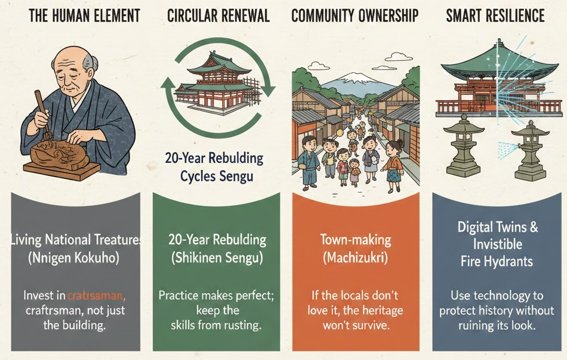 Figure 1: The Four Pillars of Japan's Heritage
- The first pillar, the Human Element, recognizes that heritage ultimately resides in people rather than objects. By institutionalizing the protection of skills through the Living National Treasure system, Japan places craftsmen, performers, and knowledge holders at the center of conservation policy. This pillar addresses the most fragile component of heritage continuity: the loss of embodied knowledge across generations.
- The second pillar, Circular Renewal, reflects Japan's acceptance of material impermanence and its response through planned rebuilding and long-term resource management. Practices such as the Shikinen Sengu demonstrate how periodic reconstruction keeps technical skills active, materials sustainably sourced, and structures resilient to natural hazards. Here, conservation is understood as a cycle rather than a one-time intervention.
- The third pillar, Community Ownership, shifts the scale of conservation from individual monuments to lived environments. Through machi zukuri, Japan embeds heritage protection within everyday life, ensuring that historic districts remain socially and economically viable. This pillar acknowledges that heritage cannot be sustained through regulation alone; it must be valued, maintained, and defended by the communities who inhabit it.
- The fourth pillar, Smart Resilience, reflects Japan's pragmatic response to disaster risk and uncertainty. By integrating invisible infrastructure, digital documentation, and predictive technologies, Japan enhances the survivability of heritage without compromising its visual integrity. Technology functions here not as a replacement for traditional practices, but as an insurance mechanism against irreversible loss.
Taken together, the four pillars reveal a conservation strategy that balances continuity and change. Skills enable rebuilding, rebuilding sustains communities, communities justify investment, and technology safeguards the whole system. The sections that follow examine each pillar in greater detail, illustrating how Japan operationalizes this integrated approach through legislation, planning instruments, and practice on the ground.
 |
1 |
The Human Archive:
Intangible Cultural Properties |
|
| |
| | |
For countries where traditional skills remain widespread but economically precarious, this pillar demonstrates how modest state recognition, stipends, and structured apprenticeships can prevent rapid skill erosion without requiring large capital investments.
.
| |
|
| | |
The most significant lesson Japan offers the world is the realization that heritage cannot survive without the hands that maintain it. While a museum can house a physical artifact, it cannot house the skill required to create a second one.
The "Living National Treasure" System
Under the 1950 Law, Japan introduced the designation of Ningen Kokuho, or Living National Treasures. These are individuals - craftspeople, musicians, and performers - who possess high-level mastery of an "Intangible Cultural Property."
- Financial Scaffolding: Designation is not merely honorary. The Japanese government provides an annual grant (currently around 2 million yen) to these masters. This stipend is specifically intended to ensure they do not have to abandon their craft for more "profitable" modern work.
- The Mandate of Succession: The stipend comes with a catch: the master is legally and ethically obligated to train successors. This creates a formal "Human Archive," ensuring that ancient techniques in weaving, pottery, smithing, and theater (like Noh or Kabuki) are passed down with unbroken continuity.
Succession Planning and the "Generation Gap"
Many countries struggle with "dying arts" because younger generations see no economic future in them. Japan combats this by integrating traditional crafts into the modern luxury and tourism markets. By elevating a master to "National Treasure" status, the government adds immense cultural capital to their work, allowing traditional products to command premium prices that sustain entire local economies.
For other nations, the lesson is clear: Conservation is a labor market issue. If a country wants to save its historic cathedrals or ancient textiles, it must first save its stonemasons and weavers. Japan teaches us that the "Human Archive" is the most fragile part of our history, and it requires direct, proactive state support to survive the pressures of globalized mass production.
Case
in
Point |
 Swordsmithing in Seki City, Gifu
Seki has been a sword-making center since the 13th century. Today, licensed swordsmiths continue traditional steel techniques while producing ceremonial swords and art objects. Local museums, apprenticeships, and controlled sales keep the craft economically viable without diluting technique.
|
|
Case
in
Point |
Yuzen dyeing in Kyoto
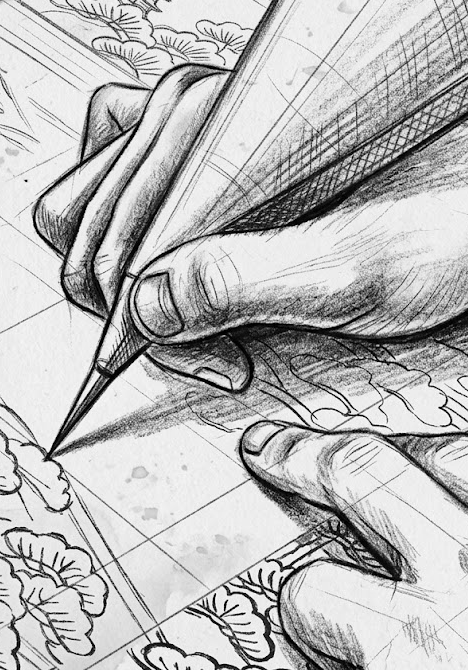
Kyoto's Yuzen silk dyeing is protected not only through master artisans but through a network of specialized sub-skills like stencil carving, color mixing, and steaming. Policy support treats the production chain as an ecosystem rather than a single craft, ensuring no critical skill disappears.
|
|
Case
in
Point |
Noh theatre transmission
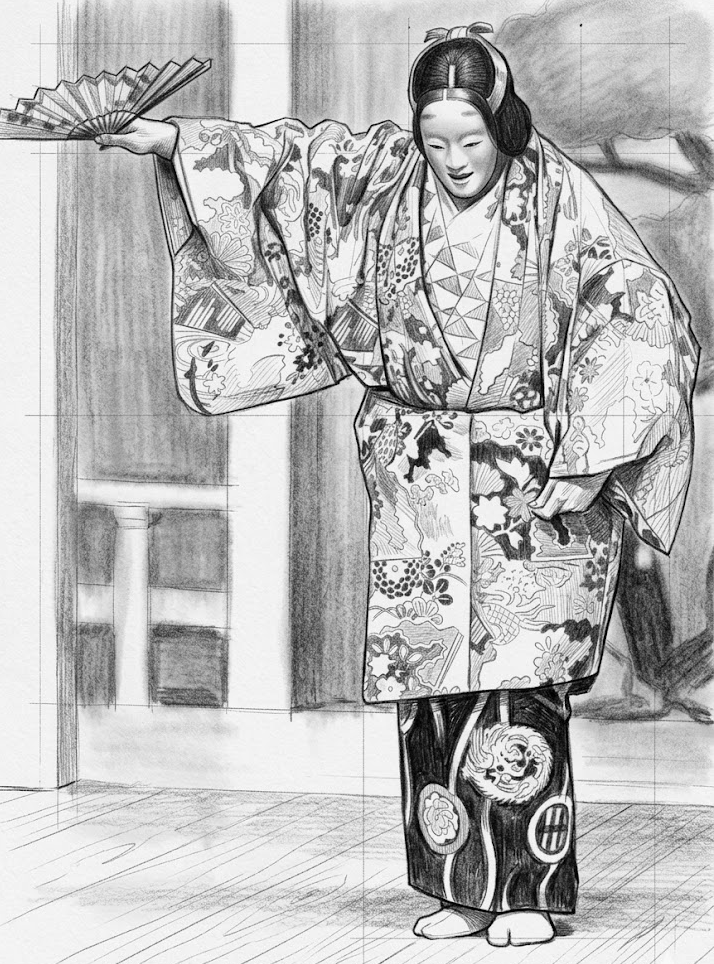
Several Noh schools operate with formal lineage systems recognized by the Agency for Cultural Affairs. Performers are designated as holders of Important Intangible Cultural Properties, while training stages ensure that rare roles and movements are practiced even when audiences are limited.
|
|
|
2 |
The Architecture of Resilience: The Ise Jingu Model |
|
| |
| | |
In contexts where material decay, climate stress, and limited maintenance budgets are common, planned cycles of repair and rebuilding offer a more realistic and sustainable alternative to high-cost, permanence-focused conservation models.
.
| |
|
| | |
The ultimate expression of Japanese conservation philosophy is found in the Shikinen Sengu ritual at Ise Jingu, Japan's most sacred Shinto shrine. Every 20 years, the entire shrine complex is demolished and rebuilt from scratch on an adjacent plot of land to the exact specifications of the original.
- Preservation Through Recreation: This 1,300-year-old tradition challenges the Western obsession with "original material." By rebuilding the shrine every two decades, the technical skills required - carpentry, thatch-roofing, and metalwork - never have the chance to grow "rusty." The knowledge is passed from master to apprentice in a constant, 20-year cycle.
- The 100-Year Forestry Plan: To facilitate this, Japan maintains a dedicated forest of Hinoki (Japanese Cypress). This is not just environmentalism; it is industrial planning for heritage. They plant trees today that will not be harvested for 200 years, ensuring that the "raw materials" for history are never depleted.
- Seismic Wisdom: Japanese wooden architecture is designed to "dance" with the earth. Instead of rigid foundations, ancient temples use the Shinbashira (a central heart-pillar) that acts as a pendulum, absorbing seismic energy during earthquakes.
For other nations, the lesson is clear: Sustainability in heritage isn't just about protecting what exists; it's about ensuring a circular economy of materials and skills that can reproduce the site indefinitely.
Case
in
Point |
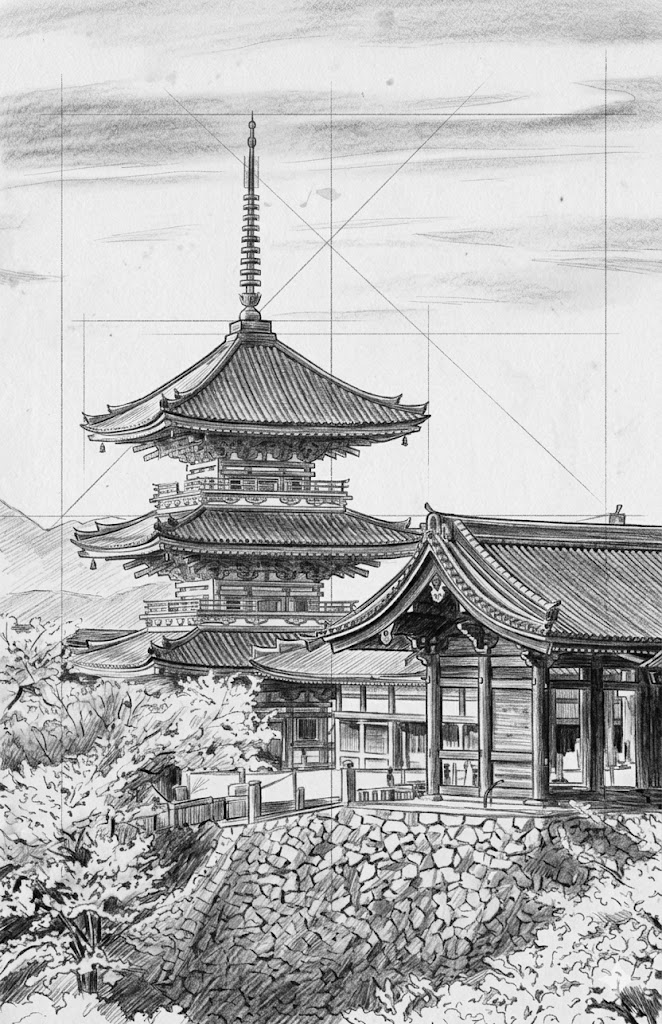 Kiyomizu-dera's periodic dismantling repairs
Rather than emergency restoration, Kiyomizu-dera undergoes planned dismantling every few decades. Beams are removed, repaired, and sometimes replaced using traditional joinery. This keeps carpentry skills alive and reduces catastrophic failure risk.
|
|
Case
in
Point |
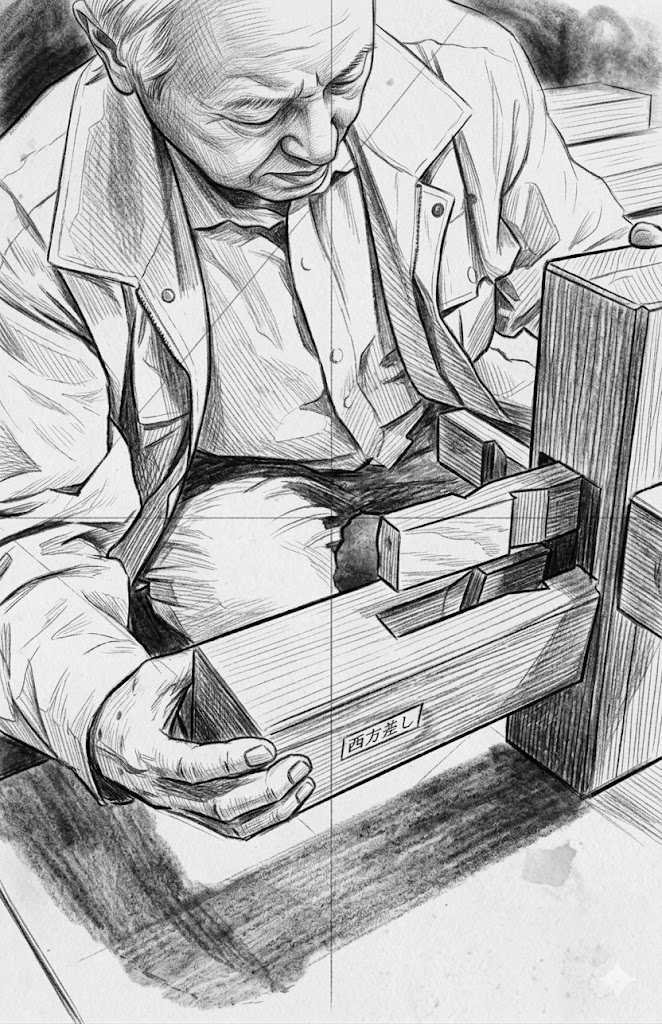 Temple carpenters (Miyadaiku) guilds
Miyadaiku are not freelancers but part of long-standing guild networks. Government restoration contracts are structured to prioritize these guilds, effectively treating conservation projects as skill-retention infrastructure rather than one-off construction jobs.
|
|
Case
in
Point |
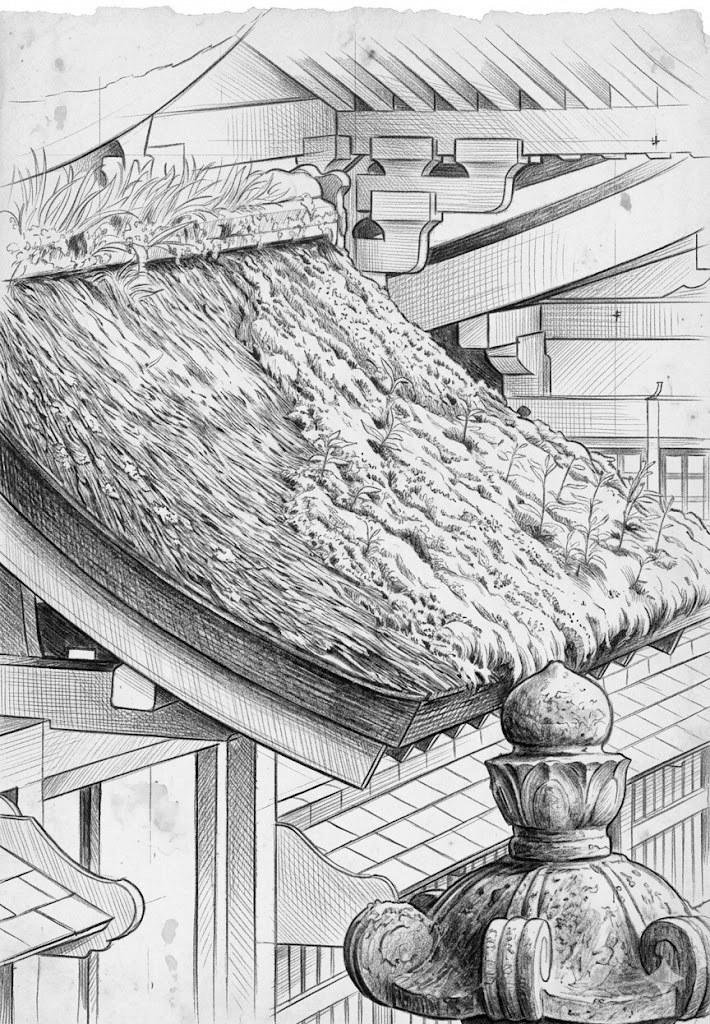
Traditional roofing cycles in Nara
Thatched and tiled roofs at historic temples follow replacement cycles embedded into management plans. Material decay is anticipated and budgeted for, reflecting a philosophy of managed impermanence rather than deferred maintenance.
|
|
|
3 |
"Machizukuri":
The Social Contract of Conservation |
|
| |
| | |
Where informal settlements, historic neighbourhoods, and living heritage districts dominate, this pillar shows how conservation can succeed only when it aligns with residents' livelihoods, housing needs, and collective decision-making structures.
.
| |
|
| | |
In many countries, designating a "historic district" is seen as a burden by residents - a "top-down" restriction that prevents them from modernizing their homes. Japan's Machizukuri (literally "town-making") flipped this script.
From Monuments to Neighborhoods
Starting in the 1970s, Japan shifted focus from individual buildings to Preservation Districts for Groups of Traditional Buildings. The strategy here is not to create a "Disney-fied" tourist trap, but to maintain a functional neighborhood.
- Subsidized Modernization: The government provides grants to residents to restore the façade of their homes (the traditional look), while allowing them to modernize the interiors (kitchens, bathrooms, insulation). This makes living in a 200-year-old house practical for a modern family.
- The Collective Agreement: Residents form local committees that decide on aesthetic rules - color palettes, signage, and even the types of trees planted. This ensures that the community feels like a steward of the history, rather than a victim of it.
For example, the thatched-roof villages of Shirakawa-go are a prime illustration of these ideas. The community practices Yui, a system of mutual labor where the entire village helps re-thatch a neighbor's roof. This social bond is what keeps the physical heritage alive.
Heritage conservation is most successful when it improves the quality of life for the people living within it. If the locals don't value the history, no amount of government regulation will save it.
Case
in
Point |
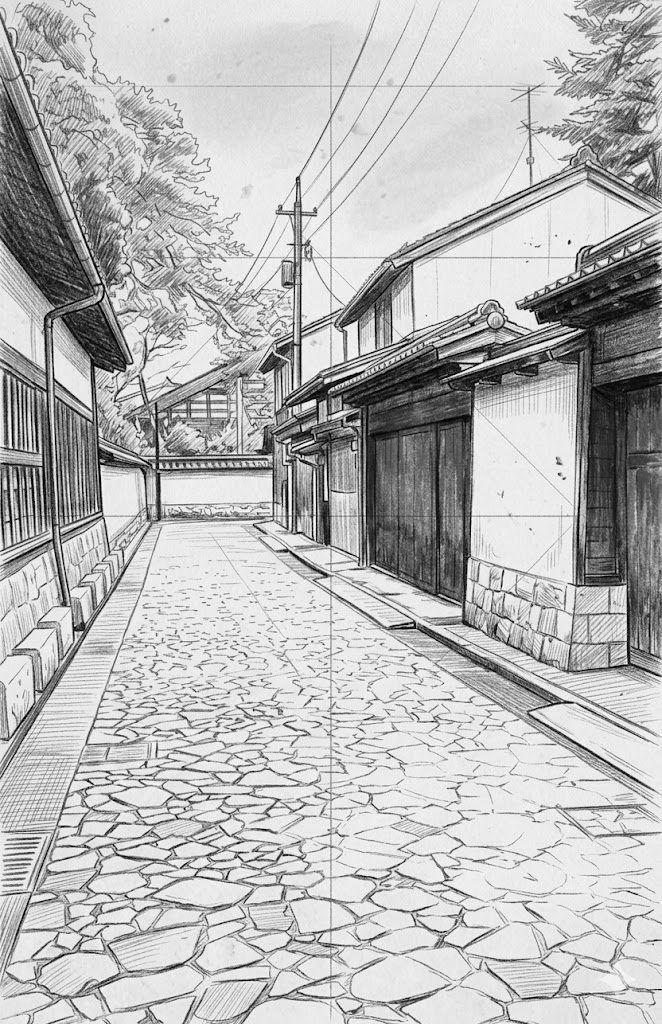
Kanazawa's Nagamachi Samurai District
Residents receive subsidies to maintain earthen walls and stone drainage channels while interiors are modernized. Strict façade guidelines coexist with high-quality contemporary living, preventing depopulation while preserving historic streetscapes.
|
|
Case
in
Point |
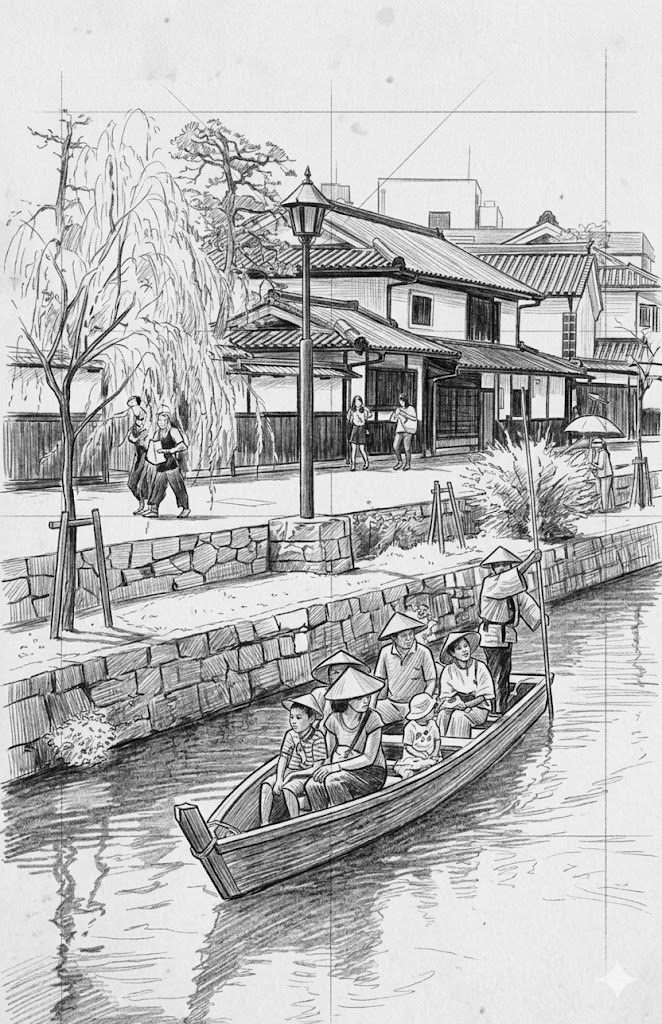
Kurashiki Bikan Historical Quarter
Local merchant families worked with municipal authorities to preserve white-walled storehouses. Rather than freezing the area, adaptive reuse turned warehouses into cafes, museums, and inns, keeping the district economically active.
|
|
Case
in
Point |
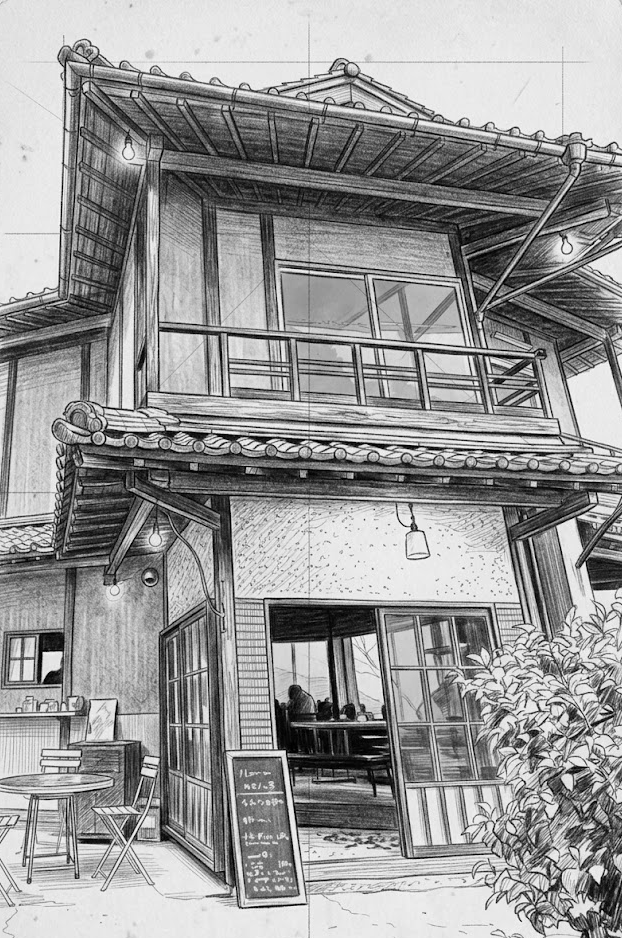
Onomichi's vacant house regeneration
In Onomichi, citizen groups and young migrants restore abandoned traditional houses with light-touch heritage guidelines. This bottom-up machizukuri model shows how heritage policy can intersect with rural revitalization and demographic decline.
|
|
|
4 |
Disaster Resilience and "Invisible" Infrastructure |
|
| |
| | |
For disaster-prone regions with constrained resources, low-cost digital documentation and discreet protective infrastructure can function as affordable insurance against irreversible heritage loss.
| |
|
| | |
Japan's heritage sites face a constant threat from fire and earthquakes. Rather than ugly modern interventions, Japan uses "invisible" technology.
- Hidden Protection: In places like Kyoto's Kiyomizu-dera or the historic streets of Ninenzaka, the government has installed massive underground water tanks and pop-up fire hydrants disguised as traditional stone features.
- Quantitative Safety: Following the 2024 Noto Peninsula earthquake, Japan accelerated its 2025-2030 "Cultural Property Disaster Prevention Plan." This plan uses AI to predict fire-spread patterns in wooden districts, allowing for the strategic placement of water curtains that can save an entire neighborhood without the need for intrusive modern walls.
Case
in
Point |
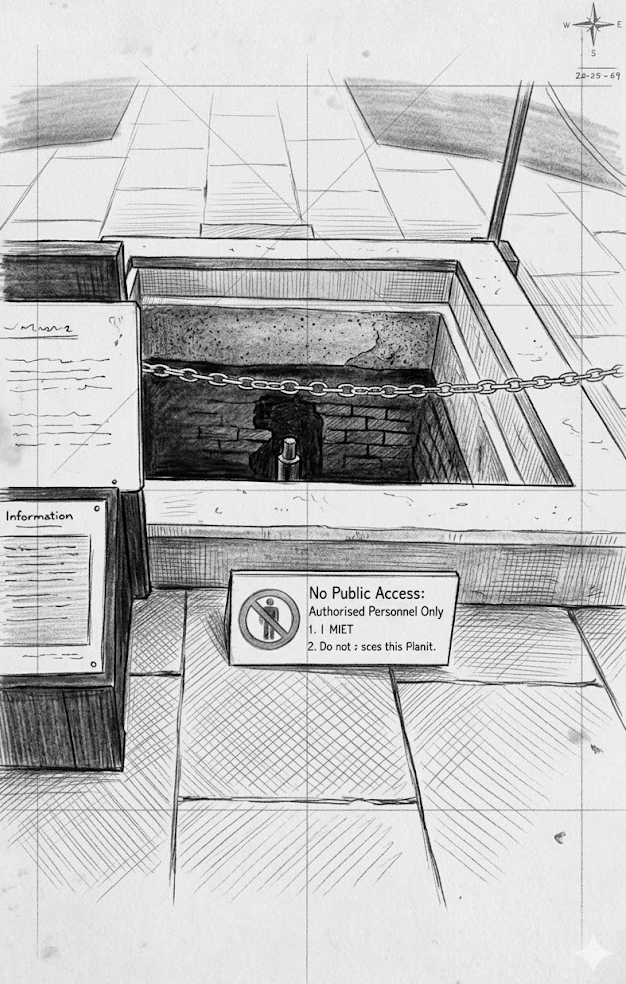
Kyoto's underground fire prevention systems
In Higashiyama, underground water reservoirs and disguised hydrants protect dense wooden districts. These systems are mapped digitally and linked to disaster response protocols without altering the visual landscape.
|
|
Case
in
Point |
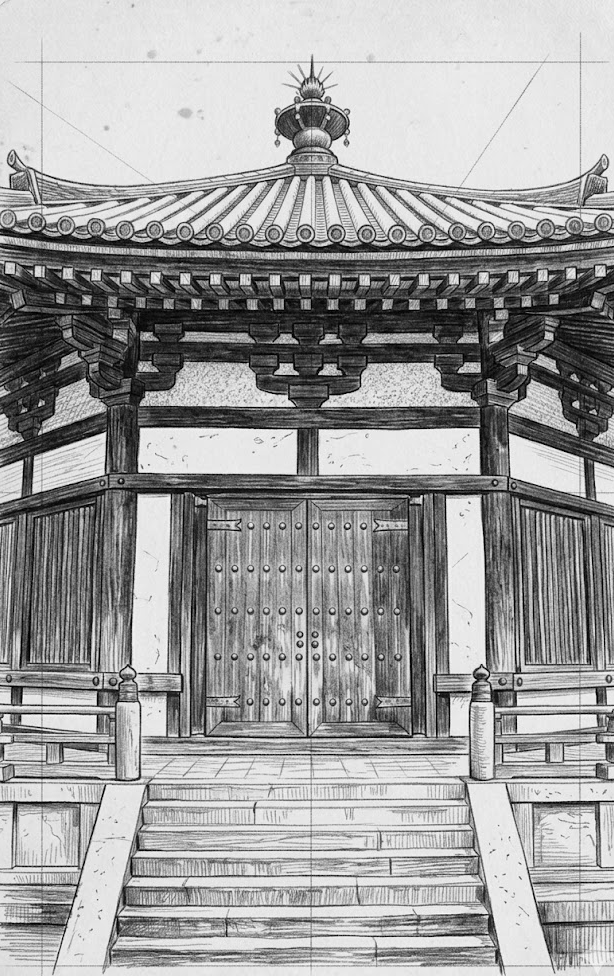
Horyu-ji digital archiving
Following earlier fire damage, Horyu-ji was among the first temples to be comprehensively scanned using LiDAR. These datasets are now used for both restoration planning and academic research on structural aging.
|
|
Case
in
Point |
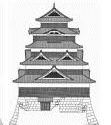
Edo Castle AR reconstruction
At the former Edo Castle site in Tokyo, AR applications allow visitors to visualize vanished structures. This reduces pressure for physical reconstruction while preserving cultural memory and educational value.
|
|
Digital Future-Proofing: The Silicon Safeguard
As we move deeper into the 21st century, Japan has recognized that even the best physical preservation cannot stop a "Black Swan" event - a catastrophic earthquake or fire that could wipe out a site entirely. To counter this, Japan has become a leader in Digital Heritage.
- The "Digital Twin" Strategy: Using high-resolution LiDAR (Light Detection and Ranging) and photogrammetry, Japan is creating millimeter-accurate 3D models of its World Heritage sites. If a temple were to burn down tomorrow, architects would have a digital blueprint so precise they could replicate every chisel mark on every beam.
- Democratizing History through VR/AR: At sites like the former Edo Castle (which no longer exists in its full form), Japan uses Augmented Reality to allow tourists to "see" the vanished structures through their smartphones. This keeps the cultural memory alive even when the physical stone is gone.
- AI in Restoration: Japanese researchers are now training AI models to recognize the "hand" of specific historical master-sculptors. This helps conservators determine exactly how to repair damaged statues in a way that remains stylistically true to the original artist.
For Japan, digital technology is not a replacement for physical heritage, but it is an essential insurance policy. Data is the ultimate "last line of defense."
Global Impact: The Nara Document on Authenticity
Perhaps Japan's greatest contribution to global heritage wasn't a building or a law, but an idea. In 1994, the Nara Document on Authenticity (See ANNEX 2 below) was drafted in Japan, fundamentally changing how UNESCO and the rest of the world view conservation.
- Challenging the Euro-Centric View: Before 1994, international standards (like the Venice Charter) prioritized "original materials." If you replaced the wood in a building, it was often no longer considered "authentic."
- The Japanese Counter-Argument: Japan argued that in Asian wooden traditions, the form, spirit, and function are what matter. A temple rebuilt with new wood using the same 1,000-year-old techniques is just as "authentic" as the original.
- The Result: This shifted the global focus toward diversity. It allowed developing nations in Africa, South America, and Asia to protect their heritage based on their own cultural values rather than Western architectural standards.
For Japan, authenticity is not a universal constant; it is culturally defined. True conservation respects the intent of the culture that created the site. (See the GDRC case study of the Dejima island in Nagasaki for a detailed exploration of the Nara Document)
Conclusion: Managing Change, Not Freezing Time
|
| |
| |
Japan's heritage strategy succeeds because it treats culture as a renewable resource rather than a finite one.
By investing in three the three "Ms" - Masters (Intangible), Materials (Environment), and Meaning (Community) - Japan has created a model that is both ancient and cutting-edge.
For any nation looking to improve its conservation efforts, the takeaways are clear:
- Fund the People: A building is just a pile of materials without the craftsmen to fix it.
- Plan for the Long Term: Heritage requires a 100-year supply chain of timber, stone, and talent.
- Modernize the Lifestyle, not the Façade: Allow people to live modern lives inside historic shells so that neighborhoods remain vibrant.
- Embrace the Digital: Use technology to archive what cannot be physically guaranteed.
Japan proves that "tradition" is not about looking backward; it's about carrying the best of the past into the future with intentionality and grace.
| |
|
| | |
Japan's heritage conservation system succeeds because it does not treat culture as a fragile relic to be locked away, nor as a luxury to be addressed after economic development. Instead, it treats heritage as a renewable resource that must be actively managed across generations. This requires accepting a fundamental lesson: change is inevitable, but loss is not.
By investing first in people rather than objects, Japan ensures that the skills required to maintain heritage remain alive even when physical structures fail. The protection of intangible cultural properties transforms conservation from a reactive activity into a forward-looking labour and education policy. In this model, craftsmen, performers, and community stewards are not peripheral actors. They are the core infrastructure of heritage continuity.
Japan's emphasis on circular renewal further challenges dominant conservation assumptions. Rebuilding, repair, and replacement are not admissions of failure but indicators of resilience. By embedding maintenance cycles, material supply chains, and skill transmission into long-term planning, Japan reduces dependence on emergency interventions and external expertise. Heritage is sustained through repetition, practice, and anticipation rather than crisis response.
Equally critical is the social dimension. Through machizukuri, Japan demonstrates that heritage conservation cannot succeed without the consent and participation of those who live within historic environments. By allowing modern life to coexist with traditional forms, conservation becomes a shared civic project rather than an imposed restriction. Where communities see tangible benefits in livability, identity, and economic opportunity, heritage becomes self-reinforcing.
Finally, Japan's use of technology reframes the role of modern tools in conservation. Digital documentation, predictive disaster modelling, and augmented interpretation are not substitutes for physical preservation but safeguards against irreversible loss. They provide redundancy in a country where earthquakes, fire, and climate risks are permanent realities. In doing so, Japan shows that tradition and technology are not opposites, but partners.
Taken together, the four pillars form a coherent and transferable framework. They suggest that successful heritage policy must integrate culture, labour, environment, community, and technology into a single system. For countries facing rapid urbanisation, demographic change, or limited conservation budgets, Japan's experience offers a critical lesson: heritage does not survive by resisting modernity, but by being deliberately woven into it.
In this sense, Japan's greatest contribution to global heritage practice is not any single law, site, or technology. It is the recognition that authenticity lies in continuity of meaning, skill, and use. Conservation, at its best, is not about preserving the past as it was, but about ensuring that future generations inherit the capacity to recreate it with understanding and care.
ANNEX 1: 1950 Law for the Protection of Cultural Properties
The 1950 Law for the Protection of Cultural Properties is the cornerstone of Japan's modern heritage policy. Enacted on 30 May 1950 and brought into force on 29 August 1950, it emerged in the immediate post-war context, when there was renewed concern about safeguarding cultural heritage. A key trigger was the 1949 fire at H?ry?-ji Temple, which damaged invaluable ancient murals and exposed weaknesses in existing protection systems. In response, the law consolidated earlier pre-war legislation into a single, comprehensive framework, marking a major shift toward systematic and state-led cultural preservation.
One of the law's most important contributions was its broad and innovative definition of "cultural properties." It extended protection beyond tangible heritage such as buildings, artworks, and historic sites to include intangible cultural properties like performing arts and craft techniques, as well as folk cultural properties and buried archaeological remains. This wide scope was considered advanced even by international standards at the time. The law also introduced a formal designation system for categories such as Important Cultural Properties and National Treasures, alongside regulatory controls, financial support, and conservation measures administered by national authorities.
Institutionally, the law created a comprehensive governance structure for heritage management, including the establishment of a national body (initially the National Commission for the Protection of Cultural Properties) to oversee implementation. It set out not only preservation measures but also the principle of utilization, emphasizing public access, education, and the cultural value of heritage for society. Over time, amendments expanded its categories and strengthened protections, but the 1950 law remains the foundation of Japan's cultural policy, balancing conservation with use and contributing to both national identity and global cultural heritage.
Full text of the law (English translation):
1950 Act on Protection of Cultural Properties
ANNEX 2: The Nara Document on Authenticity
The Nara Document on Authenticity was adopted in 1994 during an international conference held in Nara, organized with the support of UNESCO, ICOMOS, and Japanese cultural agencies. It emerged as an important milestone in global heritage conservation because it challenged the earlier tendency to judge authenticity mainly through Western architectural standards, such as original materials and physical fabric. The document recognized that cultures around the world express and preserve heritage in different ways, and therefore authenticity should be understood within the cultural context in which a heritage site exists.
A key contribution of the Nara Document was its expansion of the meaning of authenticity beyond physical appearance alone. It emphasized that authenticity may be reflected through form and design, materials, use and function, traditions and techniques, location and setting, spirit and feeling, and other cultural factors. This broader understanding was especially important for countries such as Japan, where historic structures are sometimes periodically rebuilt using traditional craftsmanship, as seen in sites like Ise Grand Shrine. In such cases, authenticity lies not only in old materials, but also in the continuity of knowledge, ritual, craftsmanship, and cultural meaning passed across generations.
The influence of the Nara Document has been far-reaching in international heritage policy and practice. It strengthened the idea that cultural diversity must be respected in conservation approaches and helped make global heritage management more inclusive and culturally sensitive. The document continues to guide evaluations for the World Heritage Convention and has inspired heritage professionals to consider intangible dimensions of culture alongside tangible structures. Today, it is regarded as one of the foundational texts in contemporary heritage conservation, particularly in discussions on living heritage, community participation, and the relationship between tradition and modernization.
Full text of the document: The Nara Document on Authenticity
|