Microcredit in Developing Countries: The Facilitative Roles of NGOs
In recent decades, microcredit has emerged as a key development tool for solving a range of problems faced by low-income households in developing countries. Donors and microenterprise development program specialists initially voiced doubts about extending financial services to low-income households. They assumed that with underemployment and low incomes, and hampered by class, social and gender barriers, low-income households could not develop successful enterprises, pay back loans, or generate enough loan volume to be financially sustainable. But practical examples from the field however, has demonstrated that microcredit has in fact enabled these people to expand and diversify their enterprises and increase their incomes to a level sufficient to repay loans at market rates and make savings deposits. In many developing countries, with limited formal employment opportunities and self-help being the only available choice, microbanking services and microcredit has emerged as a way of survival for many low income people, particularly in developing countries. This is particularly due to the fact that commercial banks and other financial institutions, citing credit risks and defaulters, have systematically kept low income households outside their credit delivery networks, forcing them to resort to informal and non conventional systems of mobilizing credit. The positive features of such informal loan systems and credit markets are only now being recognized [Srinivas, 1991]. Informal loans are usually small in size since money is acquired only for a part of a larger activity. These small amounts contrast starkly with loans from banks, which tends to be large, and for lump sum investments. Loans are usually made for very short periods. Borrowers prefer to repay loans quickly to avoid long term commitments in repayments. This also reflects the insecurity of borrowers' jobs and income. Loans are unsecured, with little or no collateral or guarantees. Lenders rely on personal information and close proximity links to "keep an eye" on borrowers' expenditures and ensure repayment. Since services are localized, and only well known borrowers serviced, the rate of repayment is also very high .
Before we explore the facilitative role that NGOs play in microcredit programmes in more detail, it is important to understand the NGO itself, and the organizational and operational framework within which it functions.
| |||||||||||||||||||||||||||||||||||||||||||||||||||||||||||

Microcredit and community development |
|
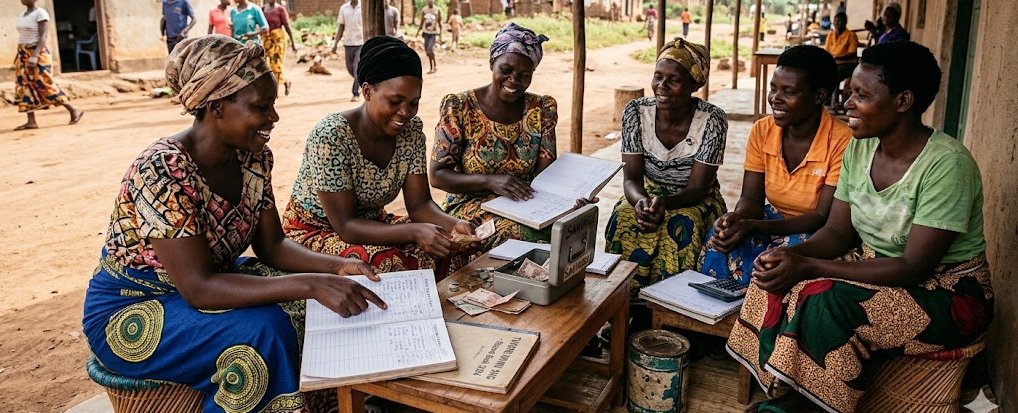
| The availability of adequate and timely microcredit services for low income households has many effects on the development of a community. It directly effects community organizing and development as a part of the microcredit activities, and indirectly enables and facilitates community development as an externality of credit. Microcredit therefore enables collective action, the coming together of the community which is an important ingredient of participation of the community in its development. | |
Microcredit and community development |
|
| The availability of adequate and timely microcredit services for low income households has many effects on the development of a community. It directly effects community organizing and development as a part of the microcredit activities, and indirectly enables and facilitates community development as an externality of credit. Microcredit therefore enables collective action, the coming together of the community which is an important ingredient of participation of the community in its development.
Formal and informal education and training are also enabled, for leaders and other members of the community, in skills that will allow them to locally design, develop and manage community projects. The enablement also has wider effects - this can be seen in greater awareness of the community in its internal potentials, in its ability to interact together to solve its own problems. It also illustrates the power of local decision making process that take place at the level of the community. |
|
Microcredit and poverty |
|
| A considerable proportion of the population in developing countries are still below the poverty line. Poverty is not a cause, but an effect of lopsided priorities, policies, and resource distribution. Programmes and projects that target poverty through microcredit have enabled higher income generation for the households by enabling economic and other entrepreneurial activities, and through training and skill development activities.
Such targeting has also lead to greater awareness of developmental issues in general. Better skills and products have meant, for example, the efficient use of technologies and materials that have less side effects, less hazardous, and better recycled. This has also accorded greater importance to individual safety and health in the long run. |
|
Microcredit and microenterprises |
|
| Microcredit is a 'common denominator' for a microenterpreneur against which many other actions depend. Access to good quality and quantity of credit has enabled innovative solutions in technology, manufacturing and marketing processes that are cost effective. Due to the very nature in which microenterprises are structured, use of sustainable and appropriate technology has ensured that minimal waste has been generated, with many by products recycled for other uses. In fact many extensively depend on recycled and other 'waste' products as raw materials. | |
Microcredit and women |
|
| Criticality of women and gender issues in microcredit programmes is best illustrated by a quote from Mohammed Yunus, founder of Grameen Bank. Explaining why 94 percent of Grameen Bank's loans go to women, he said, "Women have plans for themselves, for their children, about their home, the meals. They have a vision. A man wants to enjoy himself." [Prof. Yunus at a US Congressional Hearing, 1996].
Availability of finance to women ensures that resources and profits generated are ploughed back into the development of the immediate household and family. Protection of family values, of health and safety of household members, of a more even distribution of income, can be seen as a result. This is particularly true in the case of home based or household based enterprises, where women play a significant role. |
|
Microcredit and macrofinance |
|
| The growing realization of the importance and positive effects of microcredit on poverty, on microenterprises, on households etc. has generated considerable interest in its potential to reach low income families who have traditionally been sidelined by formal financial institutions. Opportunities to invest in global and regional funds geared towards microcredit have increased over the last few years, particularly focussing on investments that support sustainable development activities at the local level.
Interest has also been focussed on decentralized investment where the local economy is emphasized, and local profits and benefits go back to the local economy. This has essentially meant the availability of funds to generate sustainable solutions that go beyond the cliches. The realization that small local activities have many wider repercussions and effects globally, emphasizes the need for local solutions at the micro level, which is where microcredit plays a dominant role. |
|
 Microcredit Lending Mechanisms
There are a number of microcredit lending in operation all over the world. The existence of these mechanisms demonstrate the fact that there is no one single 'microcredit mechanism', but several, with varying characteristics and operations.
The reluctance of financial institutions to serve low-income households is another reason for such a wide variety of mechanisms. The parameters that have influenced these mechanisms include the socio-economic situation of the region, legal and legislative frameworks for financial activities, rules and regulations concerning the organization and operation of NGOs, etc.
| Associations | The community of low-income households forms an 'association' through which various microcredit (and other) activities are initiated. Such activities may also include savings. Associations or clubs can be composed of youth, women; can form around political/religious/cultural issues; and can create support structures for microenterprises and other work based aspects. In some countries, an 'association' can be a legal body that has certain advantages such as collection of fees, insurance, tax breaks and other protective measures. Associations are essentially mass-based, and function at the community level. |
| Bank Guarantees |
As the name suggests, a bank guarantee is a financial instrument used to obtain a loan from a commercial bank. This guarantee may be arranged externally, through a donor/donation, or government agency, or internally, using member savings. Loans obtained may be given directly to an individual, or they may be given to a self formed group.
Thus, a bank guarantee is a form of capital guarantee scheme. Guaranteed funds may be used for various purposes, including loan recovery and insurance claims. Several international and UN organizations have been creating international guarantee funds that banks and NGOs can subscribe to, for onlending or starting microcredit programmes. |
| Community Banking |
Community Banking model treats the whole community as one unit, and establishes semi formal or formal institutions through which microfinance is dispensed. Such institutions are formed by extensive help from NGOs and other organizations, who also train the community members in various financial activities of the community bank.
Community banks may have savings components and other income generating projects included in their structure. In many cases, community banks are also part of larger community development programmes which use finance as an inducement for action. |
| Cooperatives | Microcredit lending is sometimes carried out through a cooperative. A co operative is a legally constituted autonomous association of persons united voluntarily to meet their common economic, social, and cultural needs and aspirations through a jointly owned and democratically controlled enterprise. Some cooperatives include member financing and savings activities in their mandate. |
| Credit Unions | Credit unions are widely involved in microcredit. A credit union is a unique member driven, self help financial institution. It is organized by and comprised of members of a particular group or organization, who agree to save their money together and to make loans to each other at reasonable rates of interest. The structure of a credit unions is similar to ROSCAs (see below). |
| Grameen |
The Grameen model emerged from the poor focussed grassroots institution, Grameen Bank, initiated by Prof. Mohammed Yunus in Bangladesh. It essentially adopts the following mechanism: A bank unit is set up with a Field Manager and a number of bank workers, covering an area of about 15 to 20 villages.
The manager and workers start by visiting villages to familiarize themselves with the local community. Groups of five prospective borrowers are formed; in the first stage, only two of them are eligible for, and receive, a loan. Only if the first two borrowers repay the principal plus interest over a period of fifty weeks do other members of the group become eligible themselves for a loan. Because of these restrictions, there is substantial group pressure to keep individual records clear. |
| Group | The Group method is a more general form of the Grameen method. Its basic philosophy lies in the fact that shortcomings and weaknesses at the individual level are overcome by the collective responsibility and security afforded by the formation of a group of such individuals, usually numbering five or ten. The collective coming together of individual members is also used for a number of purposes: educating and awareness building, collective bargaining power, peer pressure etc. |
| Individual | This is a fundamental microcredit lending model where small loans are given directly to the borrower. It does not include the formation of groups, or generating peer pressures to ensure repayment. The individual model is, in many cases, a part of a larger 'credit plus' programme, where other socio economic services such as skill development, training, education, and other outreach services are also provided. |
| Intermediaries |
The Intermediary model of credit lending positions a 'go between' organization between the lenders and borrowers. The intermediary plays a critical role of generating credit awareness and education among the borrowers, including, in some cases, starting savings programmes. These activities are geared towards raising the 'credit worthiness' of the borrowers to a level sufficient enough to make them attractive to the lenders.
The links developed by the intermediaries could cover funding, programme links, training and education, and research. Such activities can take place at various levels from international and national to regional, local and individual levels. Examples of intermediaries include NGOs, microenterprise/microcredit programmes, and commercial banks (for government financed poverty programmes). Lenders can include government agencies, commercial banks, international donors, etc. |
| ROSCA |
Rotating Savings and Credit Associations (ROSCAs) are essentially a group of individuals who
come together and make regular cyclical contributions to a common fund, which is then given as a lump sum to one member in each cycle.
For example, a group of 12 persons may contribute INR100 (about US$1.30) per month for 12 months. The INR1,200 collected each month is given in turns to all members. Deciding who receives the lump sum is done by consensus, by lottery, by bidding or other agreed methods. ROSCAs are traditional mechanisms that have been in existence for hundreds of years. |
| Small Business |
The prevailing impression of the 'informal sector' is one of survival, low productivity and very little value addition. But this has been changing, as more and more importance is placed on small and medium enterprises (SMEs) for generating employment, for increasing income and providing public rural or urban services that are lacking, particularly with low-income households. Policies have generally focussed on direct interventions in the form of supporting systems such as training, technical advice, management principles etc.; and indirect interventions in the form of an enabling policy and market environment.
A key component that is always incorporated as a sort of common denominator has been finance, specifically microcredit in different forms and for different uses. Microcredit has been provided to SMEs directly, or as a part of a larger enterprise development programme, along with other inputs. |
| Village Banking | Village banks are community based credit and savings associations. They typically consist of 25 to 50 low income individuals who are seeking to improve their lives through self employment activities. Initial loan capital for the village bank may come from an external source, but the members themselves run the bank: they choose their members, elect their own officers, establish their own by laws, distribute loans to individuals, collect payments and savings. Their loans are backed, not by goods or property, but by moral collateral: the promise that the group stands behind each individual loan. |
The Intermediary Position of NGOs
The primary role of an NGO in a microcredit programme is that of an intermediary between lenders (such as banks, local governments or aid donors) and borrowers (mostly low-income households and microenterprises). There have been several common characteristics of the intermediary intervention of NGOs. They have essentially emphasized on the target community forming an organization that would serve as a voice to the community as a whole. Such organization also channel the activities and resources to the target households. They have also emphasized savings first as a part of the community's initial activities - no credit without saving. The accumulated savings is pooled in a central 'community fund' and used as partial collateral.
NGOs have provided bank-negotiated loans for the community organization, for onlending to members, where most credit decisions for onlending to members are taken by the community and its leaders. Interest rates and other terms and conditions for loans to members are also decided by the community. Thus, by using joint liability as a substitute for physical/asset-based collateral, and by ensuring that the ratio between savings and credit is contingent upon credit worthiness of the group as a whole, they have ensured good repayment records and financial sustainability in the long run.
In a very abstract way, there are three models that characterize the intermediary position of an NGO in a microcredit programme:
Developing a Hypothetical Triangle between
NGOs, Community Organizations and Lending Institutions.
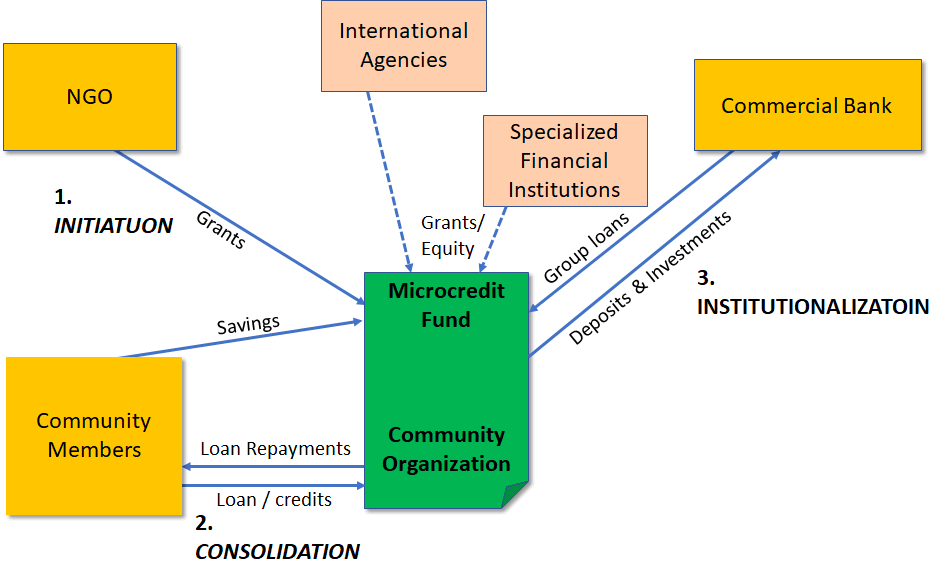
It is clear from the above discussion that three primary actors emerge in the development of successful microcredit programmes: the local community organization, the intermediary NGO, and the funding organization, usually local commercial banks. A hypothetical interaction between these three actors (with a bank as the funding institution) is illustrated here to demonstrate microcredit practices.
There are three phases to the interaction: initiation, consolidation and institutionalization. These three stages are essential due to the unique/differing factors in each community. Since microcredit programmes also need flexibility and adaptability to adopt to such unique needs, this is done in various ways: internally by setting up the community organization, and the stage-by-stage development which allows for monitoring and evaluation; externally by the involvement of the many secondary and tertiary actors who bring in the necessary experience and resources in order to make it flexible and adaptable (see Figure 4). Such features are to be entrenched into the programme by including it in the aims and objectives, and vision statements [Srinivas, 1996].
(Click image to enlarge)
Initiation Phase
The primary focus of this phase is on internal savings of the community. As the community develops organizationally, it demonstrates its ability to save regularly into a central fund that is created at the community level, with 'Savings First!' as a slogan. The NGO may provide block grants to this fund, either to raise the equity levels, or to fund training and development activities of the community that are not renumerative in nature. Thus the NGO also focusses for its part on social welfare issues to raise awareness and increase participation among the community residents. In this phase, the bank is an observer, watching the proceedings of community development and understanding the dynamics of community mobilization.
Consolidation Phase
During the phase of consolidation, the community has formed an organization with regular meetings where leaders are elected, discussions and decisions are taken, and the future activities are charted. With further increase in the CO's capital fund, small loans are now made to members in need of finance. The focus of this phase is to develop the credit-worthiness of the members. The NGO plays the role of a mediator bringing various actors together to interact with the CO. The bank upgrades its role from that of an observer to a supporter. It helps in loan making processes, procedures for keeping records, advises in disputes, and arbitrates in cases of default, if necessary.
Institutionalization Phase
The focus of this phase is on making the CO bank-worthy. Only the link between the bank and CO remains strong. The NGO has begun to gradually withdraw and is involved only in consultations with the CO and the bank. The bank itself has upgraded its role from that of a supporter to a partner - it now makes group loans to small groups of five to ten borrowers simultaneously, when loan sizes are small and are for upgradation, repairs, maintenance purposes. On the recommendation from the leaders of the community or officials designated by the community organization, it may provide individual loans directly to member when they are sufficiently large, for example for capital investment in microenterprises.
It is this dynamic nature of the stakeholders/participants entering the microcredit programme, providing pertinent resources unique to itself and then withdrawing after the task has been completed, that enables programme replicability and scaling up. Specificity of the participation ensures that there is no overlap of activities or objectives. The use of existing actors and their actions/resources obviates the need for the setting up of separate networks and institutions for microcredit programmes.
Microcredit: Future Prospects
With the current explosion of interest on microcredit issues, several developmental objectives have come to be associated with the it, besides those of only "micro" and "credit". Of particular importance is that of savings as an end in itself, and as a guarantee for loans. Microcredit has been used as an 'inducer' for many other community development activities, used as an entry point in a community organizing programme or as an ingredient in a larger education/training exercise.
By emphasizing the strength of bringing the community together as an organization, microcredit methodologies are now entering a new evolutionary phase as they become more responsive to market demands. This change in approach reflects the evolving needs of low-income households and microentrepreneurs, the maturation of microcredit institutions, and changes in the markets in which microcredit institutions and programmes operate. In this new phase, these institutions are attempting to balance three potentially competing objectives: 1) to reduce transaction costs for both borrower and lender; 2) to widen the range of microcredit products available to the clients; and 3) to reduce credit risk. These three desired objectives are not independent of each other, and may require trade offs.
Different types of micro and small enterprises have different characteristics and demand different services. Hence it is desirable to encourage a range of institutions that use specialized methods to serve their particular market niches. These can include commercial and development banks, credit unions, mutual or community banks, NGOs, finance companies, cooperatives, savings and credit associations, and other specialized intermediaries. At the same time, however, fundamental principles of financial sustainability have to be applied widely and must be observed by all institutions if they are to succeed. Moreover, support mechanisms have to be designed in ways that are consistent with best international practices and long run development of a sound financial system.
But the concept of microcredit is more than just money and access to credit. A broader perspective needs to be taken, emphasizing roles for local governments, and the larger civil society, and incorporating community development issues, and resource networking. Education and training, including the design of microcredit policies and programmes should also receive prominence. Of greater significance from a long term and broader view is the role and effect of microcredit on environmental problems and sustainable development. Supporting and inspiring these objectives with pertinent and timely knowledge and information on microcredit methodologies should be pursued. NGOs, due to their inherent organizational and operational structures and advantages, play an important role in developing such scenarios.
References
Cousins, William (1991), "Non-governmental initiatives" in ADB, The urban Poor and Basic Infrastructure Services in the Asia Pacific. Manila: Asian Development Bank.Microcredit Summit (1997) Declaration and Plan of Action. The Microcredit Summit. Results Educational Fund. Washington DC, 1-4 February, 1997.
Srinivas, Hari (1991), Viability of Urban Informal Credit to Finance Low Income-Housing: a Case Study of Three Squatter Settlements in Bangalore, India. Unpublished Masters Thesis. Bangkok: Division of Human Settlements Development, Asian Institute of Technology.
Srinivas, Hari "So, what is 'microcredit' ??" [http://www. gdrc.org /icm/what-is-ms.html] Tokyo: Department of Social Engineering, Tokyo Institute of Technology.
Srinivas, Hari and Dean Pallen, The Environmental Colours of Microfinance. [http://www.gdrc.org/icm/environ/environ.html]. Department of Social Engineering, Tokyo Institute of Technology, Tokyo, Japan.
VLM, Virtual Library on Microcredit: Conceptual Framework . [http://www.gdrc.org/icm/concept.html] Global Development Research Center, Kobe, Japan.
|
|

 |
Return to the Virtual Library on Microcredit Contact: Hari Srinivas - [email protected] |