Managed Informality: Hawker Centers as a Blueprint for Inclusive Urban Development
Hari Srinivas
Case Study Series E-268
Abstract:
Managed informality is a governance approach that integrates informal economic activities into formal urban systems through supportive infrastructure, regulation, and public oversight, while preserving the flexibility, affordability, and low barriers to entry that make informal livelihoods viable.
Urban development in developing nations faces a central paradox: how to formalize an informal economy without destroying its essential features that benefit its primary users - low-income households and entrepreneurs: low barriers to entry, affordability, and organic community culture. This paper addresses this paradox through the analytical lens of "managed informality," utilizing the evolution of Southeast Asian hawker centers from unregulated street food vending to structured, hygienic complexes as a foundational model.
The analysis identifies the core operational interventions that sustain these hybrid spaces, including municipal rental subsidies, centralized compliance economies of scale, and strict anti-subletting mandates designed to eliminate corporate rent-seeking.
Ultimately, the paper provides a scalable blueprint for the wider informal sector, demonstrating how the provision of subsidized physical platforms can successfully absorb regulatory and public safety risks for informal artisans, roadside mechanics, and gig-economy workers without stifling economic agility.
Hawker centers are open-air or semi-enclosed complexes found throughout southeast Asia, particularly Singapore, Malaysia, and Indonesia, that house numerous stalls selling affordable street food. Originally established to consolidate roving street vendors for sanitary reasons, they serve as bustling "community dining rooms" that offer a wide variety of local cuisines.
BOX 1: Features of Hawker Centers
Variety and Culture: They feature a wide mixture of Chinese, Malay, Indian and other cuisines. Stalls are highly specialized, often perfecting just one or two signature dishes over decades.
Affordability: Most food items in hawker centers are low-cost and affordable.
Hygiene: Despite the street-food roots, centers are strictly regulated and regularly inspected by governing health authorities, with hygiene grading certificates displayed at every stall.
The emergence of hawker centers was closely linked to the rapid urbanization experienced across Southeast Asia during the mid-twentieth century. As cities expanded and populations grew, large numbers of street vendors occupied sidewalks, roadsides, and public spaces, providing affordable food and essential services to urban residents. While these activities supported livelihoods and food security, they also created concerns related to congestion, sanitation, waste management, and public health.
Rather than eliminating street vending altogether, governments increasingly sought ways to retain its economic and social benefits while addressing its negative externalities. Hawker centers emerged as a pragmatic policy response, providing purpose-built spaces that combined infrastructure, regulation, and public oversight with the accessibility and entrepreneurial dynamism of the informal economy.
Hawker centers are distinguished by three defining characteristics: cultural diversity, affordability, and high standards of hygiene. They bring together a remarkable variety of culinary traditions, particularly Chinese, Malay, Indian, and other local cuisines, reflecting the multicultural character of Southeast Asian societies. Many stalls specialize in a single signature dish that has been refined over decades, creating strong culinary identities and preserving local food heritage.
At the same time, hawker centers provide some of the most affordable prepared meals available in urban areas, making them an important source of food security for residents across income groups. Table 1 lists some of the key features of hawker centers.
Table 1: The Key Features of Hawker Centers
Aspect
Description
Social Role
They serve as "community dining rooms," fostering interaction across diverse backgrounds.
Economic Role
They provide affordable, freshly cooked food.
Cultural Significance
They are often considered markers of national identity and multiculturalism.
Unlike traditional street vending environments, however, these facilities operate within structured regulatory frameworks. Regular inspections, visible hygiene grading systems, and standardized sanitation requirements help maintain public health standards while preserving the accessibility and vibrancy associated with street food culture.
2. The Paradox of Informality
There is a central paradox for urban development in developing countries: how do you formalize an informal economy without destroying the very aspects that make it work (or remain informal) - low barriers to entry, affordability, and organic community culture? Hawker centers prove that urban policy does not have to choose between aggressive eviction and unregulated street congestion. Instead, by treating informal commerce as a public asset rather than a municipal nuisance , cities can design formal physical platforms that absorb structural risks while preserving low barriers to entry and organic community culture.
BOX 2: "Managed" Informality
"Managed" Informality refers to a policy approach that integrates informal economic activities into formal urban systems through supportive infrastructure, regulation, and public oversight, while preserving the affordability, flexibility, and low barriers to entry that make the informal sector viable.
Rather than eliminating informality, it seeks to guide and support it through structured spaces, shared services, and enabling policies that balance public interests with livelihood opportunities.
The phrase "managed informality" is the perfect lens to understand this paradox. When cities try to formalize street vendors, they usually default to eradication or hyper-regulation, which just pushes people deeper into poverty or sterilizes the local culture.
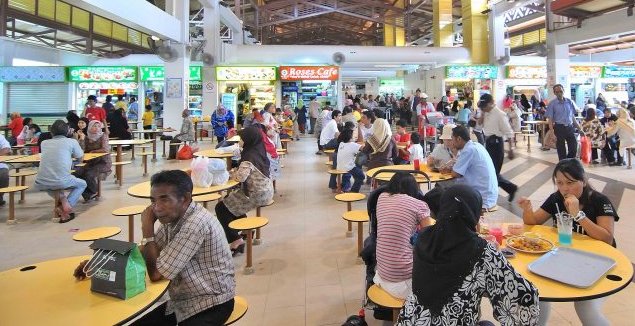
Figure 1: Managed Informality: Structural regulation meeting organic social space. Source: National Heritage Board, Signapore
To build this out into a robust framework for broader informal sector policies, three focal areas are presented: the policy levers that make it work, the economic trade-offs, and how this applies globally to non-food sectors.
2. 1 The Policy Levers of "Managed Informality"
Hawker centers serve as key policy instruments used by governments to transition informal street vendors into structured, regulated micro-enterprises. These policies typically focus on centralizing mobile vendors into permanent facilities, subsidizing rents, enforcing health codes, and balancing social safety nets with cultural preservation.
BOX 3: Core Policy Approaches
Centralization and Zoning: Governments create designated, roofed hubs (hawker centers) to clear street congestion while preserving the socio-economic benefits of informal trading.
Formalization Mandates: Vendors are required to register their businesses, obtain operating licenses, and adopt digital payments or centralized cleaning protocols
Rental Subsidies: To keep food affordable and ensure a decent livelihood, municipalities often subsidize stall rents
Manpower and Anti-Subletting Laws: Strict policies (e.g., in Singapore) require stallholders to personally operate their businesses to prevent rent-seeking and subletting.
The success of hawker centers as illustrated in Table 2, is rooted in a set of policy approaches designed to balance economic opportunity with urban management objectives. A central strategy is the creation of designated, purpose-built trading hubs that consolidate dispersed street vendors into organized locations. This spatial approach reduces congestion in public spaces while retaining the economic and social benefits generated by informal commerce.
Formalization is typically achieved through licensing systems, business registration requirements, and standardized operational practices such as centralized cleaning services and, increasingly, digital payment platforms. To ensure that participation remains accessible to low-income entrepreneurs, many governments subsidize stall rentals and related operating costs.
Additional measures, including restrictions on subletting and requirements that stallholders personally operate their businesses, help prevent speculative rent-seeking and preserve opportunities for genuine micro-entrepreneurs. Together, these policies create a hybrid model that combines the flexibility of informal trading with the safeguards of formal urban governance.
Local governments wanting to replicate this model, will gave to go beyond just building a structure. The success of the hawker center as a policy tool relies on specific, deliberate interventions:
The infrastructure subsidy as social welfare: In places such as Singapore, the National Environment Agency (NEA) heavily subsidizes the physical stalls. Instead of giving direct cash handouts, the state subsidizes the overhead (rent, utility design). This keeps operating costs low enough that vendors can sell a meal for $3-$5 while still making a living wage.
Centralized compliance for economies of scale: Informal vendors usually struggle with hygiene because they lack access to clean running water, proper waste disposal, and cold storage. Hawker centers centralize these. By providing a shared dishwashing service, grease traps, and scheduled deep-cleaning closures, the state handles the heavy operational compliance, allowing the micro-entrepreneur to focus strictly on their craft.
"Graduated" enforcement over criminalization: Instead of raiding illegal street stalls, a managed policy transitions vendors through a carrot-and-stick approach. It offers them a legal, clean space with high foot traffic (the carrot) but enforces strict demerit points for hygiene failures once inside (the stick).
2.2. Structural Comparisons
BOX 4: Regional Policy Frameworks
Singapore:
Governed by the National Environment Agency (NEA), hawker centers act as subsidized community dining rooms. Stringent policies mandate personal presence, prohibit corporate bidding, and control foreign manpower to protect local hawker heritage.
Malaysia:
Initiatives such as the National Policy on Hawkers (See Annex 1 below) seek to upgrade traditional night markets and roaming vendors into structured kiosks, with varying degrees of success across local municipal councils
India:
The Street Vendors Act provides legal protection to the informal sector, mandating town vending committees to establish specific zones and prevent arbitrary evictions.
Indonesia and Thailand:
Policies often balance upgrading infrastructure with the risk of displacing lower-tier vendors who cannot afford the formal operating fees in structured markets.
Across Asia, governments have adopted different policy frameworks to manage and support street vending, reflecting their distinct institutional contexts and development priorities. In Singapore, hawker centers are managed by the National Environment Agency as subsidized community dining spaces. Policies emphasize public health, affordability, and cultural preservation through strict licensing requirements, personal-operation mandates, restrictions on corporate ownership, and controls on foreign labor participation. The result is a highly structured system that treats street food as an essential urban service.
Elsewhere, approaches tend to place greater emphasis on social protection and livelihood security. In Malaysia, the National Policy on Hawkers promotes the gradual transition of traditional markets and roaming vendors into organized kiosks and designated trading areas, although implementation varies among local authorities. In India, the Street Vendors Act 2014 provides legal recognition and protection for street vendors, requiring local authorities to establish vending zones and limiting arbitrary evictions.
Meanwhile, countries such as Indonesia and Thailand continue to pursue a balance between infrastructure upgrading and inclusiveness, seeking to improve urban management without excluding lower-income vendors who may struggle to meet the costs associated with formalized market systems.
Several countries have implemented frameworks that parallel the approach of commonly seen hawker centers in southeast Asia, shifting from a policy of aggressive eviction to legal formalization and spatial integration.
Table 3 outlines how three notable models handle informal street commerce across different socio-economic landscapes.
Table 3: Comparative Policy Matrix
Policy Model
Primary Policy Instrument
Core Operational Mechanism
Spatial Integration Strategy
Infrastructure-Led (e.g., Singapore)
Environmental Public Health Act & Hawker Centres Upgrading Programme
Heavy state-subsidized rents, strict anti-subletting and personal presence mandates, and state-enforced hygiene grading.
High-density consolidation into permanent, purpose-built complexes integrated directly into residential hubs.
Rights-Based (e.g., India)
Street Vendors Act, 2014
40% vendor representation within localized Town Vending Committees (TVCs) and strict legal bans on arbitrary eviction.
Legal mapping of "traditional natural markets" to designate protected vending zones alongside transit and commuter routes.
Area-Based Integration (e.g., South Africa)
Durban Informal Economy Policy, 2001
Recognition of informal traders as legitimate micro-entrepreneurs protected against state asset seizure and exclusion.
Co-location of informal markets within major public transit corridors through the adaptive reuse of existing infrastructure such as flyovers and transport interchanges.
Socio-Economic Safety Net (e.g., Malaysia)
National Policy on Hawkers, 1987
Replacement of crackdowns with flexible temporary licensing, microcredit support, and standardized training programmes.
Integration of night markets (pasar malam) and structured kiosks directly into municipal urban development plans.
2.3 Three Examples of Hawker Centers Policies
BOX 5. Singapore: The Infrastructure-Led Model
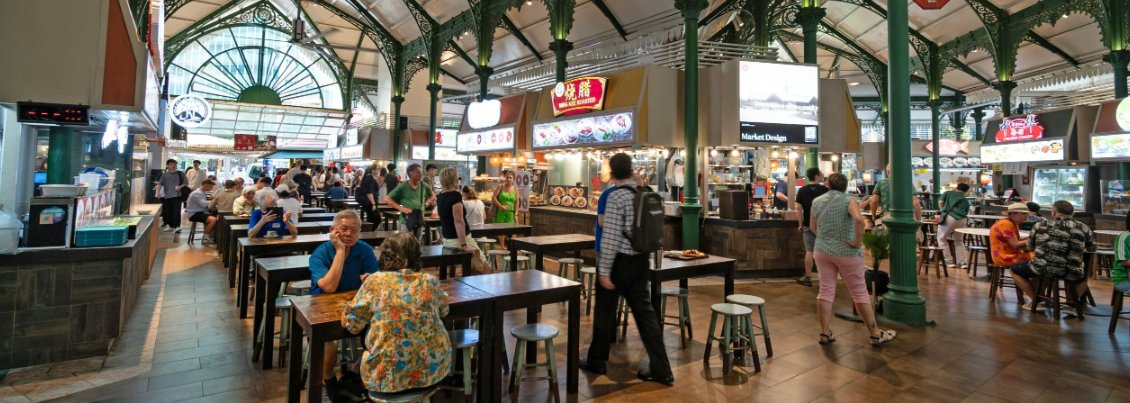
Singapore pioneered the total architectural transition of informal street vending. In the 1960s and 70s, unregulated street hawkers faced severe sanitation, safety, and water pollution challenges. Rather than banning the practice, the state built localized, permanent infrastructure.
The modern Singaporean model relies on high-density spatial consolidation. In the visual above, notice how individual vendors operate from standardized stalls equipped with running water, electricity, and dedicated waste lines, while consumers share a central seating footprint. This setup treats street food as a public utility, prioritizing strict state oversight, mandatory hygiene grading, and subsidized stall rentals.
BOX 6. India: The Rights-Based Model
India's approach is highly legislative and protective. After decades of advocacy, the Supreme Court ruled that street vending is a constitutionally protected right to livelihood. This culminated in the landmark 2014 Street Vendors Act.
India's strategy preserves open-air street culture while managing traffic congestion. The image illustrates a designated Vending Zone, where local authorities provide uniform, modular kiosks aligned carefully off the main thoroughfare.
A key element of India's policy logic is the prohibition of evictions until a comprehensive city-wide vendor survey is conducted, preventing local authorities from arbitrarily clearing "natural markets" where commuter demand is naturally high.
BOX 7. South Africa (Durban): The Area Integration Model
Durban's 2001 policy is globally recognized by urban planners for treating the informal economy as an asset rather than a symptom of underdevelopment. In the post-Apartheid era, Durban integrated thousands of informal traders directly into Warwick Junction, a massive primary transport interchange.
The city redesigned the physical layout-repurposing abandoned highway flyovers into dedicated markets for traditional medicine, clothing, and fresh produce-proving that informal commerce can operate safely alongside heavy urban transit.
The common thread that brings all these: Across all the examples illustrated above, successful hawker policies share a single realization: the informal economy cannot be swept away by urban design; instead, it must be consciously designed into the city fabric.
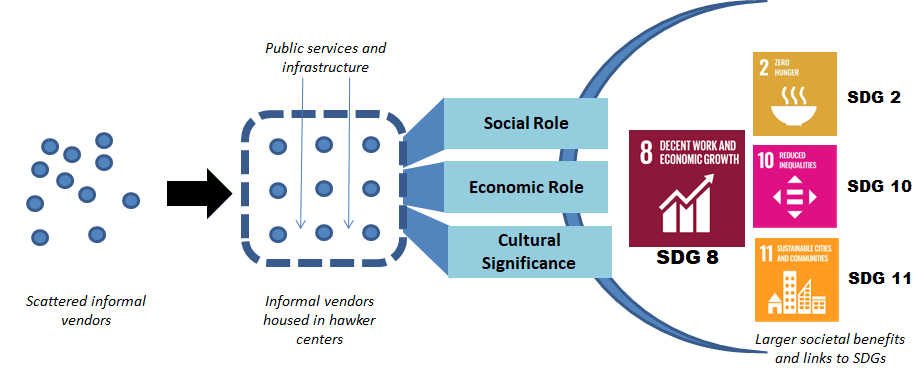
Figure 1: Managed Informality - Hawker Centers
Figure 1 illustrates the core logic of managed informality. Rather than allowing vendors to remain dispersed in unregulated public spaces, governments provide shared infrastructure, public services, and regulatory oversight through purpose-built facilities such as hawker centers. By concentrating informal vendors within a supportive institutional framework, cities can preserve the social, economic, and cultural functions of informal commerce while addressing concerns related to hygiene, safety, and urban management. The result is a model that generates broader societal benefits, contributing to food security (SDG 2), decent work and economic growth (SDG 8), reduced inequalities (SDG 10), and more inclusive and sustainable cities and communities (SDG 11).
3 Expanding Beyond Food: A Blueprint for the Wider Informal Sector
BOX 8: Common Policy Tensions and Challenges
Heritage vs. Livelihoods: Balancing consumer demands for cheap street food with the need for hawkers to earn a decent living amidst rising ingredient and manpower costs.
Aging Workforce: As seen in Singapore, the median age of hawkers is ~60 years. Policies are continuously reviewed to attract younger generations through grants and digital adoption.
Enforcement: Unlicensed "shadow" vending often persists where formalization requirements or licensing fees are too high or rigidly enforced.
Despite their success, hawker centers and similar formalization initiatives face a number of persistent policy tensions and operational challenges. One of the most significant is the need to balance cultural heritage and affordability with the economic realities faced by vendors. Consumers often expect low-cost meals and services, yet rising costs for ingredients, utilities, labor, and compliance can make it increasingly difficult for operators to earn sustainable incomes. Policymakers must therefore find ways to preserve accessibility for the public while ensuring that small entrepreneurs remain financially viable. Table 4 outlines some of the regulatory benefits from the provision of shared infrastructure in managed informality policies.
Table 4: Infrastructure and Benefits of Managed Informality
Sector
Shared Infrastructure
Regulatory Benefit
Food Vendors
Kitchens, waste systems
Hygiene compliance
Mechanics
Tool libraries, oil disposal
Environmental compliance
Artisans
Shared workshops
Safety compliance
Gig Workers
Charging hubs, rest spaces
Worker welfare
Market Traders
Storage facilities
Licensing support
Another growing concern is the aging profile of many hawker communities. In countries such as Singapore, a large proportion of hawkers are approaching retirement age, raising questions about the long-term continuity of traditional food knowledge and family-run enterprises. Governments have responded with grants, training programs, and digitalization initiatives aimed at attracting younger entrants, but succession remains a challenge. At the same time, enforcement continues to be a delicate issue.
Where licensing requirements, operating fees, or regulatory standards become too burdensome, unlicensed "shadow" vending often re-emerges outside the formal system. This highlights a fundamental lesson of managed informality: formalization succeeds only when compliance remains accessible and beneficial to those it is intended to support.
The genius of the hawker center model, however, is that it treats informal workers not as an eyesore to be cleared, but as micro-entrepreneurs who lack infrastructure.
If we apply this framework to other parts of the informal economy, we can envision new and better urban policy models:
The "Hawker Center" for Informal Mechanics and Artisans
In many developing nations, informal auto repair (like the Suame Magazine in Ghana) or textile weaving happens on roadsides, causing environmental hazards. A city could build centralized "industrial hawker centers"-shared mega-workshops with proper oil disposal systems, heavy machinery for rent by the hour, and micro-stalls, bringing safety and environmental compliance without forcing workers into expensive, formal corporate leases.
Digital and Creative Gig Hubs
As the informal sector shifts to the gig economy, delivery drivers and domestic workers lack physical safety nets. Cities could deploy neighborhood micro-hubs-providing secure resting areas, basic mechanics tools for e-bikes, charging stations, and accessible spot-clinics. It formalizes their presence in urban planning without over-regulating their flexible work hours.
The core takeaway of this discussion is that formalization shouldn't mean turning every micro-business into a tax-paying corporation overnight. It means building formal physical platforms that absorb the risks of infrastructure, sanitation, and safety, leaving the worker free to operate with the agility and low costs of the informal sector.
This "policy-leaap" from hawker centers to other broader economic sectors provide us with three operational levers for informal sector policies that make the food hawker centers work:
Economies of Scale by Centralized Compliance: Just as a hawker center provides central grease traps and shared dishwashing , an Industrial Hawker Center handles environmental liabilities (oil disposal traps, hazardous waste lines) that an individual roadside mechanic could never afford.
Infrastructure Subsidies as Social Safety Nets: Instead of taxing or corporate-leasing informal workers into bankruptcy, municipalities can provide the physical platform. For Gig Hubs, for example, this means the city absorbs the overhead of providing secure resting areas and e-bike charging infrastructure , keeping the worker's operating margin viable.
Prohibiting Corporate Rent-Seeking: Borrowing from Singapore's strict anti-subletting laws , these non-food spaces must require personal operation or direct local verification. This prevents real estate speculation from driving out the very micro-entrepreneurs the policy was built to protect.
4 The Way Forward for Managed Informality
The evolution of hawker centers from unregulated street vending to structured community hubs highlights a fundamental truth for modern urban planning: the informal economy cannot be swept away by aggressive design, nor should it be forced into hiding. Historically, municipal governance has defaulted to a binary choice of eradication or hyper-regulation-approaches that routinely push micro-entrepreneurs deeper into poverty and sterilize organic local culture. The true policy innovation lies in the middle ground: a framework of "managed informality".
The central paradox of urban development remains how to formalize an informal economy without destroying its low barriers to entry, affordability, and vital community infrastructure. Resolving this tension requires a paradigm shift in how cities view the informal sector-moving away from treating it as an urban nuisance or a symptom of underdevelopment, and instead recognizing it as an economic asset to be consciously designed into the city fabric.
BOX 9: Common Critiques and Responses
Does formalization eventually increase costs?
Formalization can increase operating costs through licensing requirements, compliance standards, and infrastructure fees. However, successful hawker center models offset these costs through subsidized rents, shared facilities, and public investment, ensuring that vendors can comply with regulations without losing their economic viability.
Can hawker centers become over-regulated?
There is a risk that excessive regulation can undermine the flexibility and entrepreneurial character that make informal economies successful. The challenge is to establish minimum standards for hygiene, safety, and public order while avoiding administrative burdens that discourage participation or innovation.
Are hawker centers vulnerable to gentrification?
As hawker centers become popular cultural and tourist destinations, there is a risk that rising rents, commercialization, and corporate involvement may displace traditional vendors. Long-term affordability measures, anti-subletting policies, and protections for owner-operators are therefore essential to preserve their social and cultural functions.
Do younger generations still want to enter the trade?
Many countries face an aging hawker population, with younger people often perceiving hawking as physically demanding and less prestigious than other occupations. Governments and industry organizations have responded with training programmes, start-up grants, digital payment systems, and branding initiatives aimed at making the profession more attractive and economically sustainable for new entrants.
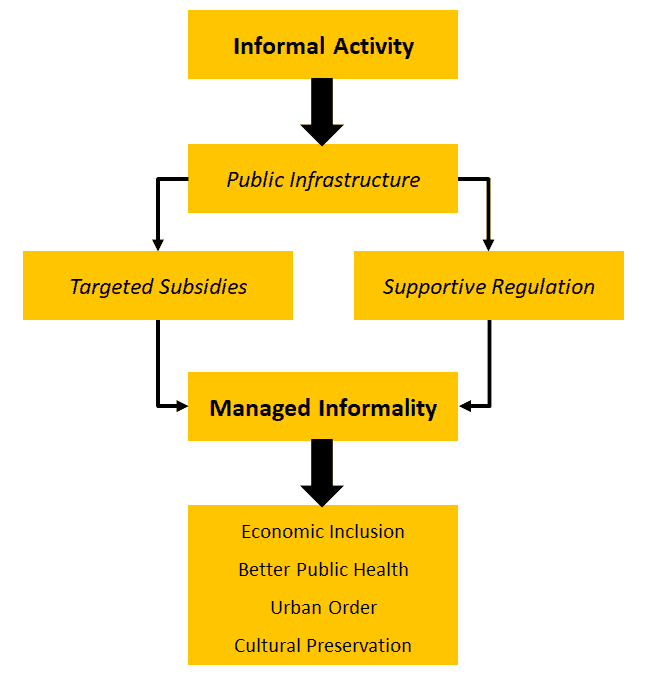
Figure 2: The Policy Flow for Managed Informality
4.1 Key Policy Implications
Moving forward, the success of the hawker center model offers a replicable blueprint for broader urban informal sector policies across three distinct pillars:
Redefining Formalization via Platforms: Formalization should no longer mean turning every micro-business into a tax-paying corporate entity overnight. Instead, municipalities must act as platform providers, constructing formal physical spaces that absorb the heavy structural risks of infrastructure, sanitation, compliance, and safety. This leaves the individual worker free to operate with the flexibility, low overhead, and competitive agility inherent to the informal sector.
Cross-Sector Adaptation: The foundational levers of this model-subsidized shared infrastructure, centralized compliance economies of scale, and protective zoning-are highly transferable. Whether applied to industrial auto-repair collectives, artisan manufacturing zones, or neighborhood micro-hubs for digital gig-economy workers, providing targeted space and baseline infrastructure legitimizes vulnerable livelihoods while mitigating public hazards.
Safeguarding Long-Term Resilience: For managed informality to remain sustainable, policies must proactively address generational and financial fractures. This requires balancing consumer demands for low-cost services with fair livelihoods for operators, creating active transitions to attract younger generations, and implementing strict anti-speculation frameworks to prevent corporate interests from pricing out the original community.
Ultimately, the way forward is not to eradicate the informal spirit, but to build for it. By providing the structural scaffolding-the roofs, the clean water lines, the legal protections, and the shared utilities-cities can cultivate safer, more resilient, and deeply inclusive urban ecosystems without sacrificing the organic vibrancy that defines them.
This work by GDRC is licensed under a Creative Commons
Attribution-ShareAlike 4.0 International License. You are free to share and adapt this piece of work for your own purposes, as long as it is appropriately cited.
More info: http://creativecommons.org/licenses/by-sa/4.0/
on


 Singapore:
  Malaysia:
  India:
 Indonesia and Thailand: