Abstract
The digital age has made information widely available, often in overwhelming volumes. While this abundance eliminates the traditional excuse of poor decisions caused by lack of information, it introduces new challenges. The key issue is no longer gathering information, but accessing the right information at the right time and transforming it into knowledge that supports effective decision-making.
This viewpoint explores the distinction between accessing information and acquiring knowledge, emphasizing the dual dimensions of technology and information management. It argues that true knowledge emerges from value-adding processes that contextualize and enrich information, enabling users to make informed, timely, and context-sensitive decisions.
Keywords
Information access, Knowledge management, Decision-making, Information overload, Value addition, Information technology, Contextualization, Information systems
I
t used to be traditional to blame bad
decisions with lack of foresight and risk averse leadership. Both
reasons have at their core a lack of information that cumulatively led
to the bad decision being taken in the first place. But with the advent
of advanced computing power, and the networking enabled by the Internet,
this reason, of lack of information, no longer holds water. The
information is there, collected in sometimes repetitive, overlapping
cycles.
Every organization produces reports, manuals, guidelines and databases. Yet people still struggle to solve problems because information alone is not enough. The challenge is converting information into knowledge, and knowledge into action. This document explores how different forms of output contribute to that transformation.
The issue is therefore no longer a lack of it, but more of accessing and
finding the right info at the right time - to be delivered to the right
target. The challenge is to match an information need with an
appropriate resource.
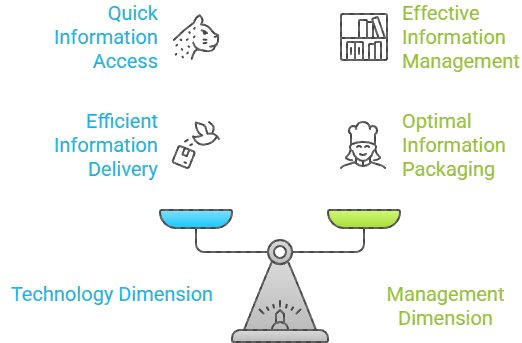
This challenge focuses our attention on two key aspects are:
Accessing information - covering the technology dimension. How do
we ensure that a decision-maker, in need of information to choose
between alternatives and take a decision, is provided that info? How can
the information be provided? The question is one of technology - how
can a decision-maker access information quickly and efficiently?
Finding information - covering the management dimension. With the
advent of the Internet comes a new expression - information overload -
of an overwhelming volume of information being delivered without
sufficient disseminative justification. How can information be managed
better - packaged better - to facilitate effective decision-making? Is a
200-page folder detailing the entire activity necessary to take a
decision to initiate it (for the deicision-maker)? Or is a one-pager
with a bulleted list giving the salient points sufficient?
Figure 1: Balancing Technology and Management in Decision Making
Knowledge is a construct that is created in the mind of the user, as a
result of the cycle of accessing, processing and understanding
information.
But providing and ensuring access to information per se will not
complete the knowledge cycle. Quite clearly, it is the opportunity for
value adding to information given to the user, which leads to generation
of knowledge and understanding. Thus along with the provision of access
to information, lies the need to create a two-way flow of opportunities
to generate knowledge.
From information to knowledge
It is essential to recognize that knowledge is not simply a collection of facts or data. Knowledge is a construct formed in the mind of the user as a result of accessing, processing, internalizing, and understanding information. The act of providing access to information, in itself, does not complete the knowledge cycle.
What truly matters is the opportunity for value addition, that is, the processes through which information is interpreted, enriched, and applied in context. It is this that transforms information into knowledge and, eventually, into wisdom that guides sound decision-making.
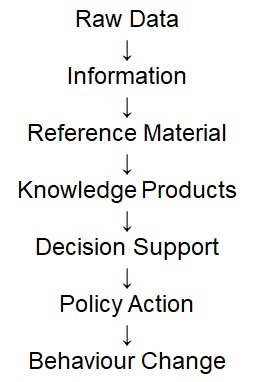
Figure 2: Transforming Information into Knowledge Figure 3: Knowledge Output Continuum
In a continuum of information and knowledge products, in order for the user to be funneled from information access to "true" knowledge [Figure 2], the presentation format and complexity should enable the user to move one step further along the output continuum [Figure 3].
Value addition takes two key forms:
Opportunities for users to "attach" their experiences, insights, and contextual information to the information they are accessing, thereby enriching the applicability of the information and knowedge they gain.
Opportunities to localize and adapt information to the specific environment in which the user operates, ensuring relevance and usability.
It is this dynamic, interactive, and reciprocal process, where information is both consumed and enriched, that leads to genuine knowledge creation. Only when we foster such an environment can information truly empower decision-makers and drive meaningful action.
On one hand are value-adding opportunities for the user to contribute
experiences, insights and related information to the information being
accessed. On the other are opportunities to contextualize and localize
the information being accessed to the environment within which the user
works.
It is this value-adding, interactive give-and-take that leads to the generation of real knowledge.
Conclusion
Knowledge outputs are far more than reports or publications. They are tools for communicating ideas, supporting decisions, transferring experience, and enabling action. Choosing the right type of output is therefore as important as the quality of its content. A well-designed fact sheet can often be more effective than a lengthy report, just as a concise checklist may achieve greater impact than a detailed manual.
Every knowledge output occupies a unique place along the pathway from information to action. Whether it is a concept note, a policy brief, a toolkit, a case study, or a repository, each serves a distinct purpose and a particular audience. Understanding these differences enables organizations to package knowledge more effectively, communicate with greater clarity, and maximize the impact of their work.
The ultimate goal is not simply to produce documents, but to create knowledge products that people can understand, trust, adapt and use. Well-designed outputs transform information into insight, insight into decisions, and decisions into meaningful action. That is the true measure of successful knowledge management.


 The issue is therefore no longer a lack of it, but more of accessing and
finding the right info at the right time - to be delivered to the right
target. The challenge is to match an information need with an
appropriate resource.
The issue is therefore no longer a lack of it, but more of accessing and
finding the right info at the right time - to be delivered to the right
target. The challenge is to match an information need with an
appropriate resource.