Enhancing Urban Governance:
Integrating Multi-stakeholder Analysis into the GET Matrix
 |
Hari Srinivas |
| Policy Analysis Series E-213 |

|
Abstract: Urban governance faces multifaceted challenges that require inclusive and adaptive policy frameworks to ensure sustainable development. This document proposes integrating multi-stakeholder analysis into the GET Matrix - a structured framework examining Governance, Education, and Technology across global, national, and local levels. By systematically engaging diverse stakeholders, including governments, businesses, civil society, and academia, the GET Matrix enhances policy decision-making, fostering collaboration and innovation. Case studies from cities such as Singapore, Tokyo, and Jakarta illustrate how this approach addresses issues such as climate adaptation, disaster resilience, and digital transformation. The proposed methodology, encompassing stakeholder mapping, engagement strategies, scenario testing, and continuous monitoring, ensures that urban policies are inclusive, evidence-based, and adaptable to evolving challenges. Ultimately, embedding multi-stakeholder analysis into the GET Matrix promotes sustainable, equitable, and resilient urban governance. |
|
Keywords: Urban governance, multi-stakeholder analysis, GET Matrix, sustainable development, stakeholder engagement, policy framework, smart cities, urban resilience. |
1. Introduction
U
rban governance is a complex process involving multiple stakeholders with diverse interests, roles, and levels of influence. Effective policy analysis requires a structured approach to stakeholder engagement to ensure inclusive and sustainable urban development. The GET Matrix - focusing on Governance, Education, and Technology across global, national, and local levels-provides a comprehensive framework for analyzing urban policies. This document integrates multi-stakeholder analysis into the GET Matrix to enhance policy decision-making in urban governance.| Multi-stakeholder analysis is a research process that involves multiple groups with an interest in a project or outcome. The goal is to ensure that the views of key stakeholders are heard and considered when making decisions. |
Modern cities face pressing challenges such as climate adaptation, mobility management, and digital governance. Addressing these issues requires a structured policy framework that aligns governance, education, and technology.
A notable example is Singapore's Smart Nation initiative, which integrates multi-stakeholder participation into urban planning through public-private collaboration and citizen engagement. Similarly, Tokyo's urban resilience strategy engages multiple stakeholders to enhance disaster preparedness, using a combination of policy regulations, educational programs, and technological innovations.
Multi-stakeholder engagement ensures that urban policies are responsive, inclusive, and evidence-based. However, achieving this requires a robust analytical framework. The GET Matrix provides a structured way to assess governance challenges at different levels while incorporating the perspectives of diverse stakeholders.
For example, cities such as Jakarta and Bangkok have leveraged multi-tiered governance structures to address flooding and pollution issues effectively. By embedding stakeholder engagement into urban planning, policies can be both sustainable and adaptable to evolving urban challenges.
2. What is the GET Matrix?
The GET Matrix is a structured framework that analyzes policies and initiatives across three key dimensions:- Governance (Policies and Regulations)
- Education (Capacity Building and Awareness)
- Technology (Infrastructure and Innovation)
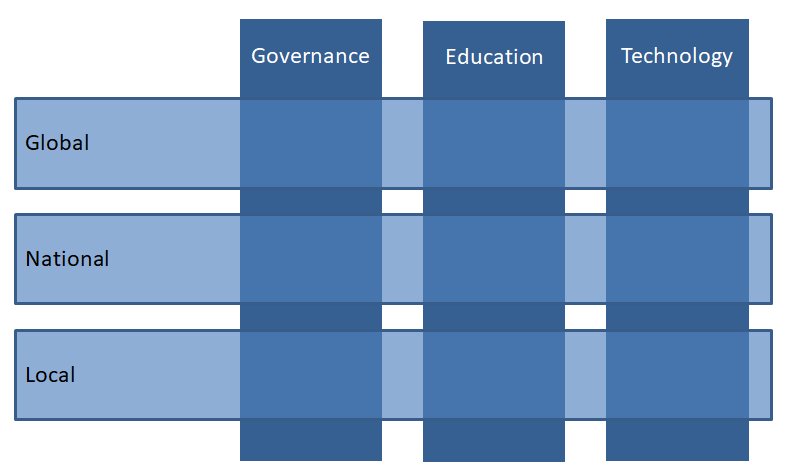
Figure 1: The GET Matrix
This 3x3 matrix helps assess how governance, education, and technology interact at different levels to address complex issues, such as sustainability, disaster risk reduction, or urban development. It also serves as a tool to identify policy gaps, enhance coordination among stakeholders, and improve decision-making.
For example, in urban governance, the GET Matrix can be used to analyze smart city policies by examining:
- Governance: National policies, municipal regulations, and global urban sustainability agreements.
- Education: Public awareness campaigns, urban planning education, and community training programs.
- Technology: Smart infrastructure, AI-driven governance tools, and IoT-based urban services.
3. The GET Matrix Framework
The GET Matrix is structured as follows:
| Stakeholder Level | Governance (Policies and Regulations) | Education (Capacity Building and Awareness) | Technology (Infrastructure and Innovation) |
|---|---|---|---|
| Global | UN-Habitat, World Bank, international agreements on urban governance | Global think tanks, academic networks on urban sustainability | Smart city innovations, AI-driven governance tools |
| National | National government policies, urban development strategies | Universities, research institutes, public awareness campaigns | National-level smart infrastructure, digital governance |
| Local | Municipal governments, city councils, local planning laws | Community workshops, citizen engagement programs | Localized IoT solutions, digital public services |
Expanding this framework allows for a detailed examination of how urban policies interact with education and technological advancements at different levels. For instance, Bangkok's smart city initiative illustrates how national policies influence local infrastructure, with urban sensors improving transport management and energy efficiency.
Similarly, Tokyo's waste reduction policies integrate regulatory measures, educational programs, and digital tracking of waste streams to minimize environmental impact.
4. Integrating Multi-stakeholder Analysis
A good methodology for conducting a multi-stakeholder analysis in an urban setting should systematically identify, categorize, and engage different stakeholders to assess their interests, influence, and roles in urban governance. Here's a structured approach you could incorporate into GDRC's Urban Governance programme:
| Step 1 | Stakeholder Mapping |
A well-defined stakeholder mapping process ensures that all key actors are identified at different levels of governance. This step is critical to understanding who influences urban policy and how they interact. Stakeholders include:
- Government: Local authorities, urban planning agencies, regulatory bodies.
- Business and Industry: Real estate developers, technology providers, private investors.
- Civil Society: NGOs, community groups, grassroots organizations, residents.
- Academia and Research Institutions: Universities, policy think tanks, independent researchers.
- Media: Traditional and digital media outlets, social influencers.
- International Organizations: UN agencies, development banks, donor agencies.
This mapping approach has also been applied in Melbourne's green infrastructure initiatives, where environmental groups, urban planners, and local businesses work together to expand urban green spaces.
| Step 2 | Power-Interest Grid |
Categorizing stakeholders based on their level of influence and interest in governance, education, and technology helps prioritize engagement efforts.
| Influence / Interest | High Interest | Low Interest |
|---|---|---|
| High Influence | Key decision-makers (Governments, large businesses, major NGOs) | Policy enablers (Think tanks, media, funding agencies) |
| Low Influence | Local communities, citizen groups | Passive observers (General public, low-engagement stakeholders) |
For example, in Hong Kong's smart mobility plan, high-influence stakeholders such as the Transport Department and major transport companies drive key decisions, while community groups advocate for improved pedestrian-friendly policies.
In Manila's informal settlement upgrading projects, community organizations play a crucial role in influencing policies by actively engaging with governmental agencies and urban planners.
| Step 3 | Engagement Strategies |
Developing tailored engagement strategies ensures that different stakeholders are involved appropriately.
- Consultative Engagement: Public forums, policy roundtables, expert panels. Example: Melbourne's participatory urban planning process, which involves public consultations and feedback loops.
- Collaborative Partnerships: Joint research projects, multi-sector task forces. Example: Seoul's public-private partnerships in smart city development, where companies and government agencies co-develop solutions.
- Participatory Mechanisms: Crowdsourced policymaking, digital civic engagement platforms. Example: Taiwan's online civic participation platform , which enables citizens to propose and refine policies.
- Capacity Building: Training programs, awareness campaigns, policy simulations. Example: India's urban climate resilience workshops, which equip local officials with tools to manage climate risks.
| Step 4 | Policy Scenario Testing |
Testing different policy scenarios helps refine urban strategies:
- Identify Potential Impacts: Use simulation models to predict stakeholder responses.
- Synergy and Conflict Analysis: Determine how policy changes affect various stakeholders.
- Feedback Loops: Incorporate iterative reviews to ensure policy adaptation.
Similarly, Tokyo's disaster preparedness programs leverage simulations to enhance stakeholder coordination in earthquake response strategies.
| Step 5 | Monitoring and Evaluation |
Implementing continuous feedback mechanisms enhances policy effectiveness:
- Key Performance Indicators (KPIs): Define measurable indicators for governance, education, and technology.
- Stakeholder Surveys: Regularly assess public satisfaction and policy impact.
- Adaptive Frameworks: Ensure flexibility in urban governance based on evolving challenges.
In Bangkok's air quality monitoring initiative, IoT-enabled sensors collect data to engage both policymakers and residents in addressing pollution concerns.
5. Case Studies from the Asia-Pacific Region
Several cities in the Asia-Pacific region have successfully integrated multi-stakeholder analysis into their urban governance frameworks:- Singapore's Smart Nation Strategy: A holistic digital transformation program involving government, business, and academia.
- Bangkok's Air Quality Monitoring Initiative: Uses IoT sensors to engage citizens and policymakers in reducing pollution.
- Jakarta's Flood Early Warning System: A collaborative effort between the government, international organizations, and local communities.
- Tokyo's Disaster Resilience Framework: Strengthens stakeholder participation in urban planning to enhance earthquake preparedness.
- Melbourne's Green Infrastructure Strategy: Promotes cooperation among municipalities, businesses, and environmental groups to expand green spaces.
5. Conclusion
| By embedding multi-stakeholder analysis into the GET Matrix, urban governance can become more inclusive, adaptive, and sustainable. The structured approach outlined in this document ensures that governance, education, and technology-driven solutions work in harmony across different levels of policymaking. |
The integration of multi-stakeholder analysis into the GET Matrix offers a transformative approach to urban governance, enabling cities to address complex challenges in a more inclusive and sustainable manner. By systematically engaging diverse stakeholders-ranging from governments and businesses to civil society and academia-the GET Matrix ensures that urban policies are responsive to the needs and aspirations of all relevant actors.
This approach not only enhances the legitimacy of decision-making but also fosters collaboration and innovation across governance, education, and technology dimensions. Case studies from cities such as Singapore, Tokyo, and Jakarta demonstrate how multi-stakeholder engagement can lead to effective solutions for issues such as climate adaptation, disaster resilience, and digital transformation.
By embedding stakeholder perspectives into the policy process, the GET Matrix becomes a dynamic tool for aligning global, national, and local priorities, ensuring that urban development strategies are both adaptable and forward-looking.
Moreover, the structured methodology for multi-stakeholder analysis-encompassing stakeholder mapping, power-interest grids, tailored engagement strategies, scenario testing, and continuous monitoring-provides a robust framework for addressing the complexities of urban governance. This approach not only identifies policy gaps and synergies but also builds trust and accountability among stakeholders.
For instance, initiatives such as Bangkok's air quality monitoring and Melbourne's green infrastructure projects highlight the importance of collaborative partnerships and participatory mechanisms in achieving sustainable outcomes. By leveraging the GET Matrix, cities can create policies that are not only evidence-based but also resilient to evolving urban challenges. Ultimately, the integration of multi-stakeholder analysis into the GET Matrix paves the way for more inclusive, adaptive, and sustainable urban governance, ensuring that cities remain livable and equitable in the face of rapid urbanization and global change.
Further reading:
- Arnstein, S. R. (1969). A ladder of citizen participation. Journal of the American Planning Association, 35(4), 216-224. https://doi.org/10.1080/01944366908977225
- Asian Development Bank (ADB). (2020). Urban development in the Asia-Pacific: Challenges and opportunities. Asian Development Bank. https://www.adb.org
- Batty, M. (2018). Artificial intelligence and smart cities. Environment and Planning B: Urban Analytics and City Science, 45(1), 3-6. https://doi.org/10.1177/2399808317751169
- OECD. (2019). Making decentralisation work: A handbook for policy-makers. Organisation for Economic Co-operation and Development. https://www.oecd.org
- OECD. (2020). Cities policy responses to climate change. Organisation for Economic Co-operation and Development. https://www.oecd.org
- Reed, M. S., Graves, A., Dandy, N., Posthumus, H., Hubacek, K., Morris, J., Prell, C., Quinn, C. H., and Stringer, L. C. (2009). Stakeholder participation for environmental management: A literature review. Biological Conservation, 141(10), 2417-2431. https://doi.org/10.1016/j.biocon.2009.07.013
- Smart Nation and Digital Government Office (SNDGO). (2021). Smart Nation: The way forward. Government of Singapore. https://www.smartnation.gov.sg
- Tokyo Metropolitan Government. (2019). Tokyo Resilience Project: Building a disaster-resilient city. Tokyo Metropolitan Government. https://www.metro.tokyo.lg.jp
- UN-Habitat. (2016). Urbanization and development: Emerging futures. World Cities Report. United Nations Human Settlements Programme. https://unhabitat.org
- UN-Habitat. (2020). The New Urban Agenda. United Nations Human Settlements Programme. https://unhabitat.org
- United Nations. (2015). Sustainable Development Goals (SDGs): Goal 11 - Sustainable cities and communities. United Nations. https://sdgs.un.org
- UNESCAP. (2018). Smart cities in Asia-Pacific: A framework for inclusive urban development. United Nations Economic and Social Commission for Asia and the Pacific. https://www.unescap.org
- World Bank. (2017). Enhancing urban resilience: A guide to urban governance. World Bank. https://www.worldbank.org
- World Bank. (2020). Smart cities for all: A vision for inclusive urban transformation. World Bank. https://www.worldbank.org
|
|

 |
Return to the Urban Governance page Comments and suggestions to - [email protected] |