
Urban Rewilding
Introductory Note on Urban Rewilding
Hari Srinivas One-Pager Series C-080
Abstract:
This extended introductory note on urban rewilding provides a comprehensive overview of the concept, its dimensions, and its practical applications in cities. It defines urban rewilding as the process of reintroducing natural elements and ecological processes into built environments to restore balance, enhance biodiversity, and improve human well-being. The document explains how rewilding transforms underused or degraded urban spaces into functioning ecosystems through actions such as planting native species, creating wildlife corridors, and adopting sustainable landscape design.It highlights key benefits including biodiversity conservation, ecosystem services such as air and water purification, climate resilience through heat and flood mitigation, and improved quality of life via enhanced mental and physical health. The note also emphasizes the importance of governance, collaboration, and context-specific strategies, illustrating how partnerships among planners, communities, and institutions are essential for success. Overall, it positions urban rewilding as a flexible, scalable, and integrative approach to building resilient, livable, and sustainable cities.
Keywords:
urban rewilding, biodiversity conservation, ecosystem services, climate resilience, green infrastructure, community well-being, ecological restoration, urban governance
Urban rewilding is a concept and practice that involves reintroducing elements of nature into urban environments, with the aim of restoring ecological balance, enhancing biodiversity, and improving the overall well-being of both human and non-human inhabitants of cities. It is a response to the loss of natural habitats and green spaces caused by urbanization.
Urban rewilding typically involves transforming underutilized or degraded urban areas, such as abandoned lots, rooftops, or industrial sites, into thriving ecosystems that mimic natural habitats.
This process often includes planting native vegetation, reintroducing native species of plants and animals, creating wildlife corridors, and implementing sustainable landscape design techniques.
Dimensions of Urban RewildingThere are a number of beneficial components of urban rewilding, including, for example biodiversity conservation - By reintroducing native plants and animals, urban rewilding aims to support a diverse range of species and promote their survival within urban areas.
Urban rewilding projects also provide ecosystem services - By creating green spaces and restoring natural habitats, rewilding projects can contribute to improved air quality, water management, temperature regulation, and overall ecological functioning.
Urban parks that result from rewilding also create well-being among a city's residents - Urban rewilding acknowledges the positive effects of nature on human health and well-being. Access to green spaces and exposure to natural elements have been linked to reduced stress, improved mental health, increased physical activity, and enhanced community cohesion.
Climate resilience is another benefit from urban rewilding - Rewilded urban areas can help cities adapt to climate change by mitigating the effects of heat islands, reducing stormwater runoff, and sequestering carbon dioxide.
Rewilding creates habitats for native plants, birds, insects, and small mammals that are often displaced in heavily built-up areas. By restoring natural corridors and green spaces, cities can support richer species diversity and help protect local ecosystems from further decline. Urban rewilding helps mitigate its impacts by increasing tree and vegetation cover, which absorbs carbon dioxide and reduces the urban heat island effect. Green spaces also improve water absorption, lowering flood risks during extreme weather events, and contribute to more resilient urban ecosystems. Rewilded areas provide accessible natural spaces that promote mental and physical well-being. Residents benefit from cleaner air, recreational opportunities, and a stronger connection to nature, which can reduce stress and foster community engagement. Urban rewilding projects can take various forms, ranging from small-scale community gardens and rooftop green spaces to large-scale restoration projects in vacant lots or along riverbanks. The exact approach depends on the available space, local context, and community involvement. Collaborative efforts between urban planners, environmental organizations, local communities, and government bodies are often necessary to implement successful urban rewilding initiatives.
Why Urban Governance and Rewilding?
Urban rewilding is important for urban governance as it promotes sustainable development, environmental stewardship, climate change adaptation, community engagement, and the well-being of urban residents.
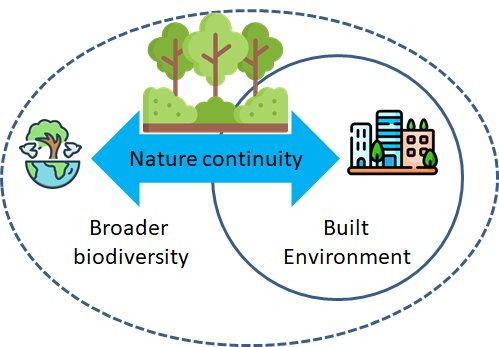
Figure 1: Continuity in Nature
Figure 1 illuatrates nature continuity as a dynamic connection between built and natural environments. Rewilding urban areas involves reestablishing this continuum to allow nature to thrive across spatial and administrative boundaries.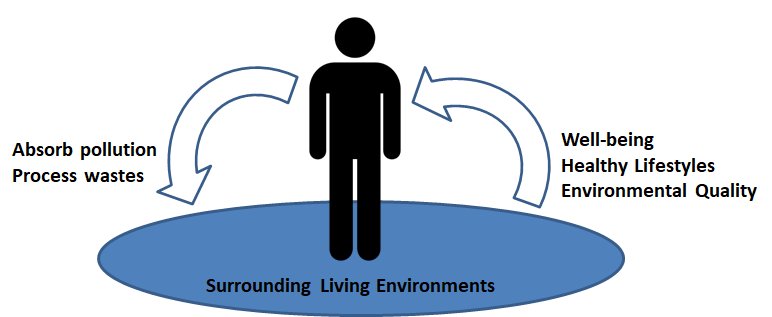
Figure 2: Human lifestyles
Figure 2 illustrates the fact that rewilding is not only about restoring nature, but also about reshaping how people engage with their environments. The two-way arrows reflect the feedback loop between human behavior and the quality of urban ecological spaces. By integrating rewilding principles and practices into urban governance frameworks, cities can effectively address environmental challenges, enhance resilience, and create healthier and more sustainable urban environments - and ultimately improve urban quality of life.
This work by GDRC is licensed under a Creative Commons Attribution-ShareAlike 4.0 International License. You are free to share and adapt this piece of work for your own purposes, as long as it is appropriately citied. . More info: http://creativecommons.org/licenses/by-sa/4.0/
on



 |
Return to Urban Rewilding Contact: |