
Urban Capacity Building Framework:
|
 |
Hari Srinivas |
| Policy Tools Series C-114 |

|
Abstract: This framework is developed for city governments, development agencies and civil society organizations to identify capacity gaps and design targeted capacity building strategies. |
|
Keywords: capacity building, urban governance, policy tools, institutional development, organizational strengthening, human resource development, urban management, sustainable cities |
Cities face a wide range of complex development challenges, from environmental management and infrastructure provision to climate resilience and housing. Addressing these challenges effectively requires more than technical solutions. It requires strengthening the capacities of the institutions, organizations and individuals responsible for planning, implementing and managing urban systems.
Capacity building can be understood through three interconnected dimensions. Human capacity focuses on the skills, knowledge and competencies of individuals. Organizational capacity refers to the systems, structures and management processes that enable institutions to function effectively. Institutional capacity encompasses the policies, legal frameworks and governance mechanisms that guide decision making and create an enabling environment for action.
The framework below links these three dimensions of capacity with key urban issues and the stakeholders involved in addressing them. It can be used as a diagnostic and planning tool to identify where capacity gaps exist and to design targeted interventions for strengthening urban governance and management.
Each urban issue involves multiple actors, including municipal governments, community organizations, private sector operators and civil society groups. For these actors to respond effectively, individuals must possess the necessary skills and knowledge, organizations must have the systems and structures to coordinate action, and the broader policy environment must provide clear rules, incentives and guidance.
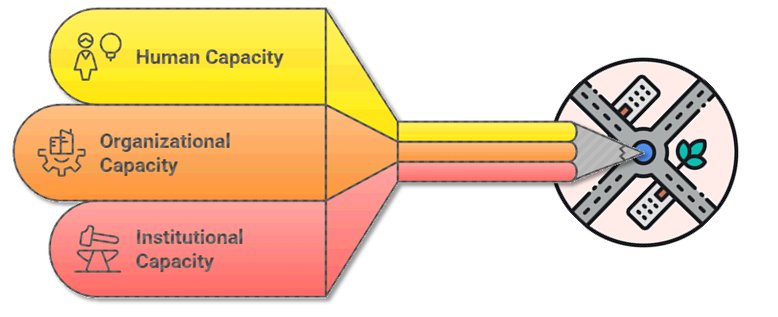
The table therefore serves as a diagnostic and planning tool. By examining a specific urban issue through these three dimensions of capacity, policy-makers and practitioners can identify where capacity gaps exist. For example, a city may have well trained professionals but weak institutional regulations, or strong policies but insufficient organizational coordination to implement them. The framework helps decision makers recognize these imbalances and design capacity building programmes that strengthen the entire system rather than focusing on a single element.
| Urban Issue | Key Stakeholders | Human Capacity (skills, knowledge) | Organizational Capacity (systems, management) | Institutional Capacity (policies, frameworks) |
|---|---|---|---|---|
| Urban environmental management | Municipal governments, environmental agencies, community groups | Environmental assessment, monitoring techniques, community education | Environmental management units, inter-agency coordination systems | Environmental regulations, compliance mechanisms, urban sustainability policies |
| Water supply and sanitation | Municipal utilities, water user groups, NGOs | Technical maintenance, water quality management, community outreach | Utility management systems, service delivery mechanisms | Water governance frameworks, tariff policies, service standards |
| Solid waste management | Municipal departments, private contractors, informal recyclers | Waste segregation practices, recycling methods, logistics planning | Integrated waste collection systems, recycling networks | Waste regulations, producer responsibility policies |
| Urban planning and land management | City planners, developers, community organizations | Participatory planning skills, GIS and spatial analysis | Urban planning departments, land information systems | Land use regulations, zoning laws, development control frameworks |
| Housing and informal settlement upgrading | Local authorities, NGOs, community groups | Community mobilization, housing design, project management | Housing support programmes, community development organizations | Housing policies, land tenure regulations, slum upgrading policies |
| Disaster risk reduction | Municipal authorities, emergency services, local communities | Risk assessment, preparedness training, emergency response | Disaster management agencies, coordination platforms | Disaster management legislation, risk reduction strategies |
| Urban transport management | City transport agencies, private operators, planners | Transport planning, traffic management, mobility analysis | Integrated transport authorities, operational management systems | Transport policy frameworks, regulatory mechanisms |
| Climate change and urban resilience | City governments, research institutions, civil society | Climate risk analysis, adaptation planning, public awareness | Climate action units, cross-sector coordination mechanisms | Climate action plans, resilience strategies, sustainability regulations |
 Participatory Slum Upgrading - Thailand Participatory Slum Upgrading - Thailand
Thailand's Baan Mankong housing programme demonstrates how capacity building at multiple levels can support inclusive urban development. Community groups were trained in planning, financial management and housing design, strengthening human capacity at the grassroots level. Community cooperatives and support organizations were established to coordinate upgrading activities, building organizational capacity. At the national level, government policies and financing mechanisms enabled communities to access infrastructure and land tenure, reflecting strengthened institutional capacity. The combination of these capacities allowed thousands of low income households to improve housing conditions through community driven development. |
 Bus Rapid Transit Systems - Colombia Bus Rapid Transit Systems - Colombia
The development of the TransMilenio Bus Rapid Transit system in Bogota required strong capacity building across several dimensions. Transport planners and engineers developed expertise in integrated public transport planning, enhancing human capacity. A specialized transport management authority was created to coordinate operations and infrastructure, strengthening organizational capacity. At the same time, regulatory frameworks and urban transport policies were introduced to guide private operators and integrate transport planning with land use policy, demonstrating strengthened institutional capacity. |
 Community Based Waste Management - Philippines Community Based Waste Management - Philippines
In several cities in the Philippines, including San Fernando and Quezon City, community based solid waste management programmes were introduced following national waste legislation. Local residents and community leaders received training in waste segregation, composting and environmental education, building human capacity. Barangay level waste management committees and collection systems improved organizational capacity for service delivery. These efforts were supported by the Ecological Solid Waste Management Act, which created the institutional framework for waste segregation and recycling at local levels. |
 Urban Climate Resilience - Bangladesh Urban Climate Resilience - Bangladesh
Cities such as Dhaka and Khulna have developed climate adaptation initiatives to address flooding and extreme weather. Technical training in climate risk assessment and urban resilience planning strengthened human capacity within municipal governments and research institutions. City resilience units and coordination mechanisms were created to manage climate related programmes, enhancing organizational capacity. National climate policies and international funding mechanisms provided the broader institutional framework supporting these efforts. |
 Participatory Urban Governance - Brazil Participatory Urban Governance - Brazil
The city of Porto Alegre became internationally known for its participatory budgeting process, which allows citizens to directly influence municipal spending priorities. The process required extensive human capacity building, as community members, civil society organizations and municipal staff were trained to participate in budgeting discussions, understand financial planning and engage in constructive dialogue. New participatory councils and deliberative forums were created within the municipal administration, strengthening organizational capacity for citizen engagement. These processes were supported by municipal regulations that formalized public participation in budget decisions, providing an institutional framework that embedded participatory governance within the city's decision making structure. |
 Water Supply Management - India Water Supply Management - India
In the city of Ahmedabad, initiatives to improve water supply and service delivery combined infrastructure development with institutional reforms and community engagement. Municipal engineers and planners received training in water system management and service monitoring, strengthening human capacity within the city's utilities. The Ahmedabad Municipal Corporation improved internal coordination and service management systems, building stronger organizational capacity for water distribution and maintenance. At the same time, policy reforms introduced new approaches to water pricing, service standards and accountability, reinforcing the institutional capacity needed to sustain improved service delivery and urban water governance. |
Capacity building is ultimately about enabling cities and communities to manage their own development effectively and sustainably. As the examples from different developing country contexts illustrate, successful urban initiatives rarely depend on infrastructure or funding alone.
They emerge when knowledgeable people work within capable organizations and supportive institutional frameworks. By viewing urban development through the combined lenses of human, organizational and institutional capacity, cities can design more resilient, inclusive and sustainable approaches to managing the complex challenges of urbanization.
|
|
 |
Return to the Capacity Building page Contact: Hari Srinivas - [email protected] |
