Abstract:
This document presents a comprehensive framework for Urban Environmental Management (UEM), positioning cities as dynamic systems shaped by the interaction of natural, built, and socio-economic environments. It introduces the "blue, green, brown, and gray" agendas as an integrative lens to understand urban sustainability, alongside six core environmental challenges: air, water, land, waste, food security, and urban risks.
By linking these agendas and challenges to a set of policy principles, the document outlines a coherent approach for managing urban systems in a holistic and coordinated manner.
It further highlights emerging trends such as digitalization, climate resilience, circular economy, nature-based solutions, and social inclusion, emphasizing the need for adaptive and forward-looking strategies. Together, these elements provide a conceptual and practical foundation for advancing sustainable, resilient, and inclusive cities.
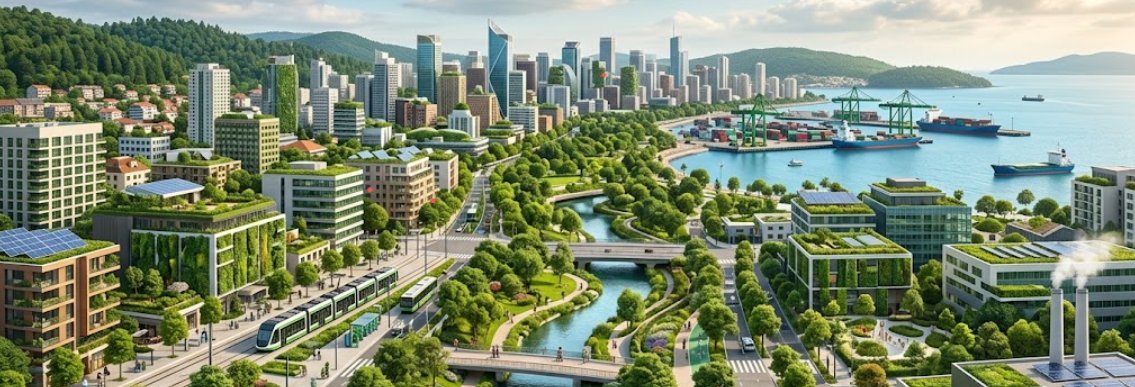
Infographic source: GDRC concept; diagram visualised with AI tools and edited by author
Keywords:
Urban Environmental Management, Sustainable Cities, Blue Green Brown Gray Agendas, Urban Systems, Environmental Policy, Circular Economy, Climate Resilience, Urban Sustainability
1. Introduction
Cities today stand at the center of global environmental change. They are hubs of economic activity, innovation, and cultural exchange, but also focal points of resource consumption, waste generation, and environmental stress. Today, more than 55 percent of the world's population lives in urban areas, a figure projected to rise to nearly 70 percent by 2050, adding an estimated 2.5 billion people to cities.
Urban areas already account for over 75 percent of global energy consumption and are responsible for approximately 70 percent of greenhouse gas emissions, underscoring their central role in shaping global environmental outcomes. At the same time, cities generate over 2 billion tonnes of municipal solid waste annually, a number expected to grow significantly with rising incomes and consumption patterns.
As urban populations continue to expand, much of this growth is concentrated in Asia and Africa, often in cities that face infrastructure deficits, informal settlements, and heightened exposure to environmental risks such as flooding, heat stress, and air pollution. Nearly one in four urban residents globally lives in informal settlements, frequently lacking access to safe water, sanitation, and basic services. These trends highlight that the challenge is not only to manage cities efficiently, but to ensure that they evolve in ways that are environmentally sustainable, socially inclusive, and economically viable.
Urban Environmental Management (UEM) emerges as a response to this challenge. It provides a framework for understanding and managing the complex interactions between human activities and the natural systems upon which cities depend. Rather than treating environmental issues in isolation, UEM emphasizes integration across sectors, scales, and stakeholders, recognizing that sustainable urban development requires coordinated and informed action. In this context, cities are not only sites of environmental problems, but also critical arenas for innovation, policy experimentation, and transformative change toward sustainability.
2. Understanding the Urban Environment
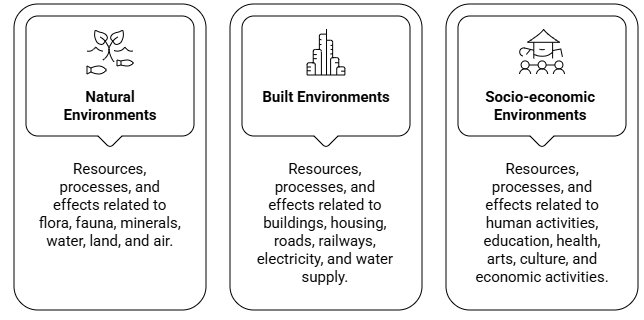
The urban environment can be understood as the dynamic interaction of three interdependent systems:
Figure 1: Natural, Built and Socio-Economic Environments of Cities
The natural environment includes air, water, land, and ecosystems that form the ecological foundation of cities. It provides essential resources such as clean water, fertile land, and breathable air, while also performing critical functions such as climate regulation, flood control, and waste assimilation. Even in highly built-up urban areas, natural systems continue to operate, often in fragmented or stressed forms. The health of the natural environment directly influences the sustainability and resilience of cities, making its protection and restoration a central concern of Urban Environmental Management.
The built environment consists of the physical structures and infrastructure that support urban life, including buildings, roads, transportation systems, water supply networks, and energy systems. It shapes how people live, work, and move within cities, and determines patterns of resource use and environmental impact. Decisions related to urban design, land use, and infrastructure development have long-term consequences, often locking cities into particular pathways of energy consumption and environmental performance. A sustainable built environment seeks to optimize efficiency, reduce resource intensity, and enhance the quality of urban life.
The socio-economic environment encompasses the human and institutional dimensions of cities, including population dynamics, economic activities, governance systems, and cultural practices. It influences how resources are distributed, how decisions are made, and how different groups experience environmental benefits and burdens. Social equity, economic opportunity, and participatory governance are key elements of this dimension. Urban environmental challenges are often rooted in socio-economic conditions, and effective solutions require attention to issues such as poverty, inequality, and access to services.
These systems are tightly interconnected. Changes in one system inevitably influence the others, often in complex and unintended ways. For example, land-use decisions affect water flows and biodiversity, while economic activities influence energy demand and waste generation.
Cities can therefore be viewed as living systems or ecosystems, where resources flow in, are transformed through human activities, and generate outputs in the form of goods, services, and wastes. Managing these flows effectively is at the heart of UEM.
3. Urban Systems: Resources, Processes, and Impacts
Urban systems operate through a series of interconnected flows:
Inputs refer to the resources that cities draw upon to sustain their functioning and growth. These include natural resources such as land, water, energy, and raw materials, as well as human resources, knowledge, and financial capital. Cities are highly dependent on external regions for many of these inputs, often extending their ecological footprint far beyond their physical boundaries. The scale and efficiency of resource use at this stage play a critical role in determining the overall sustainability of urban systems.
Processes describe the ways in which these inputs are transformed within the city through human activities. Production, transportation, consumption, construction, and governance systems all shape how resources are utilized and distributed. These processes are influenced by technology, policy frameworks, economic structures, and social behavior. The organization and efficiency of urban processes determine not only economic productivity, but also the intensity of environmental impacts generated during transformation and use.
Outputs are the results of urban activities, encompassing both desirable and undesirable outcomes. Cities produce goods, services, and economic value, contributing to livelihoods and development. At the same time, they generate waste, emissions, and pollution in various forms, including solid waste, wastewater, air pollutants, and greenhouse gases. Managing these outputs effectively, through reduction, reuse, recycling, and cleaner production, is essential to minimizing environmental damage and moving towards more sustainable urban systems.
Figure 2: Infographic on Urban Inputs, Processes and Outputs
(Click image to enlarge)
Source: GDRC concept; diagram visualised with AI tools and edited by author
Viewed together, these flows underscore the need to manage cities as integrated systems, where resource use, transformation processes, and environmental impacts are addressed in a holistic manner.
While cities generate significant economic and social benefits, they also produce negative environmental externalities such as air and water pollution, waste accumulation, land degradation, and greenhouse gas emissions.
At the same time, cities remain centers of innovation and opportunity, offering the potential to develop new technologies, governance models, and social practices that can reduce environmental impacts while enhancing quality of life.
4. Scale and Complexity
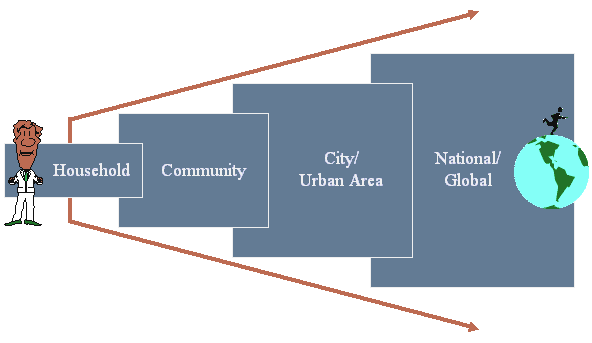
Urban environmental issues operate across multiple spatial and temporal scales:
At the household and community level, environmental issues are immediate and directly experienced in daily life. These include access to clean water, sanitation, waste disposal, indoor and outdoor air quality, noise, and exposure to health risks. As reflected in the figure, concerns such as household health, garbage generation, air and water pollution, and the spread of diseases are central at this scale, alongside community-level challenges like trash dumping, polluted land, flooding, and noise pollution. At this level, environmental conditions are closely tied to living standards, behavior, and local infrastructure, with community awareness and participation playing a critical role.
At the city level, environmental challenges emerge from the aggregation of activities across households, industries, and institutions. Issues such as traffic congestion, amenity loss, and air and water pollution become more visible, along with concerns like the loss of heritage and historical buildings and reduced property values. The figure also highlights systemic constraints such as inadequate financial resources, high living densities, and weak governance practices. City-level systems - including transportation networks, energy supply, and land use planning - strongly influence environmental performance, often locking in long-term patterns of sustainability or degradation.
At the regional and global levels, urban activities contribute to broader environmental changes that extend far beyond city boundaries. These include water pollution, loss of habitat and biodiversity, soil erosion, toxic run-off, and the effects of climate change and global warming, as indicated in the figure. Cities rely on regional ecosystems for resources while exporting environmental impacts across borders. At this scale, environmental management requires national policies, transboundary cooperation, and long-term strategies to address shared and cumulative challenges.
Figure 3: The Scale of Urban Environmental Problems
This multi-scalar nature means that local actions can have far-reaching consequences, while global trends influence local realities. The figure illustrates how environmental issues expand in scale and complexity from the household to the global level, while remaining interconnected across all levels.
Water pollution
Loss of habitat, biodiversity and species endangered
Region/Nation
Soil erosion and increased salinity
Toxic run-off and acid rain
Amenity loss
Traffic congestion
City
Loss of heritage and historical buildings
Reduced property and building values
Accidents and disasters
Polluted land
Community
inappropriate and inadequate technology use
Trash dumping
Household
household health, garbage generation, air/water/noise pollution, spread of diseases
Lack of understanding of environmental problems
Flooding
Noise pollution
Natural disasters
Inadequate tax/financial revenues
Flooding and surface drainage
Lack of, and inappropriate, laws and legislation
Toxic and hazardous wastes/dumps
High living densities
Loss of agricultural land and desertification
Air pollution
Water pollution
Inadequate supply and transmission loss of electricity
Misguided urban governments and management practices
Natural and man-made hazards and disasters
Land clearance and loss of forest cover
Effects of climate change and global warming.
Figure 4: The Concentric Issues of Urban Environmental Management
The above figure illustrates how environmental issues expand in scale and complexity from the household to the global level, while remaining interconnected across all levels.
5. Core Environmental Challenges in Cities
Urban environmental challenges are diverse, but can be broadly grouped into key domains:
Air
Urban air pollution arises from transportation, industrial activity, construction, and energy use, particularly where fossil fuels dominate. Major pollutants such as particulate matter, nitrogen oxides, and ozone have serious implications for human health, contributing to respiratory and cardiovascular diseases. Air quality is also closely linked to urban form, mobility systems, and energy choices, making it a critical area for integrated policy intervention.
Table 1: Urban Environmental Challenges: AIR
Problem area
Effects
Causes
Management options
AIR-RELATED PROBLEMS
AMBIENT AIR POLLUTION
health problems
economic costs from health care costs and productivity losses
amenity losses (aesthetic, cultural, and recreational)
industrialization
increase in motorized fleet and congestion
use of highly polluting fuels (leaded gas and high sulphur coal)
economic costs from health care and productivity losses
use of low-quality fuels for cooking and heating (biomass and high sulphur coal)
poorly ventilated dwellings and workplaces
passive smoking
cottage industry activities
substitute fuel and equipment pricing
fuel switching
building codes
public education
tax hazardous products and processes
Water
Cities face multiple water-related challenges, including scarcity, uneven distribution, pollution, and inefficient use. Rapid urbanization places pressure on freshwater sources while increasing wastewater generation. Inadequate treatment and poor management often lead to contamination of rivers, lakes, and coastal areas. Integrated water resource management approaches are essential to balance supply, demand, quality, and ecosystem needs within urban contexts.
Table 2: Urban Environmental Challenges: WATER
Problem area
Effects
Causes
Management options
WATER-RELATED PROBLEMS
SURFACE WATER POLLUTION
health problems
Economic costs (additional treatment, new sources of supply, health costs)
amenity losses
pricing policies
unclear property rights
poor regulations and/or enforcement
municipal and industrial waste disposal practices
urban runoff
irrigation practices
marginal cost pricing
regulations, standards, licensing, charges
improve monitoring and enforcement
demand management and waste water reuse
appropriate technology
land use controls
waste management
GROUNDWATER POLLUTION DEPLETION
reduced water quality from saline intrusion, biochemical seepage
health impacts
economic costs
pricing policies
unclear property rights
poor regulations and/or enforcement
unsustainable extraction
sanitation, municipal and industrial waste disposal practices
poor demand management
marginal cost pricing
regulation, standards, licensing, charges
waste management
appropriate technology
demand management
controls on land use and sources of information
COASTAL/LAKE POLLUTION
health effects due to contaminated seafood and direct contact
loss of recreational resources and tourism revenues
damage to fisheries
amenity losses
eutrophication
unclear property rights
poor regulations and/or enforcement
municipal and industrial waste disposal practices
disposal of shipboard wastes
regulations, standards, licensing charges
appropriate technology
coastal zone management and preservation
shipping facilities
waste management
land use control
Land
Urban expansion and changing land use patterns place significant pressure on land resources. The conversion of agricultural land, forests, and wetlands into built-up areas leads to habitat loss, reduced biodiversity, and increased environmental vulnerability. Poor land-use planning can also result in urban sprawl, inefficient infrastructure provision, and increased dependence on transport systems. Sustainable land management is therefore central to balancing development with ecological preservation.
Table 3: Urban Environmental Challenges: LAND
Problem area
Effects
Causes
Management options
LAND-RELATED PROBLEMS
DEGRADATION OF LAND
declining agricultural productivity
reduced renewable resource base (deforestation, lost soil fertility)
erosion and siltation
amenity losses
loss of natural habitat and species
changes in relative value of land uses
uncontrolled urban growth
unclear property rights
woodfuel and land pricing
mining and quarrying activities
land disposal of municipal and industrial wastes
internalize ecological value in land prices
designate special areas for management
local participation
clarify property rights
economic resource pricing
land use controls
LOSS OF CULTURAL AND HISTORICAL PROPERTY
loss of heritage
loss of tourism revenues
damage to culturally values buildings, monuments, natural sites.
land prices do not reflect social valuation
lack of regulation and/or enforcement
air pollution
SWM practices
land subsidence and poor drainage
internalize costs of loss in redevelopment planning
tax incentives for preservation
zone and building codes
pollution control
public education
DEGRADATION OF ECOSYSTEMS
health hazards
resettlement costs
loss of habitat and species
air, water, land pollution
failure to anticipate effects in planning and development
pricing policies
lack of rural political power
internalize costs of rural degradation
resource pricing
clarify property rights
Waste
The growing volume and complexity of urban waste, including solid, liquid, and hazardous waste, present major environmental and public health challenges. Inefficient collection, disposal, and treatment systems contribute to land, air, and water pollution. At the same time, waste represents a potential resource. Moving towards sustainable waste management requires reducing waste generation, promoting reuse and recycling, and adopting circular economy approaches.
Table 4: Urban Environmental Challenges: WASTE
Problem area
Effects
Causes
Management options
WASTE-RELATED PROBLEMS
SOLID WASTE MANAGEMENT
• land and water pollution
• public health risks (disease vectors)
• blocked drainage and flooding
• visual and amenity loss
• rapid urbanization and consumption
• inadequate collection and disposal systems
• lack of segregation at source
• informal and unregulated dumping
• integrated waste management systems
• source segregation and recycling
• improved collection and disposal infrastructure
• public awareness and participation
• support for informal recycling sector
HAZARDOUS AND INDUSTRIAL WASTE
• soil and groundwater contamination
• toxic exposure and health impacts
• long-term ecological damage
• industrial processes and chemicals
• weak regulation and enforcement
• improper storage and disposal
• lack of treatment facilities
• stricter regulations and monitoring
• safe treatment and disposal systems
• cleaner production technologies
• polluter pays principles
• hazardous waste tracking systems
WASTEWATER AND SEWAGE
• water pollution and ecosystem damage
• spread of waterborne diseases
• degradation of urban waterways
• inadequate sewerage systems
• lack of treatment facilities
• rapid population growth
• industrial discharge into water systems
• wastewater treatment and reuse
• expansion of sewerage infrastructure
• decentralized sanitation systems
• regulation of industrial effluents
• water-sensitive urban design
Food Security
Ensuring reliable access to safe, nutritious, and affordable food is an increasingly important urban challenge. Cities depend heavily on external regions for food supply, making them vulnerable to disruptions in production, transportation, and markets. At the same time, urban consumption patterns have significant environmental impacts across food systems. Strengthening urban food security involves improving supply chains, reducing food waste, supporting urban and peri-urban agriculture, and promoting sustainable diets.
• food loss and waste
• nutritional deficiencies
• environmental impacts of wasted resources
• inefficient storage and transport
• consumer behavior and overconsumption
• lack of awareness
• poor waste management systems
• reduce food loss and waste
• awareness campaigns on consumption
• redistribution systems (food banks)
• composting and circular food systems
• promote sustainable diets
Urban Risks
Urban areas are increasingly exposed to a range of risks, including natural hazards such as floods, earthquakes, and storms, as well as long-term threats from climate change. High population densities, informal settlements, and inadequate infrastructure often increase vulnerability, particularly among low-income groups. Building urban resilience requires integrating risk reduction, climate adaptation, and disaster preparedness into planning and governance systems.
These challenges are interconnected, requiring integrated responses rather than sector-specific solutions.
BOX 1: The "Blue, Green, Brown, and Gray" Agendas of Urban Environmental Management
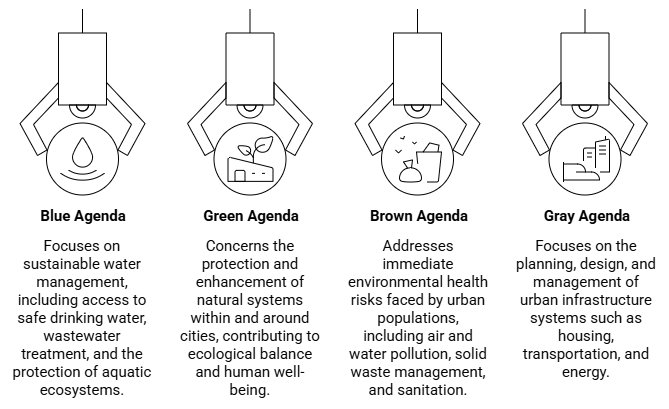
Urban environmental challenges can be understood through four interrelated "agendas," each highlighting a critical dimension of sustainability. Together, they provide a simple yet comprehensive framework for understanding and organizing the priorities of Urban Environmental Management.
Blue Agenda - Water and Aquatic Systems
Focuses on the sustainable management of water resources in cities. This includes access to safe drinking water, wastewater treatment, stormwater management, and the protection of rivers, lakes, and coastal ecosystems. The blue agenda emphasizes both resource efficiency and the health of aquatic systems that support urban life.
Green Agenda - Ecosystems and Livability
Concerns the protection and enhancement of natural systems within and around cities. Urban forests, parks, biodiversity, and green spaces contribute to ecological balance, climate regulation, and human well-being. The green agenda highlights the role of nature in making cities more resilient, healthy, and livable.
Brown Agenda - Pollution and Public Health
Addresses the immediate environmental health risks faced by urban populations, particularly in low-income and densely populated areas. Issues include air and water pollution, solid waste management, sanitation, and exposure to hazardous substances. The brown agenda is closely linked to equity, as environmental burdens are often unevenly distributed.
Gray Agenda - Built Environment and Infrastructure
Focuses on the planning, design, and management of urban infrastructure systems such as housing, transportation, energy, and industry. The gray agenda emphasizes efficiency, durability, and sustainability in the built environment, including the transition to low-carbon and resource-efficient urban systems.
Figure 5: The Four Agendas of Urban Environments
The four agendas provide a useful lens for understanding how these core challenges are interconnected. The blue agenda aligns closely with water-related issues, the green agenda with land and ecosystem concerns, the brown agenda with pollution and public health challenges such as air and waste, and the gray agenda with infrastructure systems that shape urban risks and resource use. Food security cuts across all four agendas, linking natural resources, infrastructure, environmental health, and socio-economic systems. Together, these perspectives highlight the need for integrated responses rather than sector-specific solutions.
6. Framework for Policy and Practice
Urban Environmental Management requires moving from understanding to action. The four agendas (blue, green, brown, and gray) provide a lens to interpret the urban environment, while the six core challenges (air, water, land, waste, food, and resilience) highlight priority areas of concern. The policy framework presented here translates these insights into principles for action, guiding how cities can respond in an integrated and systematic manner.
Each principle of the framework is relevant across multiple agendas and challenges. For example, water management (blue agenda) cannot be separated from land use (green agenda), infrastructure systems (gray agenda), or public health concerns (brown agenda). Similarly, challenges such as food security and urban risks cut across all agendas, requiring coordinated policy responses.
Urban Environmental Management is guided by a set of core principles:
Balancing ecology and economy to ensure long-term sustainability
Visioning and goal-setting to define desired urban futures
Action-oriented planning that translates strategies into implementation
Information access and transparency to support decision-making
Appropriate use of technology and innovation
Promotion of sustainable lifestyles and behavioral change
These principles provide a foundation for designing policies and interventions that are both practical and forward-looking. The principles are not applied in isolation, but operate across the full range of agendas and challenges:
Balancing ecology and economy connects the green agenda (ecosystems and land) with the gray agenda (infrastructure and development), while addressing challenges such as land use, food security, and climate impacts.
Visioning and goal-setting provide direction across all agendas, helping cities prioritize actions on air, water, waste, and risk in a coherent and forward-looking manner.
Action-oriented planning translates priorities into interventions across sectors, linking brown agenda concerns such as pollution and waste with gray agenda infrastructure systems.
Information access and transparency support better decision-making across all challenges, particularly in managing complex issues such as urban risks and resource use.
Technology and innovation play a key role in advancing solutions within the gray agenda, while also improving outcomes in the blue (water systems), green (resource efficiency), and brown (pollution control) agendas.
Sustainable lifestyles and behavioral change cut across all agendas, influencing consumption patterns, waste generation, energy use, and ultimately the sustainability of urban systems.
This relationship can be understood as a progression from understanding to action:
Urban Agendas Blue - Green - Brown - Gray
The agendas define how the urban environment
is conceptualized
↓
Core Challenges Air - Water - Land - Waste - Food - Risks
The challenges identify the key issues that emerge
from this understanding
↓
Policy Framework Principles for Action
The policy framework outlines how cities
can respond
The outcomes reflect the results of these
interventions in practice
Figure 7: Urban Progression from Understanding to Action
Taken together, the agendas, challenges, and policy principles form an integrated framework for Urban Environmental Management, linking how cities are understood, what issues they face, and how effective responses can be designed and implemented.
BOX 2: Tools and Approaches for Urban Environmental Management
Urban Environmental Management is supported by a range of analytical, planning, and operational tools that help cities assess impacts, design interventions, and monitor progress. These tools translate principles into practice, enabling more informed and effective decision-making across sectors.
Key tools and approaches include:
Environmental Management Systems (EMS)
Environmental Impact Assessment (EIA)
Life Cycle Analysis (LCA)
Ecological Footprint Analysis
3Rs and Circular Economy Approaches
Urban Planning and Design Strategies
These tools are most effective when applied in an integrated manner, reflecting the interconnected nature of the blue, green, brown, and gray agendas, and addressing multiple urban challenges simultaneously.
BOX 3: Key Thematic Areas of Urban Environmental Management
The UEM programme covers a wide range of thematic areas that reflect the complexity and diversity of urban environmental challenges. Each theme represents a critical entry point for policy, planning, and action.
Core thematic areas include:
Energy Management
Water Resource Management
Waste Management
Transportation Systems
Green Construction and Sustainable Buildings
Sustainable Tourism
Slums and Informal Settlements
Disaster Risk Reduction and Resilience
Urban Governance
These themes are closely interconnected and align with the four agendas of Urban Environmental Management, requiring coordinated and cross-sectoral approaches.
The thematic areas outlined above reflect the current scope of Urban Environmental Management. However, as cities continue to evolve, new challenges and opportunities are emerging that require more adaptive and forward-looking approaches. Understanding these trends is essential for shaping the future of sustainable urban development.
7. Emerging Trends and Future Directions
Urban Environmental Management continues to evolve in response to changing technologies, environmental pressures, and societal expectations. Several key trends are shaping the future of sustainable cities:
Smart Cities and Digitalization
The increasing use of digital technologies is transforming how cities are planned, managed, and experienced. Data-driven systems, sensors, and digital platforms enable real-time monitoring of infrastructure, resource use, and environmental conditions. These innovations offer opportunities to improve efficiency, responsiveness, and transparency in urban management. At the same time, ensuring equitable access, data governance, and appropriate use of technology will be critical to realizing their full potential.
Climate Resilience and Adaptation
As the impacts of climate change intensify, cities are placing greater emphasis on resilience and adaptation. This includes preparing for extreme weather events, managing flood risks, addressing heat stress, and strengthening critical infrastructure. Future urban strategies will increasingly integrate climate considerations into planning, design, and governance, moving from reactive responses to proactive and anticipatory approaches.
Circular Economy
Cities are beginning to transition from linear models of resource use to more circular systems that emphasize reduction, reuse, recycling, and regeneration. This shift redefines waste as a resource and promotes more efficient use of materials and energy. In the future, circular economy principles are likely to become embedded in urban systems, influencing production processes, consumption patterns, and infrastructure design.
Nature-Based Solutions
There is growing recognition of the role of natural systems in addressing urban environmental challenges. Nature-based solutions, such as urban green spaces, wetlands, and green infrastructure, can enhance biodiversity, improve air and water quality, and increase resilience to climate impacts. Future urban development is expected to integrate these approaches more systematically, combining ecological and engineered solutions.
Equity, Inclusion, and Well-being
Sustainable urban development is increasingly understood as not only an environmental challenge but also a social one. Issues of equity, access to services, and quality of life are becoming central to urban policy. Future approaches to Urban Environmental Management will place greater emphasis on inclusive planning, participatory governance, and the well-being of all urban residents, particularly vulnerable and marginalized groups.
8. Conclusion
Urban Environmental Management provides a comprehensive framework for addressing the complex challenges facing cities today. By integrating environmental, social, and economic considerations, it supports the transition towards more sustainable and resilient urban systems.
Cities must be seen not only as sources of environmental problems, but as key drivers of solutions. Through informed policies, innovative practices, and collective action, it is possible to create urban environments that are livable, inclusive, and sustainable for present and future generations. As emerging trends reshape urban systems, the ability to integrate knowledge, anticipate change, and respond proactively will be essential in creating cities that are not only sustainable, but also resilient, inclusive, and adaptable for the future.
Co-creation brings diverse actors together on an equal footing to design shared urban solutions.
Inclusive processes lead to better outcomes and sense of ownership.
Systems Thinking
Urban challenges are interconnected and require holistic, cross-sectoral approaches.
Seeing the whole, not just the parts.
CBDRM
Community-based disaster risk management strengthens local capacities to reduce and respond to urban risks.
Building resilience starts locally at the community level.
15-Minute City Framework
An urban design strategy ensuring all residents can meet their basic needs (work, food, health, education) within a 15-minute walk or bike ride from home.
Drastically reduces dependency on private vehicles, lowers urban carbon footprints, and strengthens local community social cohesion.
Blue-Green Infrastructure
Designing urban spaces where water management (blue) and green spaces (green) are physically linked, such as rain gardens that double as public parks.
Manages stormwater naturally to prevent flooding while simultaneously providing recreational spaces and reducing the "gray" infrastructure burden on city budgets.
Smart Cities
Smart cities intensively use data and technology to improve efficiency of urban services and quality of life.
Technology as the third leg (after governance and education) of developmental enablers.
Sustainable Cities
Sustainable cities balance environmental, economic, and social goals, and help in meeting the SDGs.
Sustainability ensures that development impacts are future oriented.
Resilient Cities
Resilient cities can withstand and recover from shocks and stresses, including natural disasters.
Urban areas demonstrate strength through flexible adaptability.
Inclusive Cities
Inclusive cities ensure equitable access to opportunities and services for all urban residents.
No one left behind - irrespective of their economic, social or ethnic backgrounds.
Nature-Based Solutions
Nature-based solutions use nature as a model (the ecosystem approach) to address urban environmental challenges.
Working with nature, and for nature.
Circular Economy
Circular systems keep resources with the loop, and reduce waste through reuse, recycling, and regeneration.
From linear to circular material flows.
SDG Governance
Better urban governance aligns and ensures strong local action to meet global sustainability goals.

 UEM Infographic