The GDRC Guide to City Networks
Global City Networks:
|
|||||||||||||||||||||||||||||||||||||||||||||||||||||||||||||||||||||||||||||||||||||||||||||||||||||||||||||||||||||||||||||||||||||||||||||||||||||||||||||||||||||||||||||||||||||||||||||||||||||||||||||||||||||||||||||||||||||||||||||||||||||
 |
Hari Srinivas |
| Concept Note Series E-271. |

|
Abstract: This document explores the structural and operational dynamics of international city networks, emphasizing how modern urban centers collaborate to tackle shared global challenges. By moving beyond traditional cross-border competition, these networks foster localized knowledge transfer, resource exchange, and joint policy implementations in key areas such as trade, innovation, and sustainable environmental management. It highlights how decentralized partnerships bridge jurisdictional gaps, empowering local municipalities to act as unified, cooperative nodes within a broader global governance framework. Ultimately, the document outlines the mechanisms through which supportive city-to-city alliances scale impact, optimize urban resilience, and drive collective progress toward multilateral developmental goals. |
|
Keywords: Global city networks, urban multilateralism, municipal collaboration, sustainable development, knowledge transfer, global governance, urban resilience, decentralization |
|
Cities around the world increasingly collaborate through international, regional, and thematic networks to exchange knowledge, build capacity, advocate for local interests, and accelerate sustainable urban development. This guide introduces the major city networks and helps local governments identify those most relevant to their needs.
|
Why City Networks Matter
WWhy do cities work together? Cities face many of the same challenges regardless of their location, including rapid urbanization, climate change, housing, transport, and public health. Working together allows them to learn from each other's experiences instead of solving problems in isolation. City networks provide a structured platform for cooperation, enabling municipalities to exchange ideas, develop partnerships, and address shared concerns more effectively.
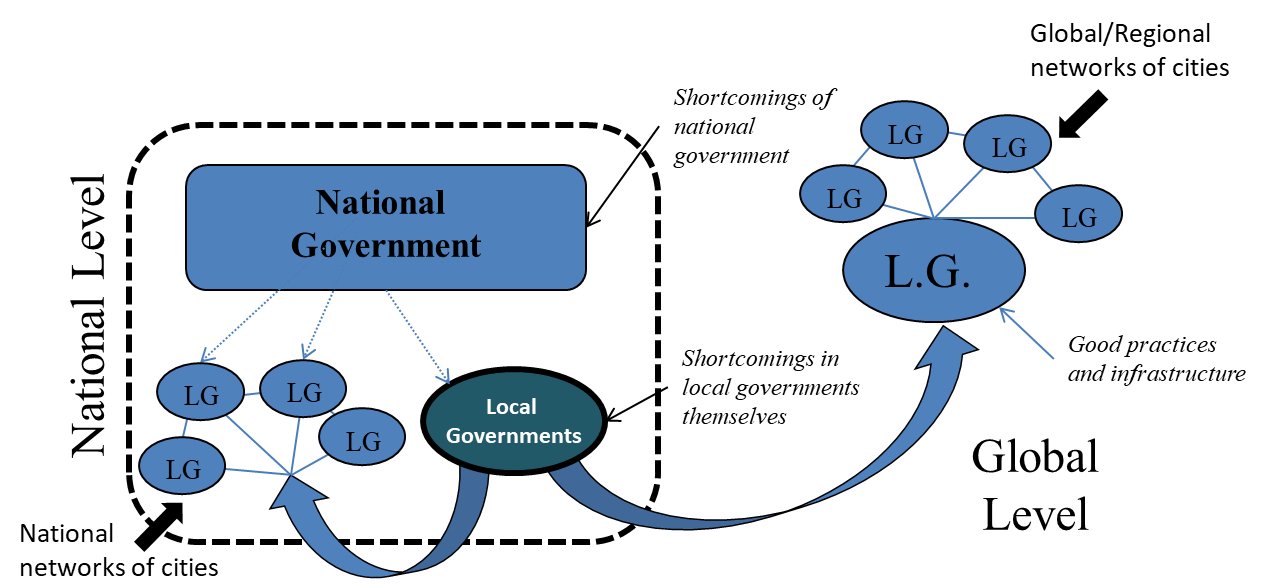
Cities and local governments bypass traditional national limitations by organizing into national and global networks to share good practices. This collaboration/networking highlights a structural shift from centralized domestic governance to decentralized, international collaboration. It happens through several key dynamics, including
- domestic limitations National governance frameworks often exhibit institutional shortcomings or policy gaps that limit local development
- internal local government constraints Individual local governments face internal operational and infrastructure shortcomings when working in isolation
- global transnationalism Successful local practices and infrastructure scale upwards into regional and global networks of cities, bypassing the state, and directly connecting with international peers to exchange solutions
Benefits of networking
Peer learning
One of the greatest strengths of city networks is the opportunity for cities to learn directly from one another. Officials can exchange practical experiences, discuss successes and failures, and adapt proven solutions to their own local circumstances. This peer to peer learning often produces more relevant and immediately applicable knowledge than traditional training programmes.
Joint projects
City networks frequently bring together members to undertake collaborative projects that address common challenges. These initiatives may involve pilot programmes, research activities, technology demonstrations, or regional planning efforts. By working collectively, cities can share costs, combine expertise, and achieve greater impact than they could individually.
Capacity building
Many city networks invest in strengthening the knowledge and skills of local government officials. Through workshops, training courses, technical assistance, and mentoring, they help cities improve planning, management, and policy implementation. Capacity building ensures that municipalities are better prepared to respond to both current and emerging urban challenges.
Funding opportunities
Membership in city networks can open doors to grants, international partnerships, and development finance. Networks often inform members about funding programmes and facilitate collaborative proposals involving multiple cities. This increases the chances of securing financial support for innovative urban initiatives.
International advocacy
City networks give local governments a stronger collective voice in regional and global policy discussions. By speaking together, cities can influence international agendas on issues such as climate change, sustainable development, and urban resilience. Their combined advocacy helps ensure that local perspectives are reflected in national and international decision making.
SDG implementation
The Sustainable Development Goals provide a common framework for addressing economic, social, and environmental challenges. City networks support municipalities by sharing tools, indicators, case studies, and practical experiences related to localizing the SDGs. This collaboration helps cities translate global goals into effective local action.
Climate action
Cities play a central role in reducing greenhouse gas emissions and adapting to the impacts of climate change. Through city networks, municipalities exchange policies, technologies, and successful practices related to energy, transport, buildings, and resilience. Collective action enables cities to accelerate progress towards low carbon and climate resilient development.
Knowledge exchange
Knowledge exchange lies at the heart of every successful city network. Members share information through publications, conferences, webinars, study visits, online platforms, and professional communities of practice. This continuous flow of knowledge enables cities to remain informed about emerging trends, innovative solutions, and lessons learned from around the world.
Types of City Network
| Climate Change | |
| Climate change networks help cities reduce greenhouse gas emissions while strengthening their ability to adapt to changing environmental conditions. They provide technical guidance, policy frameworks, data tools, and opportunities for collaborative action on issues such as energy, transport, buildings, and urban resilience. By working together, member cities can accelerate climate action and contribute to global sustainability goals. |
|
| Sustainable Development | |
| Sustainable development networks promote integrated approaches that balance economic growth, social inclusion, environmental protection, and effective governance. They assist cities in implementing the Sustainable Development Goals through planning tools, partnerships, and knowledge sharing. These networks encourage local governments to develop long term strategies that improve quality of life while safeguarding resources for future generations. |
|
| Disaster Risk Reduction | |
| Disaster risk reduction networks help cities prepare for, respond to, and recover from natural and human induced hazards. They encourage proactive planning, risk assessment, early warning systems, and resilient infrastructure rather than relying solely on emergency response. By sharing experiences and best practices, member cities strengthen their capacity to reduce disaster risks and protect communities. |
|
| Smart Cities | |
| Smart city networks promote the responsible use of digital technologies to improve urban management and public services. They facilitate collaboration on topics such as digital governance, data management, intelligent infrastructure, and citizen engagement. Their goal is to help cities become more efficient, inclusive, and sustainable through innovation and technology. |
|
| Transport and Mobility | |
| Transport and mobility networks focus on creating safe, efficient, accessible, and environmentally sustainable urban transportation systems. They support cities in improving public transport, walking, cycling, traffic management, and low emission mobility solutions. Through shared knowledge and collaborative projects, these networks contribute to more connected and livable urban environments. |
|
| Heritage and Culture | |
| Heritage and culture networks help cities preserve their historic assets while promoting cultural vitality and sustainable urban development. They encourage the exchange of experiences in heritage conservation, cultural tourism, creative industries, and community participation. These networks recognize that cultural heritage contributes to local identity, economic development, and social cohesion. |
|
| Health | |
| Health focused city networks support municipalities in creating healthier environments through integrated urban planning and public health policies. Their work addresses issues such as healthy lifestyles, environmental quality, disease prevention, and equitable access to health services. They recognize that many determinants of health are shaped by the way cities are planned and managed. |
|
| Circular Economy | |
| Circular economy networks help cities move from a linear model of production and consumption toward systems that minimize waste and maximize resource efficiency. They promote strategies such as recycling, reuse, repair, sustainable procurement, and industrial symbiosis. Through collaboration and innovation, these networks support cities in building more resilient and resource efficient urban economies. |
|
| Regional Networks | |
| Regional city networks address urban issues within specific geographic areas where member cities often share similar economic, environmental, cultural, and governance contexts. They promote regional cooperation, capacity building, policy dialogue, and the exchange of practical experiences among neighbouring municipalities. These networks complement global initiatives by focusing on region specific priorities and strengthening local partnerships. |
|
Summary of City Networks and Focal Areas
| Network | Global | Regional | Climate | SDGs | Resilience | Smart Cities | Heritage | Transport | Health |
|---|---|---|---|---|---|---|---|---|---|
| ICLEI | ✓ | ✓ | ✓ | ✓ | ✓ | ✓ | |||
| C40 Cities | ✓ | ✓ | ✓ | ✓ | |||||
| UCLG | ✓ | ✓ | ✓ | ✓ | |||||
| Global Covenant of Mayors | ✓ | ✓ | ✓ | ✓ | |||||
| MCR2030 | ✓ | ✓ | ✓ | ||||||
| Resilient Cities Network | ✓ | ✓ | ✓ | ✓ | |||||
| CITYNET | Asia | ✓ | ✓ | ✓ | ✓ | ||||
| EUROCITIES | Europe | ✓ | ✓ | ✓ | ✓ | ✓ | ✓ | ✓ | |
| UITP | ✓ | ✓ | ✓ | ||||||
| Open & Agile Smart Cities | ✓ | ✓ | ✓ | ||||||
| UNESCO Creative Cities Network | ✓ | ✓ | ✓ | ||||||
| Partnership for Healthy Cities | ✓ | ✓ | ✓ |
"Which network is right for my city?"
The benefots of participating in a network can be varied, depending on what a city wants to do, and the challenges it is facing. The following table provides a layout of what a city wants to do, and the approprate city networks.
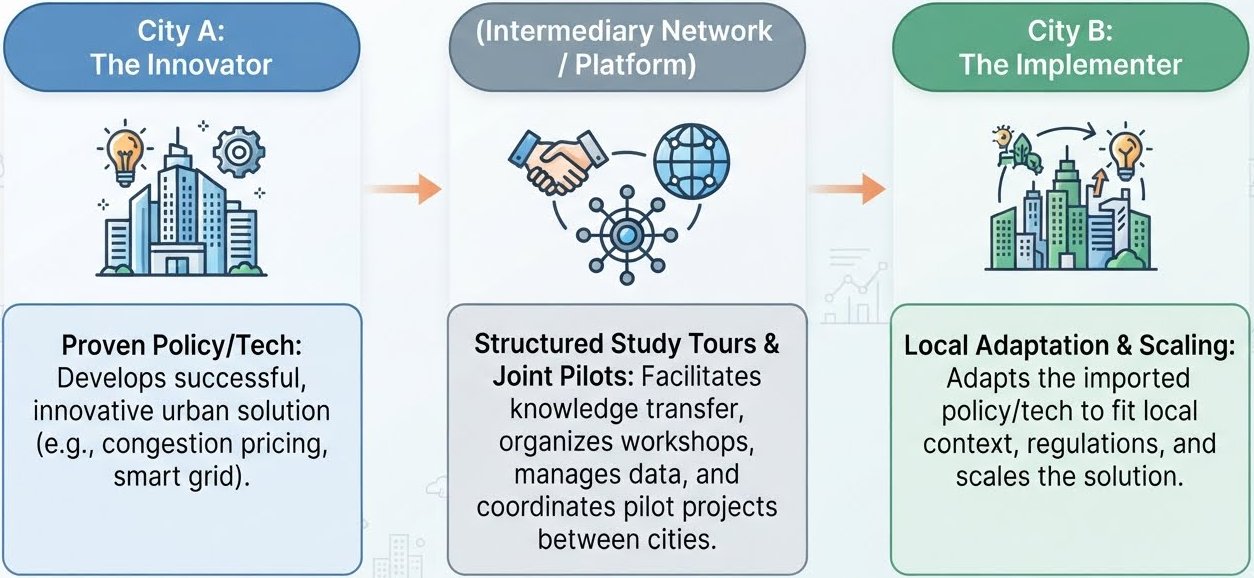
As illustrated in Figure 2 above, city-to-city networking is a structured framework for knowledge exchange and collaborative urban development. It allows municipalities to share proven solutions, avoid repeating costly mistakes, and accelerate the adoption of sustainable practices globally.
The process typically functions through a three-stage mechanical flow:
- The Innovator (City A): A pioneering city develops, tests, and successfully implements an innovative urban solution, such as congestion pricing or smart grid infrastructure.
- The Intermediary Platform: A facilitating network or organization manages data, coordinates study tours, hosts collaborative workshops, and structures joint pilot programs to transfer that knowledge.
- The Implementer (City B): A receiving city adopts the imported framework, adapting the technology or policy to fit its specific local regulations, culture, and context before scaling it up.
| If your city wants to... | Consider joining... |
|---|---|
| Reduce greenhouse gas emissions | C40 Cities, ICLEI, Global Covenant of Mayors |
| Develop a climate action plan | ICLEI, Global Covenant of Mayors |
| Improve disaster resilience | MCR2030, Resilient Cities Network |
| Strengthen sustainable urban planning | UCLG, ICLEI |
| Implement the Sustainable Development Goals (SDGs) | UCLG, Local2030 Coalition, SDG Cities Programme |
| Promote smart city initiatives | Open & Agile Smart Cities (OASC), Smart Cities Council |
| Improve digital governance and open data | Open & Agile Smart Cities (OASC) |
| Modernize public transportation | UITP, POLIS Network |
| Promote walking and cycling | POLIS Network, ICLEI |
| Preserve cultural heritage | Organization of World Heritage Cities (OWHC), UNESCO Creative Cities Network |
| Develop creative industries | UNESCO Creative Cities Network |
| Create healthier urban environments | WHO Healthy Cities, Partnership for Healthy Cities |
| Improve waste management and resource efficiency | ICLEI Circulars, Circular Cities and Regions Initiative (CCRI) |
| Advance the circular economy | Circular Cities and Regions Initiative (CCRI), ICLEI |
| Strengthen biodiversity and nature-based solutions | ICLEI CitiesWithNature, ICLEI |
| Exchange experiences with neighbouring cities in Asia | CITYNET, ASEAN Smart Cities Network |
| Collaborate with European cities | EUROCITIES |
| Collaborate with African municipalities | UCLG Africa |
| Build international partnerships across multiple urban issues | UCLG, ICLEI, CITYNET |
| Participate in international conferences and knowledge exchange | UCLG, ICLEI, CITYNET, EUROCITIES |
Emerging Trends
The city networks illustrated above will play important roles in the future on a number of themes that pose a particular challenge for cities.
| AI for City Management | Artificial intelligence is increasingly being used to support municipal decision making, optimize public services, and improve operational efficiency. Applications range from traffic management and waste collection to predictive maintenance, public safety, and citizen services. |
| Digital Twins | Digital twins are virtual models of cities that integrate real time data to simulate urban systems and test planning scenarios. They help city managers evaluate infrastructure investments, monitor performance, and make more informed decisions before implementing changes in the real world. |
| Climate Adaptation | As the impacts of climate change become more frequent and severe, cities are placing greater emphasis on adapting to changing environmental conditions. Climate adaptation includes measures such as flood protection, heat mitigation, resilient infrastructure, and improved emergency preparedness. |
| Nature-based Solutions | Nature-based solutions use natural ecosystems to address urban challenges while providing environmental, social, and economic benefits. Examples include urban forests, wetlands, green roofs, and restored rivers that help manage stormwater, reduce heat, and enhance biodiversity. |
| Urban Biodiversity | Protecting biodiversity within cities contributes to healthier ecosystems, improved resilience, and enhanced quality of life for residents. Many cities are integrating biodiversity conservation into urban planning through habitat restoration, ecological corridors, and green public spaces. |
| Circular Economy | Cities are increasingly adopting circular economy principles to minimize waste, maximize resource efficiency, and reduce environmental impacts. Strategies include promoting recycling, reuse, repair, sustainable procurement, and industrial symbiosis across urban systems. |
| Data Governance | Effective data governance ensures that urban data are collected, managed, shared, and protected in ways that support transparency, accountability, and informed decision making. As cities become more data driven, policies addressing privacy, security, interoperability, and ethical use are becoming increasingly important. |
| Urban Finance | Financing sustainable urban development requires innovative approaches that extend beyond traditional municipal budgets. Cities are exploring green bonds, public-private partnerships, climate finance, blended finance, and other mechanisms to support long term investments. |
| Citizens Participation | Successful urban development depends on the active involvement of citizens in planning, decision making, and implementation. Digital platforms, participatory budgeting, community workshops, and collaborative governance are enabling more inclusive and responsive city management. |
| Net Zero Cities | Many cities have committed to achieving net zero greenhouse gas emissions within the coming decades. These efforts combine energy efficiency, renewable energy, sustainable transport, green buildings, and carbon management to support climate neutrality. |
| 15-minute Cities | The 15-minute city concept promotes neighbourhoods where residents can access most daily needs within a short walk or bicycle ride. This approach encourages mixed land use, active mobility, stronger local communities, and improved quality of life while reducing dependence on private vehicles. |
| Urban Health | Urban health recognizes that the physical, social, economic, and environmental characteristics of cities have a profound influence on human well-being. Healthy city initiatives integrate housing, transport, green spaces, clean air, and equitable access to services into urban planning and policy. |
| Urban Food Systems | Cities are paying increasing attention to food security, local food production, resilient supply chains, and reducing food waste as essential components of sustainable urban development. |
| Energy Transition | Municipal governments are playing a central role in shifting to renewable energy, improving energy efficiency, and developing low carbon urban infrastructure to meet climate commitments. |
| Water Sensitive Cities | Cities are adopting integrated approaches to water management that combine stormwater harvesting, water conservation, wastewater reuse, and green infrastructure to improve resilience and sustainability. |
How Networks Create Change
City networks create value by bringing together local governments to exchange knowledge, build partnerships, and develop practical solutions to shared urban challenges. Through international conferences, regional meetings, webinars, study visits, and online communities of practice, city officials have opportunities to learn directly from one another and gain insights from successful policies and projects implemented elsewhere. This continuous interaction helps cities avoid repeating mistakes, adapt proven approaches to local circumstances, and remain informed about emerging trends in urban development.Beyond knowledge sharing, city networks actively strengthen the capacity of their members through training programmes, technical assistance, policy toolkits, peer reviews, benchmarking exercises, and expert advisory services. Many networks facilitate collaborative research, pilot projects, and demonstration initiatives that allow cities to test innovative ideas before wider implementation. By pooling expertise and resources, member cities are often able to achieve results that would be difficult or costly to accomplish independently.
City networks also serve as platforms for collaboration, advocacy, and international engagement. They help cities develop joint funding proposals, connect with development agencies and research institutions, and participate in global initiatives addressing climate change, resilience, sustainable development, mobility, health, and other urban priorities. Awards programmes, recognition schemes, and the publication of case studies further encourage innovation by highlighting successful practices and inspiring other cities to adopt and adapt proven solutions.
|
CITATION TEXT:
|

 |
Return to the City Networks Guide Contact: Hari Srinivas - [email protected] |