Demographic Rebalancing and Spatial Restructuring in Japan: The I-turn, U-turn, and L-turn Migration Dynamics
 |
Hari Srinivas |
| Continuing Research Series C-119 |
|
Abstract: This document examines Japan's urban transformation through the dynamics of internal migration, focusing on I-turn, U-turn, and L-turn patterns as key mechanisms shaping demographic redistribution and spatial restructuring. It traces how postwar I-turn migration drove rapid metropolitan growth and industrial concentration, while generating rural depopulation and regional disparities. In contrast, U-turn migration reflects lifestyle-driven return movements influenced by social capital and well-being, and L-turn migration highlights the growing role of regional cities in fostering a more balanced, polycentric urban system. Against the backdrop of population decline and aging, the study evaluates policy responses such as the compact city model and the Digital Garden City Nation initiative, illustrating their impacts through case studies like Toyama and Fukuoka. The analysis emphasizes the need to integrate infrastructure, digitalization, and regional policy to support sustainable urban-rural linkages, presenting the I-U-L framework as a practical tool for navigating Japan's transition toward a resilient, post-growth urban system.
Also see related: | ||
|
Keywords: Japan urbanization, internal migration, I-turn U-turn L-turn, regional revitalization, compact city model, demographic decline, polycentric development, digital transformation |
The evolution of the Japanese urban system in the post-World War II era represents a singular case study in the rapid spatial reorganization of a nation-state. This transformation, catalyzed by profound shifts in economic structure, demographic composition, and technological capability, has been primarily mediated through internal migration.
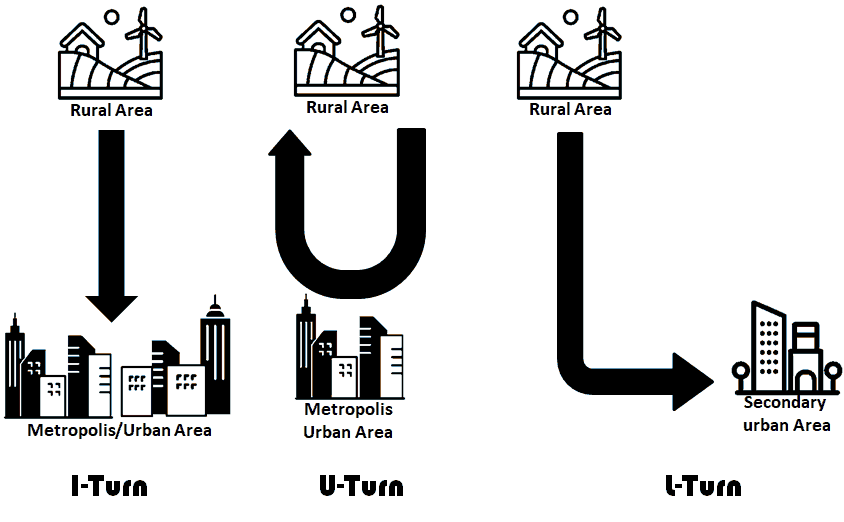
| The I-U-L classification captures not just direction, but the relationship between origin, destination, and prior life trajectory |
Internal migration has acted as the most significant force shaping the character of Japanese cities since the mid-20th century. In the immediate postwar period, the imperative of reconstruction necessitated a massive concentration of human and financial capital in a few strategic metropolitan corridors. This unipolar concentration created the "Pacific Belt," a continuous megalopolis that became the engine of the Japanese economic miracle.
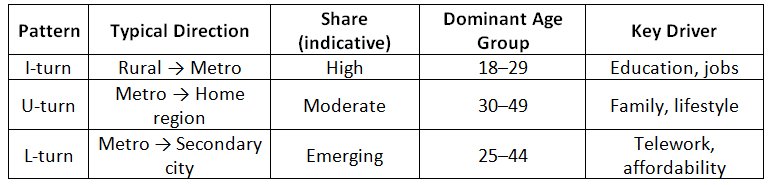 Based on national migration trends and survey data (Basic Resident Register, National Migration Surveys).
However, the externalities of this concentration-urban sprawl, congestion, environmental degradation, and the systematic hollow-out of rural communities-prompted a series of policy interventions and social shifts. As Japan entered the 21st century, the total population began to decline for the first time since the inception of the national census in 1920. This transition into an era of population contraction has fundamentally altered the migration landscape, shifting the focus from managing growth to managing shrinkage and resilience.
1. The Historical Continuum of Japanese Urbanization
This regulatory structure directly influenced the spatial manifestations of I-turn migration. As rural laborers flooded into the cities, the UPA designation allowed for the rapid construction of high-density residential corridors and transit-oriented developments.
However, the rigidity of these boundaries and the subsequent urban sprawl that leaked into the peripheries created a legacy of car dependency and infrastructure strain that contemporary "compact city" policies now struggle to resolve. The relationship between migration patterns and the legal environment is summarized in the following data regarding the 1968 City Planning Act's spatial designations.
| Area Category | Development Status | Regulatory Objective | Migration Impact |
|---|---|---|---|
| Urbanization Promotion Area (UPA) | Active or Planned | Prioritize infrastructure and development | Accommodated massive I-turn influx |
| Urbanization Control Area (UCA) | Generally Restricted | Preserve agriculture and environment | Limited urban sprawl; maintained rural periphery |
| City Planning Area | Wide Definition | Multi-jurisdictional development control | Unified planning across municipal boundaries |
The unipolar concentration in Tokyo and other major metros was further fueled by the "Pacific Belt" strategy, which emphasized industrial and administrative centralism. By 1973, Japan had reached a peak in its industrial employment and GDP growth, but the social costs of this concentration began to trigger the U-turn and L-turn behaviors that would characterize the latter part of the 20th century.
2. I-turn Migration: The Engine of Postwar Metropolitan Expansion
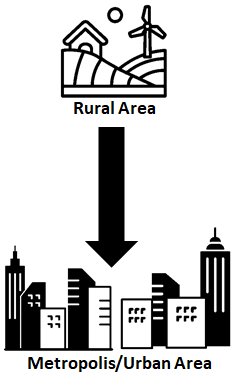
Figure 1: The I-Turn
|
Socio-Economic Drivers and the Shudan-shushoku Phenomenon
The above migration patterns were not merely organic; it was often administratively supported. One of the most notable mechanisms was Shudan-shushoku, a program managed by the Japanese Ministry of Labor to facilitate the migration of young workers from areas like Okinawa and Tohoku to mainland industrial centers. This program ensured a steady stream of labor for the steel, shipbuilding, and manufacturing industries that were the pillars of Japan's export-driven model. The economic logic of I-turn migration was anchored in the vast wage differentials and educational opportunities offered by the city. Major metropolitan areas provided access to specialized universities and large corporations that promised lifetime employment and upward social mobility. This led to a dramatic shift in the labor structure, as indicated by the following historical employment statistics.
| Sector | 1953 (% Employment) | 1973 (% Employment) | 1991 (% Employment) |
|---|---|---|---|
| Agriculture, Forestry, Fishing | High (Baseline) | 13.5 | 6.7 |
| Industry (Mining, Mfg, Construction) | - | 36.6 | 33.9 |
| Services (Tertiary) | - | 49.9 | 59.4 |
The transition from a 13.5 percent agricultural workforce in 1973 to just 6.7 percent by 1991 illustrates the profound effectiveness of I-turn migration in urbanizing the Japanese population. However, this demographic transfer resulted in significant spatial polarization. While metropolitan regions experienced rapid transit-oriented expansion and the development of dense commuter belts, rural areas faced the first waves of depopulation and the collapse of traditional agrarian economies.
Urban Form and Infrastructure Feedback Loops
3. U-turn Migration: The Quest for Quality of Life and Social Integration
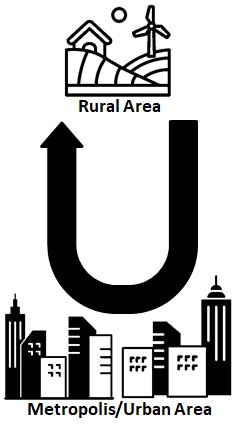
Figure 2: The U-Turn
|
Determinants of Return Migration and Subjective Well-being
The drivers of U-turn migration are multifaceted, often involving family obligations such as the inheritance of a family business, caring for elderly parents, or a desire for a "slower life". Recent empirical research highlights a significant finding for urban planners: rural residents in Japan report higher levels of subjective well-being (SWB) than urban residents, despite having lower average incomes. This suggests that the perceived utility of a rural environment-characterized by natural capital, lower cost of living, and social capital-effectively compensates for the lack of metropolitan amenities. A critical aspect of the U-turn experience is social integration. U-turn migrants typically reintegrate into familiar community networks, which provides a sense of belonging but also introduces "negative social capital" in the form of rigid community expectations and social monitoring.
| Social Capital Dimension | U-turn Migrant Profile | Impact on Happiness |
|---|---|---|
| Positive Social Integration | Higher (Existing ties, family) | Increases Happiness |
| Negative Social Capital | Higher (Community pressure, gossip) | Decreases Happiness |
| Overall Net Effect | Countervailing | Neutral/Moderate |
Policy Interventions and Regional Revitalization
To support U-turn migration, the Japanese government has implemented various "Chiho Sosei" (Regional Revitalization) policies. These include relocation incentives for firms, support for local entrepreneurship, and the development of regional universities. More recently, the feasibility of U-turn migration has been enhanced by digitalization and remote work trends, which potentially decouple professional careers from metropolitan residency. The rural impact of U-turn migration is largely qualitative. Returned migrants often bring back skills and networks acquired in the city, supporting small and medium enterprises (SMEs) and introducing innovation into traditional sectors. However, the success of these individuals often depends on the "entrepreneurial ecosystem" of the destination, highlighting the need for local governments to provide a supportive environment for professional reintegration.
4. L-turn Migration: Regional Cities as Growth Poles
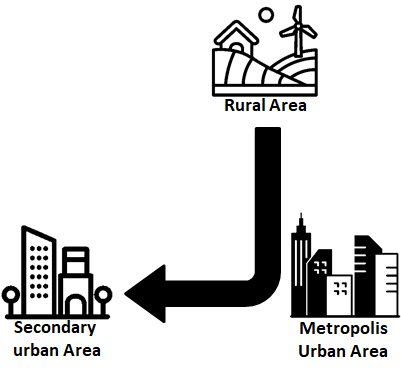
Figure 3: The L-Turn
|
The Role of Secondary Cities in a Polycentric System
L-turn migration is the primary driver behind the emergence of a polycentric urban structure in Japan. By relocating to regional hubs, L-turn migrants contribute to the growth of secondary growth poles, preventing total national reliance on the Tokyo megalopolis. These cities serve as innovation centers and administrative hubs, offering urban amenities like high-speed internet, sophisticated healthcare, and cultural nodes without the extreme congestion of the capital. The case of Fukuoka is particularly illustrative. Fukuoka has emerged as a premier destination for young and talented human resources, ranking first among government-ordinance-designated cities in population increase. This growth is driven by a vibrant startup ecosystem and a strategic focus on youth-friendly urban policies.
| City | Population Increase Rank (Designated Cities) | Growth Profile |
|---|---|---|
| Fukuoka | 1st | Startup-led, young demographic |
| Saitama | 2nd | Suburban attraction, access to TMA |
| Kawasaki | 3rd | Industrial/Suburban mix |
| Osaka | 4th | Traditional commercial core |
| Nagoya | 5th | Manufacturing/Industrial hub |
In contrast, Sapporo has developed a high-tech startup culture centered on ICT and biotechnology since the 1970s, supported by central government cluster policies in the 2000s. These cities demonstrate that for L-turn migration to be sustainable, there must be a local organizational base capable of providing employment prospects for new graduates.
Comparative Metrics of Migration Patterns
The distinct trajectories of I, U, and L migration reflect the evolving priorities of the Japanese populace. The following table synthesizes the comparative interpretation of these three patterns across key dimensions.
| Dimension | I-turn | U-turn | L-turn |
|---|---|---|---|
| Direction | Rural ➔ Metro | Rural ➔ Metro ➔ Rural | Rural ➔ Metro ➔ Regional City |
| Dominant Period | 1950s-1970s | 1970s onwards | 1980s onwards |
| Primary Driver | Industrialization/Wages | Lifestyle/Family/Subjective Well-Being | Urban rebalancing/Livability |
| Urban Effect | Concentration/Congestion | Minor redistribution | Decentralization/Polycentricity |
| Rural Effect | Severe Decline/Aging | Partial Revitalization | Limited direct benefit |
| Policy Alignment | Industrial Policy | Regional Revitalization | National Land Planning |
While I-turn migration built the mega-urban corridors of today, U-turn and L-turn movements signal the ongoing effort to rebalance population and economic activity in a post-growth society.
|
Rural ➔ Tokyo University Migration (I-turn Entry Point) For many young people, migration begins with moving from rural or regional areas to Tokyo for higher education. This I-turn entry point is a critical stage in shaping long-term migration patterns, as a significant proportion of students remain in metropolitan areas after graduation. The concentration of universities, job opportunities, and professional networks reinforces this transition from education to employment within the same urban context. As a result, what begins as a temporary move for education often becomes a permanent relocation, contributing to sustained rural out-migration. |
Tokyo ➔ Hometown Return (Classic U-turn) A common life-course trajectory in Japan involves individuals leaving their rural hometowns for education or employment in Tokyo, and later returning to their place of origin. This U-turn migration is often motivated by family responsibilities, inheritance of family businesses, or a preference for a slower-paced lifestyle. Returnees typically possess skills, savings, and professional experience acquired in metropolitan settings, which can contribute to local economies and community leadership. However, the success of such returns depends on the availability of suitable employment and social infrastructure in the home region. |
Tokyo ➔ Fukuoka Migration (L-turn, Lifestyle Shift) An increasing number of migrants are choosing to relocate from Tokyo to regional cities such as Fukuoka, representing a classic L-turn pattern. These individuals do not return to their hometowns but instead select locations that offer a balance between urban amenities and improved quality of life. Factors such as lower living costs, reduced congestion, and growing startup ecosystems make cities like Fukuoka attractive alternatives. This type of migration is often associated with younger professionals, entrepreneurs, and teleworkers seeking flexibility and lifestyle optimisation rather than purely economic necessity. |
5. The Challenge of Urban Shrinkage and the Compact City Model
Compact Plus Network: The Toyama Case Study
In response to urban shrinkage and sprawl, the Japanese government has promoted the "compact city" model. This approach emphasizes dense urban cores linked by public transit systems. Toyama City is a global exemplar of this strategy. Challenged by car dependency and a hollowed-out city center, Toyama implemented a "Compact Plus Network" policy centered on the development of a Light Rail Transit (LRT) system. The Toyama model succeeded by aligning local vision with national policy. The city optimized the distribution of public facilities, such as hospitals and care centers, bringing them back to the urban core. This initiative successfully reversed negative migration trends, as indicated by the following recovery timeline.| Area/Timeline | Net Migration Status (2006) | Turning Point Year (Positive) | Long-term Result |
|---|---|---|---|
| City Center | Negative | 2008 | Positive Growth |
| LRT Corridors | Negative | 2012 | Positive Growth |
| Population along Transit | 28% (2005) | - | 39% (2019) |
Toyama's success was also rooted in economic efficiency; by reusing old rail tracks for the LRT, the city reduced capital expenditures by 75%, achieving a cost-benefit ratio of 5.2. This demonstrates that compact city initiatives can be financially sustainable if they leverage existing assets.
Divergent Outcomes in Shrinking Regions
However, the compact city model is not a panacea. In Tottori City, studies found that the distribution of vacant land had no relationship with the convenience of public buses, primarily because residents remained highly dependent on private cars. Furthermore, in Aomori City, compact city policies based on symbolic downtown buildings became a burden on regional finances without achieving significant population density. These divergent outcomes suggest that the feasibility of compact cities is highly susceptible to local car-dependency cultures and economic vitality.6. Digital Garden City Nation: A 21st Century Strategy for Migration
The most recent phase of Japan's regional revitalization efforts is the Digital Garden City Nation Initiative (Digi-den), launched in 2021. This policy aims to leverage digital technology to eliminate the gap between rural and urban areas, creating a society where everyone can live conveniently and comfortably anywhere in Japan.Strategic Pillars and Teleworking
The initiative is built on four pillars: solving social issues via digital technology, building hardware/software infrastructure, training digital talent, and ensuring social inclusion ("leave no one behind"). Specifically, the policy promotes "migration without job change" by supporting the development of satellite offices and teleworking facilities. The government has established clear Key Performance Indicators (KPIs) to drive this transformation.| Indicator | Target | Target Date |
|---|---|---|
| 5G Population Coverage | 99% | End of FY2030 |
| Optical Fiber Coverage | 99.9% of Households | End of FY2027 |
| Digital Talent Trained | 2.3 million personnel | End of FY2026 |
| Regional Data Centers | A dozen or more | ~2026 |
| Digitalized Local Govs | 1,000 municipalities | End of FY2024 |
This digital infrastructure-including submarine cables ("Digital Garden City Superhighway") and regional data centers-is intended to support the decoupling of employment from physical location, thereby facilitating L-turn and lifestyle migration.
Smart City Development and Public-Private Partnerships
The Digi-den initiative also promotes "Smart Cities" that use data-linkage platforms and AI to address regional disparities in governance, healthcare, and transportation. For instance, mobile clinics and automated drone deliveries are being piloted to tackle the problems of aging and isolation in depopulated areas. These efforts represent a shift toward "Chiho Sosei 2.0," where digital transformation addresses the structural disparities between the rural and urban sectors.7. Demographic Pressures and the Future of the Urban System
Despite these innovative policies, Japan remains at the forefront of global depopulation. Projections suggest that 20 percent of currently inhabited land will be uninhabited by 2050, and municipalities with fewer than 10,000 residents could lose half their population. The aging population and shrinking labor force influence every aspect of regional competitiveness and the sustainability of social security systems.The Role of Regional Banks and SMEs
The stability of regional economies is also tied to the health of the regional banking sector. As the population ages and decumulates savings, regional banks must find new ways to maintain profitability and support local industries. In 2024, the normalization of monetary policy and government revitalization efforts have provided some relief, with net interest income increasing as loan volumes recover. However, the long-term viability of these banks depends on the "economic vitality" of their respective regions, which is directly influenced by migration patterns.Subjective Well-being and Lifestyle Migration
8. Conclusion: Synthesizing the I-U-L Framework for Future Planning
The interaction of I-turn, U-turn, and L-turn migration patterns provides a comprehensive lens through which to analyze the past, present, and future of the Japanese urban system. While I-turn migration was the architect of Japan's globally significant metropolitan regions, its legacy of unipolar concentration and rural hollow-out has necessitated the more balanced approaches represented by U-turn and L-turn movements.As a synthesis, the following takeaways are critical:
- Infrastructure as a Catalyst: Infrastructure investments (Shinkansen, LRT, 5G) are not just passive responses to demand but active tools for shaping migration flows and urban form.
- Social Capital Matters: Successful migration-especially U-turns-depends on managing both positive and negative social integration to ensure migrant well-being.
- Polycentricity over Centralism: Strengthening regional hubs like Fukuoka and Sapporo through L-turn migration is essential for national resilience in an era of population decline.
- Digital Decoupling: The "Digital Garden City" initiative offers the first viable pathway to decoupling economic productivity from metropolitan density, potentially enabling a new era of decentralized growth.
As Japan continues to navigate the complexities of a shrinking society, the I-U-L framework remains a powerful tool for linking demographic change with spatial planning. The ultimate goal is to move beyond the dichotomy of urban growth and rural decline, fostering a resilient urban system where sustainable cores and vibrant rural communities coexist in a digitally integrated national network.
ANNEX: Beyond the I-U-L Patterns
While the I-U-L framework is the most widely cited, it does not capture the full diversity of mobility patterns in contemporary Japan. Researchers and policymakers often use additional "turns" and flow concepts to describe more nuanced or recent migration behaviors.Japan's migration today is best understood as a fluid, multi-scalar system of circulation, partial return, and dual residence, rather than a simple one-way shift toward cities.
1. J-turn Migration
2. O-turn Migration
3. S-turn Migration
4. Reverse I-turn (Counter-Urbanization)
5. Two-Region Residence (Dual Living)
6. Return Migration of Retirees
7. International-Internal Hybrid Migration
Together, these additional patterns show that Japan's migration system is:
- Increasingly Complex: Simple one-directional flows (I-turn) are giving way to multi-directional and cyclical mobility.
- Less Permanently Settled: Migration is no longer a one-time decision but an ongoing, life-course process.
- More Networked than Hierarchical: Rather than a strict rural ➔ urban hierarchy, Japan is evolving toward a network of interconnected places.
- Strongly Influenced by Lifestyle and Technology: Quality of life, remote work, and personal preferences now rival traditional economic drivers.
Further reading and references:
Official Statistics and Datasets
-
Statistics Bureau of Japan (e-Stat Portal)
National datasets on migration, population distribution, and demographics. -
Ministry of Internal Affairs and Communications
Annual migration reports and inter-prefectural population flows.
Migration Surveys and Research
-
National Institute of Population and Social Security Research
Surveys on migration behaviour and demographic projections. -
Cabinet Office of Japan
Regional revitalisation policies and migration-related studies. - Public Relations Office - Regional Revitalisation
Regional revitalisation themes, includes migration-related topics. -
CiNii Research
Academic papers on internal migration and urbanisation in Japan. -
OECD Regional Development
Comparative international perspectives on migration and regions.
|
|

 |
Return to the Japan Urban Observatory Contact: Hari Srinivas - [email protected] |