Introduction to Information Design:
From Data to Action
Hari Srinivas Explainer Series C-115

Abstract:
This document provides a comprehensive introduction to information design as a critical bridge between data, knowledge, and action. It emphasizes that the central challenge in today�fs information-rich world is not access, but usability. The text outlines the information continuum from data to impact, and presents key principles such as relevance, clarity, context, accessibility, actionability, layering, and credibility. It further details a practical, iterative process for designing effective information products, and highlights diverse formats including policy briefs, dashboards, toolkits, and case studies.With a focus on sustainable development, the document positions information design as a strategic tool for enabling informed decision-making across multiple levels of society. It concludes by exploring emerging trends such as AI-driven personalization, mobile-first communication, and micro-content, underscoring the evolving role of information design in improving outcomes and impact.
Keywords:
information design, data to action, decision-making, knowledge management, sustainable development, data visualization, communication strategy, user-centered design
I
nformation Design is the practice of collating, packaging and displaying information in such a way as to communicate and meet the needs of the user, for intended purposes. In a very broad sense of the term, it is the bridge that links information technologies and knowledge creation. It helps enhance interaction with all our senses in order to create knowledge. It uses effective design principles, for offline and/or online presentation, in order to understand the essence and meaning of the professed information.It refers to the skills and capacities that will enable the processing of information so that users can use it with efficiency and effectiveness. Information design practices takes graphic design principles, and applies and integrates it with text.
1. Why Information Design Matters
We live in a world of unprecedented access to data and information. Yet, better decisions do not automatically follow from more information. In many cases, the opposite is true: information overload leads to confusion, delay, and poor choices.The central challenge today is not the availability of information, but its usability.
Information design addresses this challenge by focusing on how information is selected, structured, presented and delivered so that it can be understood, trusted, and acted upon. At its core, information design is about bridging the gap between what is known and what needs to be done.
2. From Data to Action: The Information Continuum
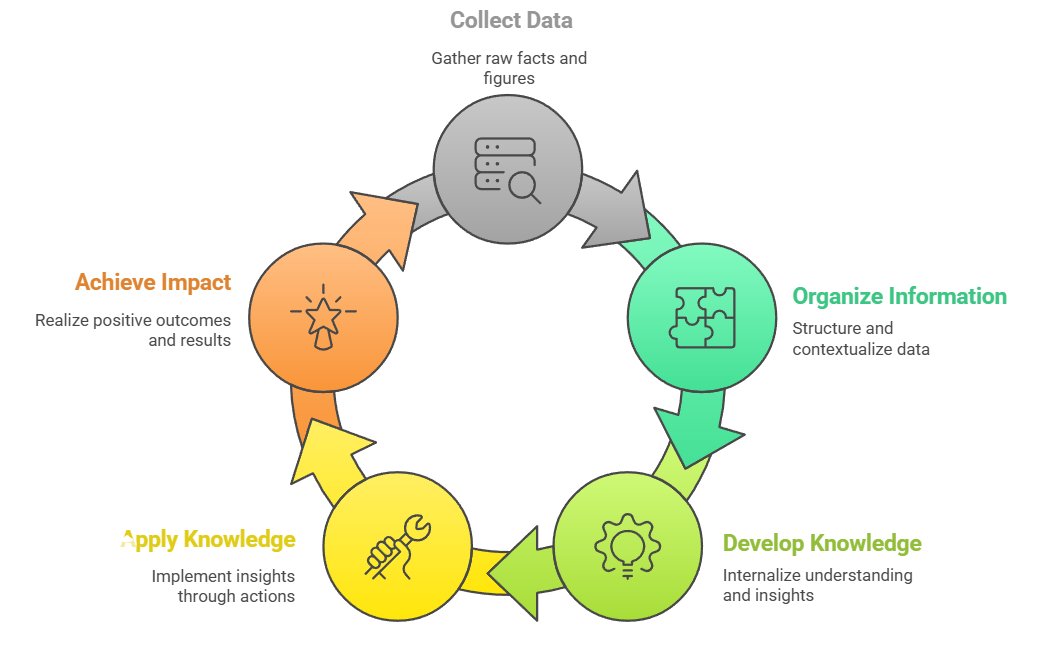
Information does not exist in isolation. It is part of a continuum:
In this continuum, Data is raw facts and figures; Information is organized and contextualized data; Knowledge is internalized understanding; Action is the application of knowledge; and Impact is the outcome of action.
Information design plays a critical role in moving users along this continuum. Poorly designed information gets stuck at the data stage. Well-designed information enables action and creates impact.
Figure 1: The Information Continuum
3. What is Information Design?
Information design is the art and science of preparing information so that it can be used effectively by people to achieve specific goals. It involves:Importantly, information design is not just about visual presentation. It is equally about content, context, and purpose.
- understanding users and their needs
- selecting and filtering relevant content
- structuring information logically
- choosing appropriate formats and media
- presenting information clearly and intuitively
4. Core Principles of Effective Information Design
Effective information design is guided by a set of interrelated principles:
- Relevance: Information must respond directly to the user's needs and context. Irrelevant information, even if accurate, reduces effectiveness.
- Clarity: Clarity means making information easy to understand without oversimplifying it. It involves careful choice of language, structure, and emphasis.
- Context: Information gains meaning when placed within the right context. Localization and cultural sensitivity are critical, especially in development settings.
- Accessibility: Information should be accessible in terms of language, format, and medium. This includes consideration of digital access, literacy levels, and usability.
- Actionability: Information should enable users to take the next step. Good information answers not only "what" and "why", but also "what now"?
- Layering: Users should be able to move from overview to detail. A well-designed structure allows both quick scanning and deeper exploration.
- Credibility: Trust is essential. Sources, methods, and assumptions should be transparent and reliable.
5. The Information Design Process
Information design is an iterative process rather than a one-time activity. A typical cycle includes:
- Identify the user - Who will use the information? What are their needs, constraints, and context?
- Define the purpose - What decision or action should the information support?
- Collect and filter content - What information is essential? What can be removed?
- Structure the information - How should the content be organized for clarity and flow?
- Choose the format - Text, visuals, tables, infographics, interactive tools, or combinations?
- Design and present - Apply layout, language, and visual elements to enhance understanding.
- Test and refine - Gather feedback and improve continuously.
6. Types of Information Products
Information design results in a wide range of outputs, depending on purpose and audience:Each type requires a different balance of depth, simplicity, and interactivity.
- Policy briefs for decision-makers
- Infographics for quick understanding
- Toolkits and guidelines for practitioners
- Dashboards for real-time monitoring
- Training materials for capacity building
- Case studies for learning and replication
Across the three examples listed below, the common thread is clear: effective information design does not merely inform - it enables timely, context-specific action.
Case Study 1: Urban Air Quality DashboardContext: Fragmented and technical air pollution data made it difficult for citizens to understand daily risks.Information Design: Unified dashboard using simple categories, color coding, real-time updates, and health-linked advisories.Outcome: Improved public awareness, behavior change in outdoor activities, and more effective risk communication.Key Insight: Simplification and real-time relevance drive behavioral change.
Case Study 2: Farmer Advisory SystemContext: Farmers received generic, technical, and poorly timed agricultural information.Information Design: Mobile-based, localized, time-sensitive messages with clear action steps and simple language.Outcome: Better farm decisions, reduced input costs, and increased trust in advisory systems.Key Insight: Action-oriented, timely information is more effective than comprehensive detail.
Case Study 3: Community Waste Segregation GuideContext: Low compliance with waste rules due to confusion about categories and procedures.Information Design: Visual guides with clear categories, illustrated examples, and step-by-step instructions.Outcome: Improved segregation rates, cleaner recycling streams, and reduced system costs.Key Insight: Information must be clear at the exact point of decision-making.7. Information Design for Sustainable Development
In the context of sustainable development, information design takes on added significance. Development challenges (for example, environmental issues such as climate change) are often complex, multi-sectoral, and context-specific.At the same time, users range from policy-makers and planners to businesses and civil society, and to communities and individuals.
Effective information design therefore helps translate complex ideas into usable knowledge and support decision-making at multiple levels. It also helps empower communities with relevant and actionable information and bridge global knowledge and local realities.
In this sense, information design becomes a development tool, not just a communication exercise.
8. Emerging Trends in Information Design
The field of information design continues to evolve in response to technological and societal changes:
- Data Visualization and Interactive Tools: Dynamic dashboards and visual platforms are enabling users to explore data more intuitively.
- Mobile-First Communication: Information is increasingly consumed on mobile devices, requiring concise and adaptable formats.
- Personalization and AI: Artificial intelligence allows for tailored information delivery based on user preferences and behavior.
- Micro-Content and Modular Design: Short, focused content units (cards, snippets, posts) allow flexible use and recombination.
- Integration of Human and Machine Intelligence: While AI can process and generate information at scale, human judgment remains essential for context, ethics, and meaning.
9. A Simple Checklist for Practitioners
Before finalizing any information product, it is useful to ask:
- Who is the user?
- What decision or action is this supporting?
- What is the minimum information required?
- Is the content clear and well-structured?
- Is the format appropriate for the audience?
- Can the user easily act on this information?
Policy Implications:
Information design is not an optional add-on. It is central to how knowledge is created, shared, and used. In a world where information is abundant but attention is limited, the ability to design information effectively is critical for better decisions, meaningful action, and lasting impact. Ultimately, good information design ensures that knowledge serves its purpose: improving the quality of human decisions and outcomes.
Also see -
What is Information Design? Some Definitions Information Design: Lessons Learnt at GDRC!
This work by GDRC is licensed under a Creative Commons Attribution-ShareAlike 4.0 International License. You are free to share and adapt this piece of work for your own purposes, as long as it is appropriately cited. More info: http://creativecommons.org/licenses/by-sa/4.0/
CITATION TEXT:
Hari Srinivas - [email protected]
Return to the Information Design Page