Multilateral Emphasis on Energy Management and Security: Transitioning to a Sustainable, Secure Future
Hari Srinivas
Policy Analysis Series E-252.
Abstract:
This paper examines the central role of energy management within global sustainable development frameworks, focusing on Agenda 21 and the Sustainable Development Goals as complementary multilateral processes that address energy security, environmental protection, and socio economic development. It highlights how energy considerations are embedded across sectors such as health, agriculture, urban development, and climate action, underscoring energy�fs cross cutting influence on development outcomes. By tracing the evolution from Agenda 21's integrated approach to the more goal oriented SDG framework, the paper demonstrates how multilateral cooperation provides shared principles and policy coherence for managing energy transitions.
It further emphasizes the importance of translating global commitments into national and local action, particularly through governance reform, institutional capacity building, and the accelerated adoption of renewable energy. The analysis concludes that effective energy management, grounded in multilateral frameworks and adapted to local contexts, is essential for achieving energy security while responding to the interconnected economic, social, and environmental challenges facing societies today.
Keywords:
energy management, energy security, Agenda 21, Sustainable Development Goals, multilateral governance, renewable energy, sustainable development, local and national policy
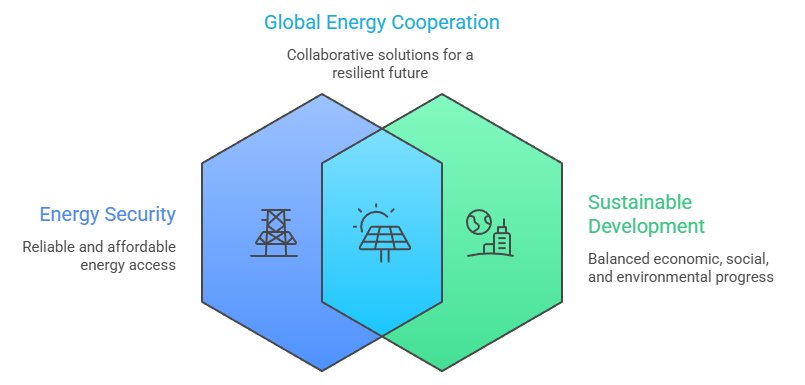
Energy lies at the heart of modern economies, social well being, and geopolitical stability, yet its production and use increasingly expose countries to risks related to climate change, price volatility, resource scarcity, and conflict. No country can address these challenges alone, making multilateral cooperation essential for ensuring energy security while advancing sustainable development.
Figure 1: COntextualizing Energy Security
Global frameworks such as Agenda 21 and the Sustainable Development Goals provide shared principles, common language, and coordinated pathways for managing energy systems in ways that balance economic growth, environmental protection, and social equity. By embedding energy management within broader development agendas, these multilateral processes help countries align national priorities with global responsibilities, encourage knowledge sharing, and promote collective action on one of the most critical issues of our time.
Energy Management in Agenda 21
Energy receives significant coverage within the chapters of Agenda 21, though there is no specific chapter devoted to the topic. It addresses the full continuum from energy supply to demand, and makes a strong case for the transition from unsustainable to sustainable approaches to energy management.
Most chapters mention energy as a key issue, recognizing its importance for human productivity and development. Agenda 21 also places caution on the negative impacts and effects of both energy production and consumption. It places greater emphasis on renewable energy sources, calling for the conservation of energy through energy efficient technologies and energy recovery in production and consumption processes.
Chapter 4. Changing consumption patterns
Changing consumption patterns is dealt with in this chapter in terms of how economies can grow and prosper while reducing the use of energy and materials and the production of harmful materials. The chapter encourages greater efficiency in the use of energy and resources by reducing the amount of energy and materials used per unit in the production of goods and services that contributes both to the alleviation of environmental stress and to
greater economic and industrial productivity and competitiveness. "Governments, in cooperation with industry, should therefore intensify efforts to use energy and resources in an economically efficient and environmentally sound manner ... " [4.18]. The chapter also cautions that " ... without the stimulus of prices and market signals that make clear to producers and consumers the environmental costs of the consumption of energy, materials and natural resources and the generation of wastes, significant changes in consumption and production patterns seem unlikely to occur in the near future." [4.24]
Chapter 6. Protecting and promoting human health conditions
In many locations around the world the general environment (air, water and land), workplaces and even individual dwellings are so badly polluted that the health of hundreds of millions of people is adversely affected. This is, inter alia, due to past and present developments in consumption and production patterns and lifestyles, in energy production and use, in industry, in transportation etc., with little or no regard for environmental protection. In order to overcome this, the chapter calls for - "establishing environmental health impact assessment procedures for the planning and development of new industries and energy facilities; incorporating appropriate health risk analysis in all national programmes for pollution control and management, with particular emphasis on toxic compounds such as lead; establishing industrial hygiene programmes in all major industries for the surveillance of workers' exposure to health hazards; promoting the introduction of environmentally sound technologies within the industry and energy sectors" [6.41]
Chapter 7. Promoting sustainable human settlement development
Chapter 7 clearly recognizes that "promoting sustainable energy and transport systems in human settlements" is one way of achieving sustainability. It calls for efforts in saving energy, as a basis for living systems and opportunity for all human activity; promoting renewable energy techniques and technologies in general; and the use of energy efficient building materials. It also calls for an integrated approach to the provision of energy and other infrastructure needs.
"Most of the commercial and non-commercial energy produced today is used in and for human settlements, and a substantial percentage of it is used by the household sector. Developing countries are at present faced with the need to increase their energy production to accelerate development and raise the living standards of their populations, while at the same time reducing energy production costs and energy-related pollution. Increasing the efficiency of energy use to reduce its polluting effects and to promote the use of renewable energies must be a priority in any action taken to protect the urban environment. " [7.46]
Chapter 9. Protection of the atmosphere
The chapter recognizes that energy is essential to economic and social development and improved quality of life. "Much of the world's energy, however, is currently produced and consumed in ways that could not be sustained ... the need to control atmospheric emissions of greenhouse and other gases and substances will increasingly need to be based on efficiency in energy production, transmission, distribution and consumption, and on growing reliance on
environmentally sound energy systems, particularly new and renewable sources of energy. All energy sources will need to be used in ways that respect the atmosphere, human health and the environment as a whole. " [9.9]. It calls for cooperation in identifying and developing economically viable, environmentally sound energy sources to promote the availability of increased energy supplies to support sustainable development efforts, in particular in developing countries; promoting the development at the national level of appropriate methodologies for making integrated energy, environment and economic policy decisions for sustainable development, inter alia, through environmental impact assessments; and other measures.
Chapter 14. Promoting sustainable agriculture and rural development
Key to sustainable agriculture and rural development is the transition of rural energy to enhance productivity. Chapter recommends action on this front by providing support services and training, recognizing the variation in agricultural circumstances and practices by location; the optimal use of on-farm inputs and the minimal use of external inputs; optimal use of local natural resources and management of renewable energy sources; and the establishment of networks that deal with the exchange of information on alternative forms of agriculture.
Energy Management Across the SDGs
Energy management is a cross cutting foundation of sustainable development, influencing how societies produce, distribute, and use power across all sectors of the economy. While SDG 7 focuses explicitly on affordable and clean energy, effective energy management is embedded throughout the entire SDG framework, shaping outcomes in poverty reduction, health, education, food systems, urban development, and climate action. Managing energy efficiently, equitably, and sustainably is therefore not only a technical challenge but also a governance and behavioural one, requiring coordinated policies, innovation, and partnerships at global, national, and local levels.
SDG 1 No Poverty
Affordable and reliable energy reduces household expenditure burdens and enables income generating activities. Energy access supports livelihoods, small enterprises, and basic services that help lift communities out of poverty.
SDG 2 Zero Hunger
Energy is essential for irrigation, mechanised farming, food processing, storage, and cold chains. Efficient and renewable energy systems reduce post harvest losses and improve food system resilience.
SDG 3 Good Health and Well-being
Clean energy reduces indoor air pollution from traditional cooking fuels. Reliable electricity is critical for healthcare facilities, medical equipment, vaccine storage, and emergency services.
SDG 4 Quality Education
Electricity enables lighting, digital learning, internet access, and safe school environments. Energy access supports extended study hours and modern educational infrastructure.
SDG 5 Gender Equality
Clean and accessible energy reduces the time women spend collecting fuel and managing household energy. Energy services enable women s participation in education, employment, and entrepreneurship.
SDG 6 Clean Water and Sanitation
Energy is required for water pumping, treatment, distribution, and wastewater management. Energy efficient water systems reduce costs and environmental impacts.
SDG 7 Affordable and Clean Energy
This is the core energy goal, focusing on universal access, renewable energy expansion, energy efficiency improvement, and international cooperation on clean energy technologies.
SDG 8 Decent Work and Economic Growth
Energy underpins industrial activity, services, and job creation. Clean energy transitions generate new employment opportunities while improving productivity.
SDG 9 Industry, Innovation and Infrastructure
Energy efficient industries, smart grids, and resilient infrastructure are central to sustainable industrialisation. Innovation in energy technologies drives competitiveness and sustainability.
SDG 10 Reduced Inequalities
Equitable energy access reduces disparities between urban and rural areas and between income groups. Inclusive energy policies support marginalised communities.
SDG 11 Sustainable Cities and Communities
Urban energy management affects buildings, transport, waste, and public services. Energy efficient buildings and renewable powered cities reduce emissions and improve livability.
SDG 12 Responsible Consumption and Production
Energy efficiency and cleaner production reduce resource use and emissions. Energy management supports sustainable supply chains and circular economy approaches.
SDG 13 Climate Action
Energy systems are the largest source of greenhouse gas emissions. Decarbonising energy through renewables, efficiency, and demand management is central to climate mitigation and adaptation.
SDG 14 Life Below Water
Reduced fossil fuel use lowers ocean acidification and marine pollution. Offshore renewable energy requires careful management to protect marine ecosystems.
SDG 15 Life on Land
Sustainable energy reduces deforestation and land degradation caused by fuelwood extraction. Renewable energy planning must minimise impacts on biodiversity.
SDG 16 Peace, Justice and Strong Institutions
Transparent and accountable energy governance reduces conflict over resources. Stable energy systems support institutional capacity and public service delivery.
SDG 17 Partnerships for the Goals
Energy transitions depend on global cooperation, finance, technology transfer, and capacity building. Partnerships accelerate clean energy deployment and policy alignment.
Policy Implications
The challenge ahead is to translate the principles of Agenda 21 and the SDGs into concrete action at national and local levels, where energy decisions are planned, financed, and implemented. Governments must integrate energy security into development planning by strengthening institutions, adopting long term energy strategies, and aligning policies across sectors such as transport, housing, industry, water, and agriculture.
Local governments play a particularly important role through urban planning, building regulations, public transport systems, and community level energy initiatives that directly influence demand and efficiency. Accelerating the transition to renewable energy is central to this effort, as renewables address multiple challenges simultaneously by reducing emissions, lowering dependence on imported fuels, improving resilience, and creating local economic opportunities.
By using global frameworks as guiding anchors and tailoring them to local contexts, countries can move toward energy systems that are secure, affordable, inclusive, and capable of supporting sustainable development in an increasingly uncertain world.