Sustainability Dimensions of
|
 |
Hari Srinivas |
| Concept Note Series E-113. |
|
Abstract: Sustainable transportation extends beyond efficient mobility to encompass equitable access, environmental responsibility, and economic viability. It focuses on providing services closer to users through decentralized and mixed-use urban planning, thereby reducing travel demand while improving accessibility. A sustainable transport system emphasizes flexibility, efficiency, and inclusivity through pedestrianization, clean public transit, bicycle networks, and green corridors. Its three dimensions - ecological, economic, and social - mirror those of sustainable development, promoting reduced emissions, affordability, and social equity. Transport systems intersect with climate change mitigation, energy efficiency, sustainable tourism, and urban planning, requiring coherent policies, technologies, and financing. By aligning transport strategies with broader sustainability goals, cities can enhance access and mobility while contributing to long-term environmental and socio-economic resilience. |
|
Keywords: sustainable transportation, climate mitigation, energy efficiency, sustainable tourism, urban planning, accessibility, ecological economics, mobility systems |
 GDRC's approach to Sustainable Transportation emphasizes broader access to goods and services, rather than just making mobility more efficient.
This would essentially provide better and more urban services closer to the user, by 'decentralizing' services to be spread out and made available in larger number of places. This is essentially done through urban planning and 'mixed' zoning, including financial incentives and development strategies, that influence locational decisions of businesses and trade establishments.
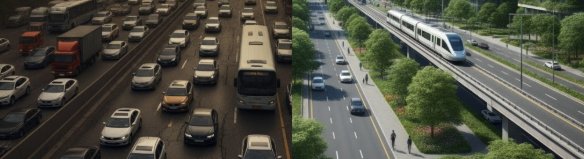
Sustainable transportation would therefore focus on flexibility, efficiency and accessibility, manifesting in the form of more pedestrianization (with walkways and cycling routes), public transit systems that are operated on clean and renewable energy sources, bicycle stations and car share options, safe and fluid vehicle movement, networks of green corridors that connect people and open space, et al.
 Put together, a sustainable transportation system takes its inspiration from that of broader sustainable development itself, calling for:
- ecological: reduced emissions, pollution and waste, minimized consumption of non-renewable energy sources and uses technologies that reuses and recycles its components.
- economic: affordable systems that operate efficiently, offers a mix of transport mode choices, and supports the local economy.
- social: basic access needs of individuals/communities to be met safely and support good lifestyles, and with equity within and between generations.
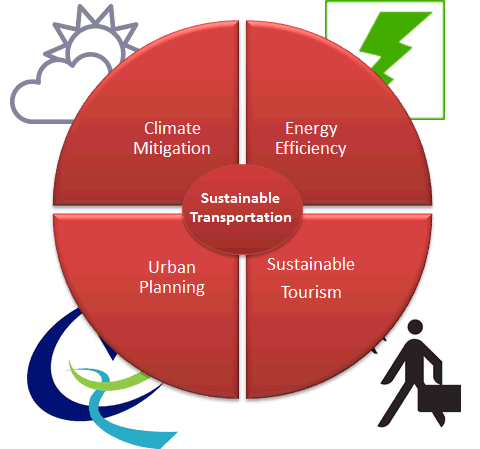
With these perspectives, sustainable transportation can fall within, and linked to, a number of interlinked sectors, including climate mitigation, energy efficiency, sustainable tourism and urban planning.
- Climate Change Adaptation and Mitigation: The transport sector as a whole is a major contributor to green house gases (GHGs) and air pollution. How transport policies and strategies at aim to be sustainable, help in mitigating the impacts of climate change?
→ Explore further: GDRC's Climate Change Policy magazine, curated on the Flipboard app. - Energy Efficiency: Carbon emissions and fossil-based fuels have a number of cascading negative impacts on the global environment. How can the use of energy by the transport sector be made more efficient, in terms of people and goods transported per kilometer? How can the multiple benefits of a shift towards renewable sources of energy be effected (using governance, eduction and technology management systems)?
→ Explore further: Sustainable Urban Energy Management - Sustainable Tourism:
Taking all the components of tourism together, the sector is touted as the largest employer of people - local and national governments have recognized this by promoting sustainable tourism policies. With transport forming one of the key components of tourism, how can it contribute to sustainability in tourism?
→ Explore further: Sustainable Tourism - Urban Planning: Achieving the goals of sustainable development requires a fundamental shift in the way we design and manage our cities. How can urban planning principles and systems help in making the transport sector more sustainable? How can a shift from vehicle-based mobility approach be made towards more access-based planning and zoning that reduces the amount of vehicular travel? ANd promote bicycle and walking cultures?
→ Explore further: Urban Planning and Management

Besides the four topics outlined above, cross-cutting and supporting each of them are(a) relevant transport laws and regulations, supportive technologies, and (c) financial allocations (from public and private sectors).

It is important to look at the big picture - of transportation policies on one hand ensuring efficient access and mobility of residents, and on the other, to contribute to sustainable development as well.
Policy Implications
Sustainable transportation represents a shift from moving vehicles to moving people and goods in smarter, cleaner, and fairer ways. It is not only a technical or infrastructural challenge but also a social and institutional transformation that redefines how cities function and how communities connect.Achieving this vision requires integrated policies that link transport with energy, land use, and social equity goals, supported by innovation, collaboration, and informed governance. By embedding sustainability into the very fabric of transport planning and practice, societies can ensure that mobility becomes a driver of inclusiveness, resilience, and well-being for present and future generations.
References:
- Banister, David. "The sustainable mobility paradigm." Transport policy 15.2 (2008): 73-80.
- Feitelson, Eran. "Introducing environmental equity dimensions into the sustainable transport discourse: issues and pitfalls." Transportation Research Part D: Transport and Environment 7.2 (2002): 99-118.
- Hellstr�m, Tomas. "Dimensions of environmentally sustainable innovation: the structure of eco-innovation concepts." Sustainable Development 15.3 (2007): 148-159.
- Kenworthy, Jeffrey R. "The eco-city: ten key transport and planning dimensions for sustainable city development." Environment and urbanization 18.1 (2006): 7-85.
- Lautso, Kari, et al. "Planning and research of policies for land use and transport for increasing urban sustainability." Final report, Institute of Spatial Planning (IRPUD), Dortmund (2004).
- Rodrigue, Jean-Paul, Claude Comtois, and Brian Slack. The geography of transport systems. Routledge, 2013.
|
|

 |
Return to Sustainable Transportation |